CFP Theorizing Transcultural Communication

“PublicationCall for papers, Special Issue: Theorizing Transcultural Communication: Paradigms and Approaches, Journal of Transcultural Communication. Deadline: April 15, 2021.

Sponsored by Beijing Foreign Studies University and Published by Sage, Journal of Transcultural Communication (JTC) will be a new international academic platform dedicated to the publication of interdisciplinary researches into theories and practices of transcultural communication.
Built upon the long-standing scholarship in the arenas of cross-cultural communication, intercultural communication, and international communication, JTC focuses on transcultural communication, which is defined as a paradigmatic shift to a broader field of research concerning both differences between cultures and cultural transformations that go beyond those differences in an increasingly globalizing and networking society.

The inaugural issue, scheduled to publish in September 2021 and themed “Theorizing Transcultural Communication: Paradigms and Approaches”, is now inviting original articles. Prospective contributions are expected to define and discuss the theoretical boundary, core concepts, analytical framework, and practical implications of transcultural communication transcending the existing works in relation to the interplay between culture and communication.

In addition to the special issue, submissions are welcome to future issues of the journal.

CFP Construction of Nativeness & Non-nativeness in Non-Anglophone Contexts

“PublicationCall for chapter proposals, The Construction of Nativeness and Non-Nativeness in Non-Anglophone Contexts: A Global Perspective, to be edited by Ali Karakaş, and published by Cambridge Scholars. Deadline: Open until filled.

This manuscript explores and systemize a more cohesive understanding of the native speaker and non-native speaker based on the collective works of various scholars from various perspectives of the relevant stakeholders as well as policy-based documents in the field of English language teaching across non-Anglophone contexts.

(To find the call, look in the Language and Linguistics section.)

Ali Karakaş is an Associate Professor in the Department of English Language Teaching at Mehmet Akif Ersoy University, Turkey. He earned his PhD in Applied Linguistics from Southampton University, UK. His research interests include Global Englishes, Language Policy, Planning, and Teacher Education.

CFP M/C Journal: Zoom (Australia)

“Publication Opportunities

Call for Papers: Special issue on “Zoom” for M/C Journal (A Journal of Media and Culture). Deadline: April 16, 2021.


On 9 March 2020, just two days before the World Health Organization would name the COVID-19 outbreak a global pandemic, Italy declared a nation-wide lockdown. Over the following weeks, cities, states, and nations around the world would do the same, dramatically changing the social landscape for millions of individuals. Overnight, it seemed, Zoom became the default modality for remote engagement, rapidly morphing from brand name to eponymous generic—a verb and a place and mode of being all at once. In an era of COVID-19, our relationships and experiences are deeply intertwined with our ability to “zoom.”

This issue of M/C Journal will explore the impacts and implications of Zoom and other teleconferencing platforms one year after the start of the COVID-19 pandemic. Editors seek a wide range of submissions that will explore how a simple, four letter word has come to encapsulate a distinct moment in human history. How do we Zoom, and why?

CFP Race Matters in JACR

“PublicationCall for Proposals: Special Issue: ‘Race Matters’ in Applied Communication Research, Journal of Applied Communication Research.  Deadline: February 11, 2021.

In 2008, Mark P. Orbe and Brenda J. Allen published a critique of race-related research appearing in the Journal of Applied Communication Research, and in doing so, conceptualized a typology of different genres of race-related scholarship in the field of communication. This proposed JACR special issue is designed to create an academic space that highlights applied communication research that centralizes race—and through intersectionality, other salient aspects of identity—in meaningful ways. In essence, the special issue situates JACR as a productive location for engaged research that centralizes race as both a theoretical anchor and powerful point of praxis. Authors are invited to submit proposals of theoretically-informed applied communication research that engages the social construction of race at the center of analysis. The guest editors for the proposed special issue are Mark P. Orbe, Western Michigan University, and Jasmine T. Austin, Texas State University.

CFP What Do We Say to Migrants? (Belgium and Online)

ConferencesCall for abstracts: “​What do we say to migrants throughout their journey?” Disputed communication strategies and informational practices between spaces of origin, transit and destination (Workshop & Journal Special Issue), Université libre de Bruxelles, Belgium, 22-23 April 2021. Deadline: 30 November 2020.

Convenors and Prospective Editors: Anissa Maâ (Université libre de Bruxelles), Julia Van Dessel (Université libre de Bruxelles), Amandine Van Neste-Gottignies (Université libre de Bruxelles).

The workshop and journal special issue will be structured around three analytical and complementary axes​:

1. Who says what to migrants?
Discourses and/or counter narratives designed by actors invested in the migration field, including representations and moral economies conveyed by these discourses.

2. How is it disseminated on the field?
Communication strategies implemented to reach and convince the target audience – including the material and human channels used on the ground – and their interaction and transformation in specific local contexts.

3. How is it perceived by migrants?
Informational practices defined by migrants and asylum seekers, and their perception and reappropriation of information-disseminating initiatives.

CFP Diversity, Intersectionality, Transnationality & Pedagogy

“PublicationCall for Papers: Diversity, Intersectionality, Transnationality, and Pedagogy, Communication Education Forum, to be edited by Ahmet Atay (College of Wooster). Deadline: November 15, 2020.

The discourse of cultural diversity has emerged as a vital component of communication pedagogy. However, the current political events and social contexts that surround us—such as the Black Lives Matter movement, ongoing negative immigration discourse, changing visa policies to limit the experiences of immigrants and international students, as well as homophobia and transphobia within and outside of higher education—invite us, as communication education scholars, to respond to these exigencies and be more self-reflexive of our pedagogies. Perhaps more than ever before, the notion of cultural diversity is an instrumental part of communication pedagogy and of what we do in the classroom.

To understand the current political moment and the cultural dynamics that are shaping our interactions and pedagogies within and outside of the classroom, there is a need for a dynamic intersectional approach to our scholarship. Our classrooms are political because as faculty and students, we bring our culturally and politically marked bodies into the classroom. Hence, how we teach and learn, as well as what we do with the information we share, is always political, ideological, contextual, and influenced by history. Furthermore, our identities are fluid, ever-changing, and intersectional. The pedagogies that we employ must recognize this complex positionality and intersectionality.

Building on the discourse of critical communication pedagogy and critical intercultural communication pedagogy, this forum aims to provide a scholarly space to engage with critical approaches and intersectionality in the context of communication pedagogy. This forum invites scholars to engage with current political and cultural dynamics and how they are embodied in the classroom. Authors should address the following two questions in their essays:

    1. How can intersectionality help us to make sense of the current political moment and cultural dynamics in the classroom?
    2. In what ways can critical frameworks (e.g., transnational, postcolonial, decolonizing, feminist, and queer approaches) individually or intersectionally help communication teachers to engage with diversity?

The forum will consist of four essays. Essays should not exceed 1,000 words, including references. Please direct forum questions to Ahmet Atay. Please email a blinded copy of your essay by November 15, 2020, to Melissa Broeckelman-Post, Consulting Editor for Forums.

CFP Are We Making a Difference? Peacebuilding Effectiveness

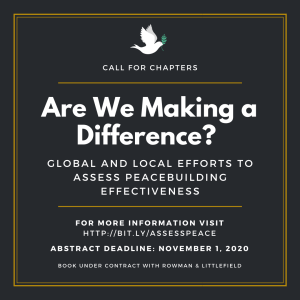
“PublicationCall for Chapters: Are We Making a Difference? Global and Local Efforts to Assess Peacebuilding Effectiveness, to be edited by Stacey L. Connaughton (Purdue) and Jasmine R. Linabary (Emporia State). Deadline for abstract only: November 1, 2020.

Assessing Peace CFP

Chapter abstracts invited for a forthcoming edited book project on assessment and peacebuilding. The book is entitled “Are we making a difference?: Global and local efforts to assess peacebuilding effectiveness” and will be published by Rowman & Littlefield. Peacebuilding practitioners at local, national, and international levels and educators are the primary audiences for the book.

This edited volume seeks to highlight data-driven/evidence-based efforts to assess the effectiveness of peacebuilding efforts worldwide and to be inclusive of voices worldwide and of diverse methods for assessing effectiveness (e.g., qualitative, quantitative, participatory). The book will also serve as a platform to share case studies of, critical reflections on, and practical tools for assessment. We encourage chapters written by peacebuilding practitioners and/or academics from a variety of fields. We are particularly interested in chapters written by or co-authored with local peacebuilders.

CFP Crisis, Conflict, and Cultural Relations in Media Environments

“PublicationCall for Papers: Crisis, Conflict, and Cultural Relations in Media Environments, to be edited by Ahmet Atay (Wooster) and Margaret D’Silva (Alabama, Tuscaloosa). Deadline for Abstract only: October 15, 2020.

In the wake of current cultural, social, and political happenings and due to the ongoing global COVID-19 related health crisis, the role of new media technologies is heightened. The current global pandemic created new cultural and political conflicts, presenting new issues, heightening some of the oppressive structures, and creating newer troubles for members of marginalized communities. As a result, people are turning to media technologies to escape reality, to find solutions, and to create new online communities to belong.

Digital communication connects residents of different countries in an invisible web of entanglement that creates a layered global identity beyond the confines of national borders. Our collective ideas of our past, our perceptions of the present, and projections for the future are influenced by our constantly changing information and communicative environment. This book takes a broad theoretical and applied perspective to describing conceptual links among conflict, crisis, and cultural relations in a mediated world.

This call invites abstracts for an edited book that takes qualitative, interpretive, and critical and cultural perspectives in examining the reciprocal relationship among new media, culture, and crisis in the context of communication.

CFP Mobilizing Race and Racism

“PublicationCall for papers: Mobilizing race and racism: Racism as an explanation for actions, events, and outcomes, special section of The British Journal of Social Psychology. Deadline: December 31, 2020.

Guest editors: Rahul Sambaraju & Chris McVittie.

In recent times, events such as the murders of George Floyd, Breonna Taylor, Rayshard Brooks and other Black persons in the USA, and the disparity in COVID-19 rates of infection and mortality, have brought issues of race and racism into direct focus. The actions of the Black Lives Matter and All Lives Matter movements, and debates over the relevance and symbolism of statues of controversial historical figures, have demonstrated the contested nature of race and racism in contemporary societies.

Editors invite papers that examine social psychological processes involved in making racism explicit and/or the use of racism as an explanation for events in a) everyday life; b) institutional settings; or c) for broader societal outcomes. The special section will include articles that examine data from various methodological (qualitative and quantitative) and theoretical perspectives (e.g. social constructionism, social identity theory, social representations theory, and others).

CFP Lessons From Practice: Extensions of Current Negotiation Theory and Research

“PublicationCall for Papers: Lessons From Practice: Extensions of Current Negotiation Theory and Research, for special issue of Negotiation and Conflict Management Research. Deadline for proposals: October 15, 2020.

Special Issue Editors: Jimena Ramirez Marin, IESEG School of Business; Daniel Druckman, George Mason University, Macquarie University, University of Queensland; William Donohue, Michigan State University.

Practice can be a resource for investigating the limits of current negotiation and conflict management theories. Practice can also help academics engage in a reality-check process that contributes to our understanding of the phenomenon. This issue is intended to bring various types of practices closer to ongoing and planned research. The call for papers is focused on contributions from practice to current negotiation/ conflict management theory and research as well as from research to practice. Collaborations between researchers and practitioners are strongly recommended.