CFP 3rd International Conference on Freedom of Religion and Belief (Spain)

ConferencesCall for proposals: Third International Conference on Freedom of Religion and Belief, Faculty of Communication and International Relations Blanquerna (Ramon Llull University), Barcelona, Spain, 28-30 January 2026. Deadline: 14 September 2025.

The Third International Conference on Freedom of Religion and Belief, convened by the Chair of Religious Freedom and Conscience of Catalonia and the Blanquerna Observatory on Media, Religion and Culture, will take place in Barcelona on 28 – 30 January, 2026. The goals of the conference are to:

  • Share good practices at the local, regional or international level in regards to the management of religious diversity and the promotion of religious freedom.
  • Analyze the international standards that assess the exercise of the right to religious freedom and the prevention of violations to the right.
  • Create a debate among experts and members of international institutions about the international situation and trends in freedom of religion and conscience, as well as methodologies, categories and indicators for the analysis of the reality of religious freedom.

Practical proposals that explain initiatives on religious freedom, the promotion of interreligious and interfaith dialogue are also welcome. In this case, a summary of what will be presented is also required, with a maximum of 500 words, along with the author’s institution. Communications can be submitted in Catalan, Spanish, English, or French.

CFP ICA 2026: Communication and Inequalities in Context (South Africa)

ConferencesCall for papers: Communication and Inequalities in Context, International Communication Association, Cape Town, South Africa, 4-8 June 2026. Deadline: 1 November 2025.

The ICA 2026 conference theme invites critical reflection on the dynamics between communication and inequality and its tensions across different social, cultural and geographical backgrounds. As such, it is a call to engage with research exploring the deep divisions and existing interpersonal, institutional, and structural inequalities in our societies.

In a world shaped by the unequal distribution of political, economic, societal, cultural, and communication resources, considering the complex architecture of global inequalities remains a critical issue. Communication scholars have long recognized how structural divides shape all communication processes, from persistent barriers rooted in historical inequities to emerging forms of digital exclusion and fragmentation. Today, as disinformation, extremism, polarization, hate, oppression, and algorithmic discrimination pose global challenges, the specific contexts in which people encounter these phenomena–including political institutions, media systems, regulatory capacity, and social norms—may fundamentally shape their lived experiences. Thus, it becomes crucial to examine how and under what conditions these forces unevenly affect different communities and individuals across multiple domains of life and in various geographical and cultural settings. For example, communication barriers may impact disaster preparedness and response in vulnerable individuals; the increasing complexity of digital literacy requirements constitutes a significant threat to inclusion, and global internet governance and infrastructure decisions create and amplify disparities between and within different nations and communities.

Such inequalities and power dynamics are also expressed within/across communication research. From gender gaps in publications and language barriers for scholars from non-English-speaking countries to the invisibility of knowledge produced in the Global South and calls to de-Westernize communication research, several divides in communication in terms of the subject of study, the body of evidence, analytical frameworks, and academic cultures limits our ability to gain insights relevant to the current global social and political condition.

In this spirit, organizers invite submissions for papers and panel proposals that address the conference theme along the lines outlined here. Submissions may address, but are not limited to, the following issues and topics:

*The evolving landscape of the relationship between communication and inequality.
*Conceptualizations and theorizations of communication inequality and inclusion/exclusion.
*The dynamics and implications of enduring inequalities and new divides for communication scholarship in different settings.
*Broader social and communicational outcomes of communication divides.
*Tensions and intersectionality of power hierarchies in communication.
*Algorithmic biases and marginalization (e.g., algorithmic decisions reinforcing disparities faced by marginalized groups; societal implications of algorithmic; data inequality, algorithmic fairness).
*Cross-border communication inequalities.
*Inequalities across and within communication research, including power imbalances in knowledge production within the field, and differences in opportunities, resources, and capacities among researchers, institutions, and regions.

CFP: Korean American Communication Association (USA)

ConferencesCall for proposals: Korean American Communication Association, University of Hawaiʻi at Mānoa, Honolulu, Hawaiʻi, 2-5 January 2026. Deadline: 31 August 2025.

Organizers welcome high-quality papers that offer valuable implications for the broader scholarly community both within and beyond the Korean communication context. Areas of interest include, but are not limited to: advertising, cultural studies, interpersonal and organizational communication, journalism, political communication, public relations, and science, health, environment and risk communication.

Submissions exploring Korea-related communication contexts are particularly encouraged and will be prioritized, provided they meet the conference’s quality standards.

You do not need to be a member of the KACA to submit a completed paper or extended abstract. However, if your paper or extended abstract is accepted, you must (1) be a member of the KACA, (2) register for the conference, and (3) attend the conference to present your research.

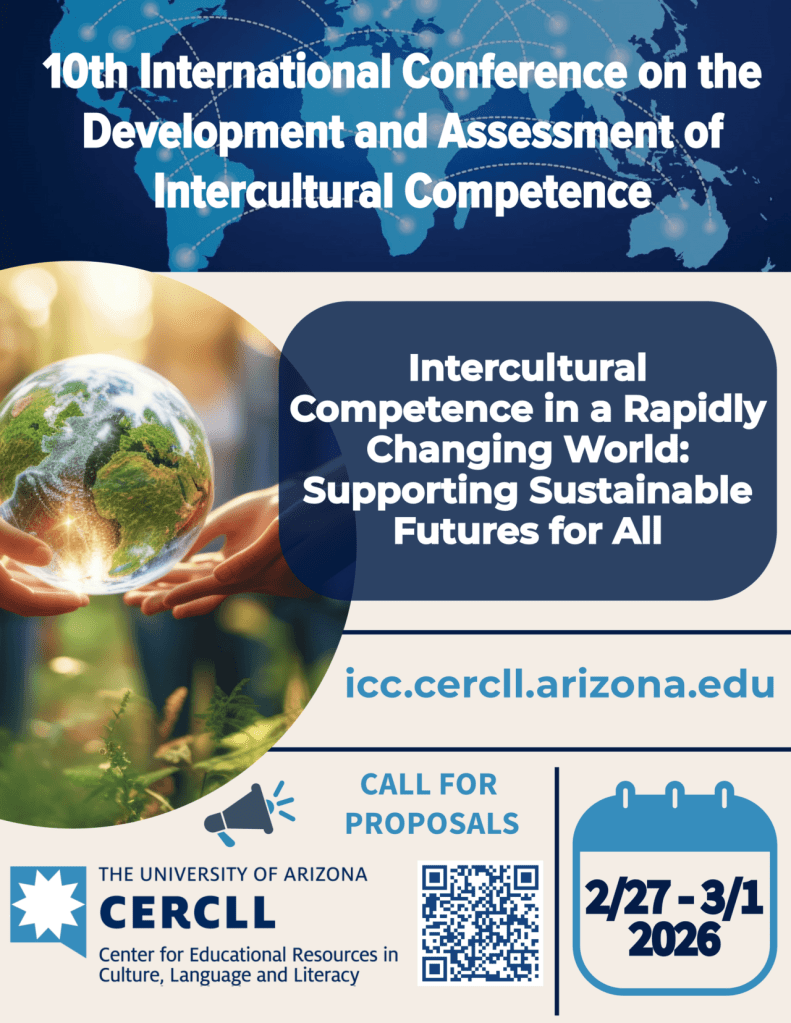
CFP: Intercultural Competence in a Rapidly Changing World (USA & Online)

ConferencesCall for proposals: Supporting Sustainable Futures for All: Intercultural Competence in a Rapidly Changing World, 10th International Conference on the Development and Assessment of Intercultural Competence, University of Arizona, Tucson, AZ and Online hybrid, 27 February-1 March 2026. Deadline: 21 July 2025.

Intercultural Competence in a Rapidly Changing World

What role might intercultural communicative language education play in promoting a more sustainable world for all? What might an intercultural communicative language education for a more sustainable world look like? What might be the implications for teachers and learners of moving towards intercultural communicative language education for sustainability? With these issues and questions in mind, CERCLL invites language educators to reflect on how they could re-envision what they teach and how they teach it to meaningfully address these crises with the goal of building a sustainable world for all. The organizers of ICC 2026 seek presentation proposals that focus upon these questions.

CFP: eLearning Forum Asia 2025: Digitalization of Learning Toward Diversity, Equity & Inclusion (Thailand)

ConferencesCall for proposals: eLearning Forum Asia 2025: Digitalization of Learning Toward Diversity, Equity & Inclusion, 14-15 August, 2025, Bangkok, Thailand. Deadline: 5 June 2025.

Sub-themes:
* Digital instructional & assessment strategies
– Global perspectives in virtual classrooms
– Adaptive learning
– AI enhanced learning experiences
* Nurturing employability & essential skills in digital age
* Lifelong learning in digital age
– Faculty development for digital age
-Professional development (upskill, reskill, new skill) in digital age
* Democratizing/Open education for equity

CFP: Globalisation in Languages, Education, Culture & Communication (UK)

ConferencesCall for proposals: Globalisation in Languages, Education, Culture, and Communication, 30-31 July 2025, Manchester, UK. Deadline: 18 May 2025.

The first International Conference on Globalisation/Deglobalisation in Languages, Education, Culture and Communication (GLECC2025) is going to be held 30-31 July, 2025, Manchester, UK., with pre-conference workshops on 29th July and post-conference cultural visits on 1st August.

The past two decades have witnessed remarkable advancements in the studies into Education, Second and Foreign Languages, Translation and Interpreting, Cultural Studies, and Communication. This growth, evident in both the number of active researchers and the volume of scholarly throughput and outcomes, can be largely attributed to the forces of globalisation. Consequently, adopting the globalisation perspective is timely and provides a natural framework for connecting these diverse yet interlinked disciplines.

GLECC2025 aims to bring together researchers, educators, practitioners, and policymakers from the realms of education, foreign and second languages, cultural studies, translation, interpreting, and communication to disseminate research outcomes, share insights, discuss findings, exchange visions, and identify challenges and trends in an interactive and immersive multidisciplinary environment.

CFP FEL: The Missing SDG: Endangered Languages and Sustainable Development (Spain)

ConferencesCall for papers: The Missing SDG: Endangered Languages and Sustainable Development, 29th Annual Conference of the Foundation for Endangered Languages, 22-25 October 2025, University of the Basque Country, Vitoria-Gasteiz, Spain. Deadline: 15 May 2025.

Why is world shouting everywhere about sustainability but is decidedly mute on language? Sustainable Development Goals, or SDGs, are, in the words of the UN, “the blueprint to achieve a better and more sustainable future for all”. They address “global challenges” which include eradicating poverty, ensuring good health and well-being, providing quality education, protecting the environment, upholding human rights, and promoting the rule of law, among others. However, languages are not explicitly mentioned, and the way in which culture is addressed remains very limited. As one linguist (Suzanne Romaine (2019: 41) put it, “language is the missing link in the global debate on sustainability”.

Without linguistic diversity and the promotion of multilingualism, many communities, particularly minority, indigenous and marginalized groups, are excluded from decision-making processes and denied equal access to vital resources. The endangerment or extinction of languages is often a consequence of this exclusion, but it also escalates it.

Main sub-themes include the topics below:

  • The conceptialisation of the links between the maintenance and revitalisation of minority, endangered and indigenous languages and sustainable development.

  • Practices of community-based and public institution initiatives that integrate both agendas.

  • Prospects of the 2030 agenda and the inclusion of the linguistic and cultural issue.

  • Proposal for a workable UN programme and document: Designing SDG 18

CFP ELAN: Linguistic Anthropology in Europe: Past, Present, Futures (Netherlands)

ConferencesCall for papers, inaugural ELAN conference: Linguistic Anthropology in Europe: Past, Present, Futures, Leiden University, 6-7 November 2025. Deadline: 15 May 2025, extended to 1 June 2025.

The goal of this first conference of ELAN, the Linguistic Anthropology Network of EASA (European Association of Social Anthropologists), is to bring together a wide range of scholars interested in doing and defining linguistic anthropology in the European context, whether Europe is their fieldsite, institutional base, or European scholars are simply key interlocutors.

In this conference, organizers invite linguistic anthropologists, broadly defined, to come together to explore the range of theoretical and methodological approaches that have composed and now compose linguistic anthropological scholarship in Europe and to imagine future possibilities and directions for carrying out linguistic anthropological research in and on Europe. They welcome papers, panels, and roundtables that showcase scholars’ own linguistic anthropological scholarship, examine intersections and dialogues between different theoretical traditions, and/or reflect on the past, present and future of linguistic anthropology in Europe.

CFP History of Digital History between East and West (Luxembourg)

ConferencesHistory of Digital History between East and West, Centre for Contemporary and Digital History, University of Luxembourg, Luxembourg, 5-6 February 2026. Deadline for abstract: 29 May 2025.

In histories of digital history, as in digital humanities in general, much emphasis has been placed on the two commonly recognized centers of the development of historical computing since the 1950s: the United States and Western Europe. As a result, crucial developments elsewhere have been overlooked, including in the Nordic countries as well as the Soviet Union and the various states of the Eastern bloc. The consequence of this omission is not merely a lack of knowledge about specific countries and a skewed understanding of digital history’s manifold early trajectories. It also creates epistemological blind spots regarding the political dimensions of the development of early historical computing and, given the latter’s networked nature within a general context of ‘East-West’ scholarly exchange in the Cold War period, obscures the transnational dimensions of the early history of digital history.

This workshop will address these blind spots by focusing attention on the question of how the local and the transnational intersected in the technology-inflected reshaping of historical research practices and how political backgrounds, contexts and constraints fed into this process. Organizers therefore seek papers that focus on local case studies in a transnational ‘East-West’ context, as well as those that consider comparative perspectives. Papers that ask what resources are available to support research in this area are similarly welcome.

CFP Marginalized Identities and Change in SWANA Region (USA)

ConferencesCall for panelists: Marginalized Identities and Change in SWANA Region, South West Asia and North Africa (SWANA) caucus, National Communication Association, 20-23 November 2025, Denver, CO, USA. Deadline for abstract: 29 March 2025.

The South West Asia and North Africa (SWANA) caucus invites scholars and activists for a special discussion panel on how marginalized identities, such as expats, women, religious minorities, racial minorities, and LGBTQ+ communities, balance the social struggles for recognition within their communities and the broader national/regional/global context. We invite scholars and activists whose focus is one of the countries within the SWANA region, such as Iran, Cyprus, Egypt, Morocco, Iraq, Afghanistan, Syria, etc, to submit abstracts addressing one or more of the following questions for their specific country:

  • Given the socio-political constraints, how do marginalized groups communicate and mobilize within the region?
  • How do activists within marginalized communities strike a balance between advocating for change within their groups and fighting for broader rights and recognition within the mainstream in the region?
    In what ways can media professionals contribute to more accurate and nuanced representations of diversity within the region?
  • What are the effects of alternative media on shaping youth attitudes and beliefs in relation to diversity and inclusion in the region?
  • How do the region’s alternative and independent media outlets contribute to pluralism and diversity in news coverage?
  • How can communication strategies be developed to more effectively address sexual health and rights within culturally sensitive contexts in the region?