Montana Grassroots Project Promoting Cross-Cultural Dialogue

Applied ICD

Montana Cross Community Reconciliation Project, founded by the Global Peace Foundation, enters 7th year promoting cross-cultural dialogue.

The Montana Cross Community Reconciliation Project, founded by the Global Peace Foundation, aims to promote cultural respect and mutual understanding by helping participants overcome personal biases and prejudices.

Ultimately, the greatest form of change, the greatest form of just improvement of different causes, different issues, different strife between people really just seems to be, sit down, have a meal together, have difficult conversations.

  • Nick Enslow, a member and facilitator at the program

The group meets once a month, with each seminar featuring guest speakers from around the globe who share their personal experiences related to culture, race, gender, religion, or economic status.

International House Association

Applied ICD

International House Association (IHA), a global nonprofit connecting a network of historic International Houses around the world, announced on 22 October 2025 its official launch and mission to focus on advancing peacebuilding, global citizenship and intercultural leadership.

Inspired by the pioneering spirit that led to the establishment of the historic International Houses in New York (1924), Berkeley (1930), Chicago (1932), Paris (1936), Tokyo (1952), and London (1965), we serve as conveyors, sources of analysis of current events, curators of cultural content, as educators, and as a group of global institutions committed to furthering understanding across the broad set of communities we serve.

Rooted in a legacy that began in 1924 with the founding of International House New York and formally organized with Rockefeller support in 1939, the Association has relaunched to meet the demands of a more divided, globalized and complex world. The revitalized IHA builds on a century of fostering successful cross-cultural understanding through intentional living, learning and engagement. The goal is to foster a global community committed to peace through cultural exchange, open discourse, and intellectual collaboration. Its member Houses serve as incubators of dialogue and leadership in major academic and metropolitan centers worldwide.

International Houses typically are based on a major university campus. They were designed as a way for international students to connect with local peers. For the last hundred years, they have been doing just that. Read the history of the project here.

Quilt of Belonging: A Place for All

Applied ICD

Quilt of Belonging: A Place for All, primarily created in Glengarry Village, Williamstown, ON, Canada.
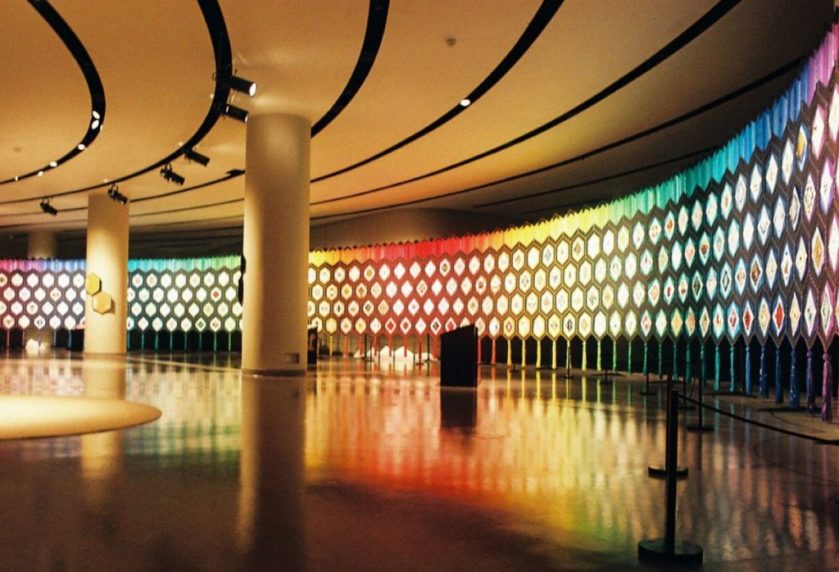
The Quilt of Belonging: A Place for All is a collaborative work of art whose mission is “to recognize Canada’s diversity, celebrate our common humanity and promote harmony and compassion among people.” A richly hued portrait of the human family, Quilt of Belonging is a 120 foot (36 metres) long collaborative textile art project. Its 263 blocks portray the rich cultural legacies of all the First Peoples in Canada and every nation of the world at the dawn of the new Millennium. The goal of those who created it is to “tell the stories of Canadians of all generations throughout our history, from First Nations to new settlers to the new citizens of today, to all from coast to coast to coast who call this wonderful country home.”

The Quilt of Belonging was begun in the fall of 1998 by artist Esther Bryan. In 1995 she went on a life-changing journey to Slovakia with her parents to find the family and home her father had left behind 43 years earlier. The dream of making this artwork was born as she recognized that everyone has a story to tell, each culture has a unique beauty and that the experiences and values of our past inform who we are today. Volunteers were found from each cultural identity to create the 263 diamond shaped textile blocks. Help was provided as needed with design, research and needlework to ensure that each piece reflects the unique beauty and character of the culture depicted. In this textile mosaic, each person can experience a sense of belonging and find a place in the overall design – there is “A Place for All.” Together they record human history in textile, illustrating the beauty, complexity and sheer size of the human story.

Canada’s immigration records showed that as of January 1st, 2000 at least one person from every country of the world was living in Canada. It took over 6 years for volunteers to find a representative from each of the 263 cultural groups on the quilt. Thousands of calls, letters and countless visits were made to organizations, immigration centres, native bands, churches, embassies, and individual contacts – in short every possible source was considered. Appeals were also made in the media, needlecraft publications and numerous “in-progress” exhibitions.

Blockmakers were found to create the 9-inch diamond shaped textile “block”. Volunteers assisted them with materials, design and sewing expertise. Countless hours of research supplied information on design, fabrics and techniques and provided the historical, cultural context from which to make the artwork and develop texts for books and web-site.

Over 3 million visitors have seen the Quilt while the Quilt of Belonging companion book is available in English or French, and the 48-minute documentary is free to watch online. This artwork is also used in a variety of projects and education programs, creating an impact nationally and around the world. As of 2025, it is housed at TriSisters Art House in St Jacobs, Ontario, when not on tour.

Culture as a Space for Addressing Interconnected Global Crises

Applied ICD

Culture as a Space for Addressing Interconnected Global Crises, written by Ian Thomas (Head of Research and Insights, Arts, The British Council), and published by the International Institute for Sustainable Development, is an article worth reading.

“In a fragmented global policy environment characterized by complex crises, culture possesses the ability to reshape public policy and development frameworks. It also plays a crucial role in preventing, responding to, and recovering from crises, from initiatives focused on heritage restoration to intercultural dialogue aid in post-crisis reconstruction. Community-driven cultural engagement, too, strengthens social and economic resilience.

This impact arises from culture’s ability to promote inclusivity, foster social cohesion, and encourage sustainable practices. By incorporating cultural perspectives and values into policymaking, societies can tackle challenges more effectively and establish more resilient and equitable development pathways.

Culture offers the narratives and frameworks that enable societies to comprehend themselves and their position in the world. These narratives can serve as potent instruments for shaping development priorities and advocating specific values.”

Peace by Prompt

Applied ICD

Peace by Prompt, by Lena Slachmuijlder, and published in the Tech and Social Cohesion substack, provides a fascinating description of two efforts to build AI tools to facilitate mediation and encourage peacebuilding.

Slachmuijlder focuses on two initiatives:

Akord AI and the peace accord library

“Developed by Conflict Dynamics International, Akord AI is a chatbot designed to support Sudanese peacebuilders, civil society actors, diplomats, and policy influencers. Instead of scraping the internet, it draws exclusively from a curated library of more than 3,000 resources—peace agreements, constitutional texts, case studies on women’s inclusion, and strategies from both global and local sources, in English and Modern Standard Arabic. Because Akord only draws on its curated library, it has so far avoided the hallucinations common in mainstream chatbots.”

Kinshasa’s AI Analyst

“In Kinshasa, a different experiment is unfolding. “Cocorico,” an AI chatbot developed by Kinshasa Television, isn’t just helping in the newsroom—it’s become an on-air analyst. It has weighed in on issues from the DRC–Rwanda peace talks to UN expert reports, government reshuffles, and legal cases.”

The Science Behind the Human Library (Denmark)

Applied ICD

The Science Behind the Human Library’s Methodology, Human Library Organization, Copenhagen, Denmark.

The Human Library creates a safe space for dialogue where topics are discussed openly between human “books” and their readers. The human books are volunteers with personal experience with a topic. Here’s a brief introduction.

Recently researchers at the University of Glasgow investigated the impacts of social interaction with stigmatized people in the learning space provided by the Human Library. The study, called Reducing stigma and discrimination: A case study of a ‘Human Library’ Reading event, includes extensive literature review where three types of strategies to dismantle stereotypes are introduced: educational, interpersonal and activism.

By employing the educational strategy, one attempts to reduce stigma by presenting facts. However, such an approach appeals mainly to the intellect and appears to be efficient when applied on adolescents. When working with adults, a more efficient strategy to dismantle stigma seems to be direct interpersonal contact with representatives of the stigmatized groups. This approach is at the center of the methodology used in the Human Library.

Organizing events to provide safe space for open discussions, this format creates learning experiences remembered for the rest of one’s life. At the Human Library, it is the combination of experience and new knowledge that give this approach such an impact.

For more information about the entire movement, see here. Over the last 24 years, the Human Library has hosted events virtually and in libraries, museums, festivals, conferences, schools, universities and for the private sector, in over 85 countries. They are currently opening libraries in Switzerland, and are looking for volunteers to help.

Dartmouth Dialogue Project: Shared Studios Portal (USA)

Applied ICDShared Studios Portal, Dialogue Project, Dartmouth College, Hanover, NH, USA, 28 April-15 May 2025.

“The Dialogue Project is excited to host a Shared Studios Portal on campus beginning April 28, 2025. Located in the Kemeny Courtyard behind Baker-Berry Library, the Dartmouth Portal features an immersive room, one wall of which is a screen that connects you to people in other portals around the world.

In the spirit of the Dialogue Project’s commitment to respectful discussion across differences, the Dartmouth Portal will enable students, staff, and faculty to engage with communities in nearly 20 countries to challenge our perspectives, sharpen intercultural communication skills, and facilitate difficult conversations. Additionally, students enrolled in Speech at Dartmouth classes will present speeches to diverse audiences, hone rhetorical skills, and make meaningful connections.

Rooted in storytelling and the expertise of lived experience, portal connections will allow students to connect with artists, activists, teachers, professionals, and fellow students from across the African continent, Latin and South America, the Middle East, and beyond!”

Picasso in Dialogue (Hong Kong)

Applied ICDPicasso for Asia: A Conversation, Hong Kong Jockey Club Series, M+ Museum, Hong Kong, 15 March-13 July 2025.

…the exhibition poses an interpretative framework for examining the works of the twentieth-century European master in relation to contemporary Asian and Asian-diasporic artists active today and in the recent past.

M+, Asia’s global museum of contemporary visual culture in the West Kowloon Cultural District in Hong Kong, proudly presents The Hong Kong Jockey Club Series: Picasso for Asia—A Conversation. The Special Exhibition is a rich intercultural and intergenerational dialogue between more than sixty masterpieces by Spanish artist Pablo Picasso (1881–1973) from the Musée national Picasso-Paris, which holds the largest collection of works by Picasso in the world, and around 130 works by thirty Asian and Asian-diasporic artists from the M+ Collections, and select loans from a museum, a foundation, and private collections. Co-organised by M+ and MnPP, this exhibition is a significant milestone in which masterpieces from MnPP are being shown alongside works from a museum collection in Asia for the first time. It is also the first major showcase of Picasso’s works in Hong Kong in over a decade, offering an unprecedented and unique perspective on the artist’s wide-reaching influence and what it means to be an artist in our time.

This Special Exhibition introduces four artist archetypes that encapsulate why Picasso is considered the quintessential twentieth-century artist and how the legacy of his art and life continues to influence contemporary artists as well as the public to this day. The four archetypes also serve as the sections of the exhibition and as powerful paradigms to which the contemporary Asian artists in the exhibition respond in their diverse, individualistic practices. The four are: the genius, the outsider, the magician, and the apprentice.

UNESCO: Youth as Researchers (Central Asia)

Applied ICDLaunch of the Youth as Researchers Project in Central Asia, organized by UNESCO Almaty Regional Office, UNESCO Office in Tashkent, International Centre for the Rapprochement of Cultures, and Kazakhstan National Federation of Clubs for UNESCO.

This exciting project empowers young people across Kazakhstan, Kyrgyzstan, Tajikistan, Turkmenistan, and Uzbekistan to engage in research on critical themes that impact their communities. Through this initiative, nine youth research groups have been selected to focus on five key topics:

  • Promotion of Science
  • Peace and Intercultural Dialogue
  • Gender Equality
  • Youth Mental Health
  • Ethics of Artificial Intelligence

Over several months, these youth groups will undergo comprehensive training in research methodologies, particularly in the social and human sciences. This training will equip them with the necessary tools to develop impactful knowledge products, which will contain recommendations on the selected topics. The findings will be shared with the National Commissions and Permanent Delegations to UNESCO of the participating countries.

The Youth as Researchers (YAR) programme, which is part of a global UNESCO initiative, is designed to empower young people to conduct research that addresses the issues they face. By equipping youth with research skills, YAR fosters evidence-based advocacy, encourages active participation in policy discussions, and strengthens their roles as agents of change in society.


Promoting Intercultural Dialogue Onstage (Czech Republic)

Applied ICDToday is the First Day of the Rest of My Life, Lutheran World Federation (LWF) Prague, Czech Republic.


Through a theater play, LWF Prague supports the integration of people with a migration background into Czech Society.

“Memories and personal stories are among the few things that refugees and migrants can carry with them wherever they go. The LWF office in Prague, Czech Republic, encouraged people with different cultural backgrounds and locals to share their stories in a theatre play, to connect and foster integration. The first edition premiered in November 2024.

Based on true stories of foreigners and Czechs living in Prague, the play examines the universal challenges of love, friendship, fear, and tough life choices. The amateur actors brought questions from their everyday experience to the play: How can I navigate societal stereotypes about single motherhood while considering what’s best for me and my baby? Will my girlfriend’s mother accept me, or will she always think I’m using marriage for a residence permit? Where can I get help for domestic violence if I don’t speak the local language? Will the authorities trust me, or will I face deportation? These are just some of the real-life situations explored in Today is the First Day of the Rest of My Life, a play that premiered at Vinohrady Theater D21 in Prague.”