

From traditional wet markets to food delivery by drone, by Casey Man Kong Lum.
I have been traveling and conducting fieldwork in China, Hong Kong, and Taiwan quite extensively recently. In particular, I spent several months on two separate trips to Shenzhen. A stone’s throw away from Hong Kong, Shenzhen is one of the special economic zones and industrial metropolises in China. It was during my months-long stay in Shenzhen that I first witnessed food delivery by drone, something I had earlier read about in food or lifestyle blogs. Incidentally, the experience has also raised some questions that are useful to my ongoing research in urban foodways, communication, and intangible cultural heritage (Lum & de Ferriere le Vayer, 2016).
One of my first drone food delivery encounters took place on a Saturday inside Huanggang Park, which is an easy 20-minute walk from the Futian’s China border crossing to Hong Kong. Covering about 17.3 hectares of land, Huanggang Park is a recreational facility very popular among residents in the neighboring communities (e.g., exercising, family picnic, group activities). The park is full of all kinds of activities over the weekend, especially on clear days.
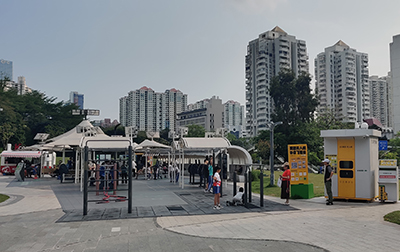
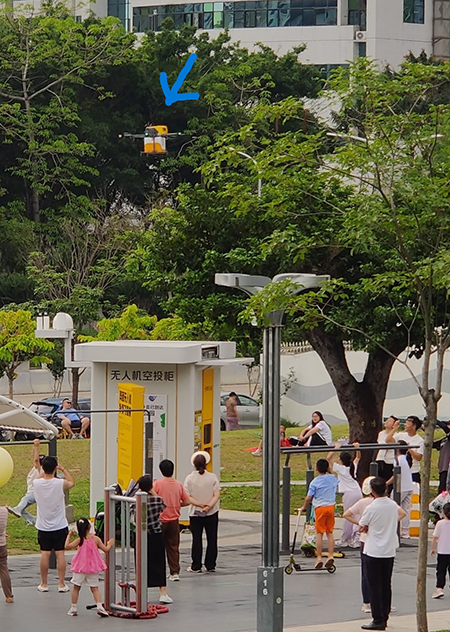
A relatively nondescript structure, the drone drop-off or pick-up station in Huanggang Park is located next to an area equipped with a number of digital exercise machines (see photo 1). The operation is run by Meituan (美团), a big food delivery platform in China with an estimated 65% of the market share. To order their take-out, the park goers use a dedicated app on their phone to scan in their account ID and food choices from an online menu. Their order would be delivered in a box to that station via a drone (see photo 2). After the box is dropped down a channel from the top of the station, the customers then use a QR code on the phone specific to their paid order to retrieve the delivery.
While the e-commerce giant JD.com (Jing Dong or 京东) made China’s first drone delivery in a rural destination outside of Xi’an in November 2016 (Parmar, 2016), Meituan started its drone food delivery program in Shenzhen in 2021, four years after its own initial experimentation with the delivery method in 2017 (Yang, 2023). My initial archival research indicates that drone delivery is gaining acceptance from consumers across China. In addition to the kind of food delivery in urban settings described above, drone service can also deliver a variety of other goods, such as medical or other daily supplies; such services are especially useful to people living in hard-to-reach areas in the countryside.
Indeed, food delivery by drone is gaining popularity among consumers in China, such as those ordering take-out for a picnic in the park. However, my participant observation over more than six months seemed to suggest that drone food delivery has yet to become an everyday foodways practice as deeply ingrained as in-person food delivery. For example, currently drones cannot make delivery directly to individual apartment units in the thousands upon thousands of high-rise residential or office buildings in Shenzhen. (As a safety measure, all the balconies in the residential buildings in the community are sealed off with metal mesh.) Instead, such drone deliveries are made in pick-up venues (which may resemble vending machines) put in place by the delivery platform in a residential or office building nearby. For prompt food delivery that one can pick up at their own apartment’s doorstep, in-person delivery continues to be ubiquitous.
In fact, during our months-long stay at our hosts’ apartment in a residential high-rise across the street from Huanggang Park, I observed that the bulk of groceries were purchased from a selection of online delivery platforms. Our hosts consist of a young professional couple with their infant child and the latter’s live-in nanny and family cook. The family typically places grocery orders twice daily, once for lunch and the other for dinner. They also order cooked breakfast on some occasions if they need not go to the office early. Their orders typically consist of fresh produce and some form of protein, while in my experience in Shenzhen, customers have the option of ordering live seafood (e.g., as in shrimp are still swimming upon delivery in a sealed plastic bag). To avoid a delivery charge, a minimum purchase of about RMB38 (approx. $5.29) or RMB58 ($8.07) is required on popular grocery delivery platforms such as Xiaoxiang (小象) or Hema (河马), respectively. Otherwise, a delivery charge can be as low as RMB5 (app. $0.70).
Of course, none of the above is meant to suggest that more traditional forms of food shopping are becoming obsolete. In fact, it does not take much effort for visitors to witness and experience a multitude of food shopping practices throughout China, such as independent street vendors, small family grocers, traditional wet markets, supermarkets of all sizes having diverse corporate ownership, specialty stores that sell international products in high-end shopping malls, and so on. In fact, as house guests we often contributed various food items we acquired in traditional venues, such as neighborhood supermarkets, street vendors, shopping malls, etc.
But the proliferation and increasing presence of online food shopping and delivery platforms gives rise to some very interesting possibilities for research, such as examining the role of technological innovation in the transformation of foodways; the changing relationship or dynamic between people and their food, as well as the places or sellers in their neighborhood from which they acquire their food; issues related to class and gender in the evolving foodways; the rise of a convenience economy and changing consumer behavior in foodways; how, and the extent to which, traditional food vendors adjust to the changing food retail landscape; and so on.
Photo credit: Casey Man Kong Lum
References
Lum, C. M. K., & de Ferriere le Vayer, Marc. (Eds.). (2016). Urban foodways and communication: Ethnographic studies in intangible culture food heritages around the world. Lanham, MD: Rowman and Littlefield.
Parmar, T. (2016, Nov 14). This tech giant has kicked off drone delivery in rural China. Fortune.
Yang, Z. (2023, May 23). Food delivery by drone is just part of daily life in Shenzhen. MIT Technology Review.

 Center for Intercultural Dialogue