CFP A Sociolinguistics of Islam

“Publication

Call for papers: A Sociolinguistics of Islam: Exploring Multilingualism & Meaning in Faith, A Special Issue of the Journal of Multilingual & Multicultural Development. Deadline for extended abstract: 22 August 2025.

Special Issue Editors: Ibrar Bhatt (Queen’s University Belfast, UK); Othman Barnawi (Royal Commission for Yanbu Colleges and Institutes, Saudi Arabia); Rizwan Ahmad (Qatar University, Qatar)

Across the fields of sociolinguistics, applied linguistics, literacy studies, and linguistic anthropology, the role of religion has been present yet marginalised, and often subsumed under broader categories such as ‘identity’, ‘ideology’, or ‘cultural practice’. Despite this presence, scholarship within linguistic and cultural studies, broadly speaking, has not fully capitalised on the onto-epistemic
potential of how language and society intersect in contexts where the Islamic faith serves as a defining worldview. Engaging more deeply with such contexts offers valuable opportunities to advance research on religious multilingual and multicultural development, particularly when grounded in Islamic historicity, theology, and the distinctive features of Islamic knowledge traditions.

This special issue seeks to redress this imbalance by exploring a ‘sociolinguistics of Islam’, a conceptual and empirical orientation, as defined by Bhatt, Barnawi and Ahmad (2025), that foregrounds contexts of linguistic practice shaped by Islamic traditions, whether in Muslim-majority or Muslim-minority settings, as deserving of dedicated scholarly attention. The sociolinguistics of Islam refers to the exploration of how language and society intersect within contexts where the Islamic faith is a defining worldview shaping language, literacy, and other processes of semiosis. Building on foundational work in the ‘sociology of language and religion’ (e.g. Fishman 2006; Omoniyi 2010), and drawing inspiration from sociolinguistic analyses in religious communities (e.g. Spolsky 2014; Shandler 2006; Fishman et al. 1966), this special issue invites critical, theoretical, and empirical contributions that advance the study of language within Islamic sociolinguistic ecologies.
Oxford University: Rhodes Scholarship (UK)

“Studentships“Rhodes Scholarship for either MA or Ph.D. Studentship, Oxford University, Oxford, England, UK. Deadline: 1 August 2025.

The Rhodes Scholarship is a fully-funded postgraduate award which enables talented young people from around the world to study full-time at the University of Oxford. The Rhodes Scholarship is merit-based, with the purpose of developing public-spirited leaders, and to promote international understanding and peace through an international community of Scholars.

Applying for the Scholarship is a challenge, but it is an experience which has helped generations of young people to succeed. They encourage applications from talented students everywhere.

Rhodes Scholars go to the UK for two or more years and can apply to study most full-time postgraduate courses in almost any field offered by Oxford University. (Available for those wanting a PHD, an MA, or even a second BA.) If your country is not listed, you can apply for a Global Scholarship if you meet the eligibility criteria.

CFP: Pathways to Global Competence

“Publication

Call for chapter proposals: Pathways to Global Competence, an edited collection. Deadline: 31 August 2025.

Editors:
Soyhan Egitim (Toyo University, Japan)
Seiko Harumi (SOAS, University of London, UK)

The editors are pleased to invite chapter proposals for an upcoming edited volume that explores interdisciplinary approaches to fostering global competence through a practical, research-based framework. This volume brings together scholars and practitioners from diverse fields to share empirical studies, pedagogical innovations, and theoretical insights on cultivating global competence in educational and professional contexts.

In today’s globalized world, the ability to navigate cultural boundaries is an essential skill for success. Engaging with individuals from diverse linguistic, cultural, and social backgrounds requires more than language proficiency alone; it also demands a deep understanding of cultural nuances, empathy, and adaptability. As internationalization accelerates across educational and professional domains, there is a growing need for a structured approach to fostering effective
communication and building meaningful intercultural relationships. In response to this need, the editors have developed a global competence framework tailored specifically for educational contexts. This framework emphasizes four essential components: linguistic proficiency, cross-cultural knowledge, adaptability in communication styles, and adopting values beyond our horizon. Far from being solely theoretical, our framework is grounded in empirical research as well as the lived experiences of educators and students navigating diverse cultural environments.

U Leiden: PhD Studentships in Interpersonal Conflicts & Violence (Netherlands)

“Studentships“Interpersonal Conflicts and Violence, 3 Ph.D. Studentships, University of Leiden, Netherlands. Deadline: 18 July 2025

(If the topic interests you, but you already have a PHD, there is also a postdoctoral researcher position available with the same team.)

Why and how do interpersonal conflicts turn physically violent? What are the turning points towards the beginning and ending of violence in encounters between civilians and between police and civilians? If you want to work on these questions, have a master’s degree in communication science, social science, or psychology, and would like to conduct qualitative video analysis, this may be the position for you.

The main aim of this ERC TURNING VIOLENT research is to identify turning points towards one-sided violence in interpersonal conflicts. Projects will focus on conflicts between civilians or between police and civilians in Berlin, Paris, or London. The team will be using publicly available video data, complemented with video elicitation interviews. They are seeking candidates who are interested in learning or who are already experienced in video based ethnomethodological conversation analysis and multimodal analysis and who are comfortable working with qualitative research methods and video annotation tools (e.g. ELAN, NVivo, or similar).

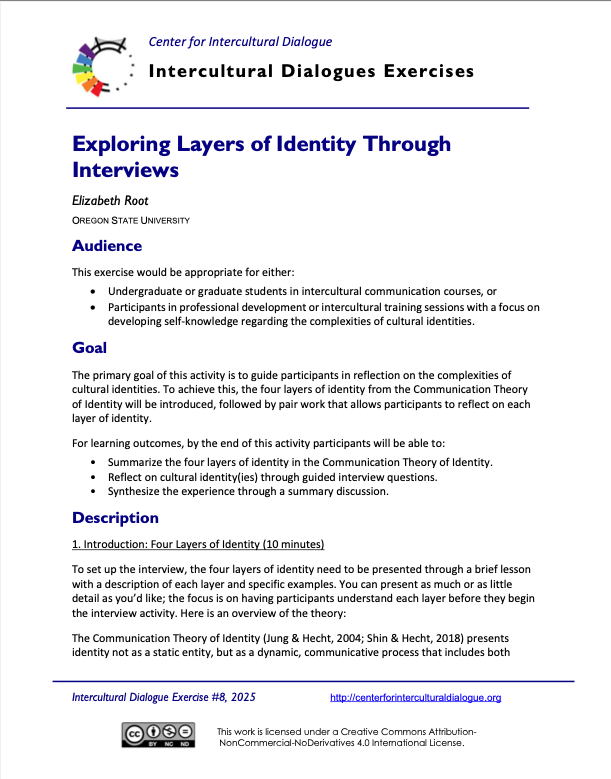
ICD Exercise #8: Exploring Layers of Identity Through Interviews

ICD Exercises

The next ICD Exercise is now available. Elizabeth Root describes an exercise she has successfully used with students, Exploring Layers of Identity Through Interviews.

The primary goal of this activity is to guide participants in reflection on the complexities of cultural identities. To achieve this, the four layers of identity from the Communication Theory of Identity will be introduced, followed by pair work that allows participants to reflect on each layer of identity.

As with prior publications, ICD Exercises are available as free PDFs; just click on the thumbnail to download.

Intercultural Dialogue Exercise 8 by Elizabeth Root

Root, E. (2025). Exploring layers of identity through interviews. Intercultural Dialogue Exercises, 8. Available from: https://centerforinterculturaldialogue.org/wp-content/uploads/2025/06/icd-ex-8-root.pdf

If you have an exercise you’ve used that works, and you would like to share it, please submit it. All authors will be asked to answer the same set of questions, and to make the exercises available for others to use, thus these are being published with a Creative Commons license (as is the case for all CID publications). If you are new to CID, please provide a brief resume. This opportunity is open to masters students and above, on the assumption that some familiarity with academic conventions generally, and discussion of intercultural dialogue specifically, are useful.


This work is licensed under a Creative Commons Attribution-NonCommercial-NoDerivatives 4.0 International License.
Wendy Leeds-Hurwitz Director Center for Intercultural Dialogue

University of California Education Abroad Program: Academic Specialist (USA)

“JobAcademic Specialist, Global Programs, University of California Education Abroad Program, Goleta, CA, USA. Deadline: 18 July 2025.

The Academic Specialist is an experienced professional who applies theory and puts it into practice with in-depth understanding of the professional field; independently performs the full range of responsibilities within the function; possesses broad job knowledge; analyzes problems/issues of diverse scope and determines solutions. Applies knowledge and skills as a seasoned, experienced academic professional. Provides advice and recommends solutions which may apply to unique (not-clearly-defined) programs and issues without prior precedent. Reporting to the Academics Managing Supervisor, the Academic Specialist serves as the primary interface for academic matters within an assigned portfolio and is responsible for the accurate distribution of academic program information between the Systemwide Office of the University of California Education Abroad Program (UCEAP) and (a) UCEAP Study Center staff worldwide; (b) UC Campus Study Abroad Offices; (c) UC students participating in UCEAP; and (d) the UC campus registrars’ offices. Communications with students primarily take place remotely (online and phone) rather than in person. Performs complex research, review, and analysis of host institution academic opportunities appropriate to UC undergraduate and/or graduate students and of UC, UCEAP, and host institution academic policies and procedures; and disseminates advising and recruitment information to indicated UC campus offices and academic departments. Manages the process by which credit earned abroad is applied to a student’s UC record; advises Study Centers, Campus Study Abroad Offices, registrar offices, and students about UC and UCEAP policies pertaining to students’ academic work and records in programs worldwide; and works to ensure that automation of these processes is as advanced and efficient as possible. Responsible for all academic information pertaining to a specified portfolio group within the approximate 6,000 student UCEAP participants each year, in over 40 countries worldwide. Works closely with the Associate Dean in implementing and archiving academic policies and procedures. Promotes UCEAP programs at occasional student fairs and campus events. Assembles and maintains program information, manages student registration information, and generates reports in a complex in-house database. Collaborates with IT and Marketing units on academic web and database issues and requests.

U North Carolina: Assistant Director of Education Abroad (USA)

“JobAssistant Director of Education Abroad, University of North Carolina Wilmington, NC, USA. Deadline: 16 July 2025.

The Assistant Director of Education Abroad will liaise with campus academic departments for course articulations and international credit transfer. Additionally, they will oversee the coordination, marketing, promotion, and execution of education abroad events, programs, and outreach, while also advising on a small portfolio of education abroad opportunities. This position will also manage UNCW’s Education Abroad scholarship processes, and will coordinate programming, fundraising, assessment, and career-related activities for education abroad alumni and returnees.

The Office of Global Partnerships and International Education is dedicated to developing and increasing the international dimension of the UNCW campus. This is accomplished by fostering programs and services for international students; helping UNCW students to participate in education abroad programs; assisting UNCW faculty in their teaching, research, and scholarship abroad; developing and strengthening educational linkages with international partners so as to create opportunities for student, faculty, and staff exchanges; identifying and obtaining resources to further the internationalization of UNCW, and by enhancing and expanding international and global opportunities and resources on campus and in the surrounding community.

CFP ICA 2026: Communication and Inequalities in Context (South Africa)

ConferencesCall for papers: Communication and Inequalities in Context, International Communication Association, Cape Town, South Africa, 4-8 June 2026. Deadline: 1 November 2025.

The ICA 2026 conference theme invites critical reflection on the dynamics between communication and inequality and its tensions across different social, cultural and geographical backgrounds. As such, it is a call to engage with research exploring the deep divisions and existing interpersonal, institutional, and structural inequalities in our societies.

In a world shaped by the unequal distribution of political, economic, societal, cultural, and communication resources, considering the complex architecture of global inequalities remains a critical issue. Communication scholars have long recognized how structural divides shape all communication processes, from persistent barriers rooted in historical inequities to emerging forms of digital exclusion and fragmentation. Today, as disinformation, extremism, polarization, hate, oppression, and algorithmic discrimination pose global challenges, the specific contexts in which people encounter these phenomena–including political institutions, media systems, regulatory capacity, and social norms—may fundamentally shape their lived experiences. Thus, it becomes crucial to examine how and under what conditions these forces unevenly affect different communities and individuals across multiple domains of life and in various geographical and cultural settings. For example, communication barriers may impact disaster preparedness and response in vulnerable individuals; the increasing complexity of digital literacy requirements constitutes a significant threat to inclusion, and global internet governance and infrastructure decisions create and amplify disparities between and within different nations and communities.

Such inequalities and power dynamics are also expressed within/across communication research. From gender gaps in publications and language barriers for scholars from non-English-speaking countries to the invisibility of knowledge produced in the Global South and calls to de-Westernize communication research, several divides in communication in terms of the subject of study, the body of evidence, analytical frameworks, and academic cultures limits our ability to gain insights relevant to the current global social and political condition.

In this spirit, organizers invite submissions for papers and panel proposals that address the conference theme along the lines outlined here. Submissions may address, but are not limited to, the following issues and topics:

*The evolving landscape of the relationship between communication and inequality.
*Conceptualizations and theorizations of communication inequality and inclusion/exclusion.
*The dynamics and implications of enduring inequalities and new divides for communication scholarship in different settings.
*Broader social and communicational outcomes of communication divides.
*Tensions and intersectionality of power hierarchies in communication.
*Algorithmic biases and marginalization (e.g., algorithmic decisions reinforcing disparities faced by marginalized groups; societal implications of algorithmic; data inequality, algorithmic fairness).
*Cross-border communication inequalities.
*Inequalities across and within communication research, including power imbalances in knowledge production within the field, and differences in opportunities, resources, and capacities among researchers, institutions, and regions.

CFP Interculture: Photography & (Post-)Coloniality

“Publication

Call for submissions: Photography and (Post-) Coloniality: Visual Representations of Colonial Encounters in Intercultural Perspective, Interculture Journal. Deadline: 30 August 2025.

Special issue editors: Romuald Valentin Nkouda Sopgui, (University of Maroua, Cameroon)
Christoph Vatter (Friedrich Schiller University Jena, Germany)

Interculture Journal is looking for contributions in German, English or French for issue 02/2026 on the topic of “Photography and (Post-)Coloniality: Visual Representations of Colonial Encounters in Intercultural Perspective”. This special issue explores the role of photography as a central medium of (post-)coloniality and welcomes contributions examining visual representations of colonial encounters from an intercultural perspective. Contributions may examine both historical and contemporary photographic practices to locate the medium of photography in (post)colonial and intercultural discourse. The bracketed prefix “(post-)” indicates that the colonial as an ongoing historical power structure is not always obvious, but is always present and must be deconstructed to achieve the decolonization of society and culture. This thematic issue explores the intersection of photography, (post)coloniality and interculturality offering a research perspective that has not yet been adequately examined and aligning with current German and international discussions about the insufficiently addressed cultural “legacy” of colonialism.

Intercultural Competences for Peacebuilding in Africa: Road to Global Peace (Webinar)

EventsIntercultural Competences for Peacebuilding in Africa: Road to Global Peace, a webinar presented by George Mutalemwa and sponsored by the UNESCO Chair on Intercultural Competences, 24 July 2025, 15:00 CAT.

This free webinar series provides a dynamic platform for scholars, practitioners, and thought leaders to explore the role of intercultural competence in fostering understanding, inclusion, and collaboration across diverse societies. Each session delves into critical global issues, sharing research, best practices, and innovative approaches to climate action, peacebuilding and gender equity​​. This session is presented by George Mutalemwa founding director of the Africa Peace and Development Network and Senior Research Fellow at St. Augustine University of Tanzania (SAUT).