Applications are invited for a Lectureship in Sociolinguistics for Language Education. The successful candidate is required to make a major contribution to the range of Master’s programmes in Applied Linguistics and TESOL, and to research and administration in the Centre for Applied Linguistics, including programme management, supervising PhDs, and carrying out first-class research activities. This post is available from 1st January 2019.
Applications are invited for the post of Research Associate in the Institute of Multimodal Communication, located within the Experimental Psychology Research Department, UCL. The project, funded by a ERC grant awarded to Gabriella Vigliocco, investigates the role of multimodal cues (such as gesture and eyegaze) in language learning and processing. The successful candidate will be expected to develop and implement multimodal computational models to be used to predict behavioural and neural responses. The appointee will also be expected to contribute to the writing of manuscripts and presenting the data at international conferences. Strong support for personal and professional development will be available. This post in funded for 2 years, in the first instance.
Applicants must hold a PhD, or have submitted their thesis, in Experimental Psychology, AI, Computer Science, Cognitive Science, or Linguistics, and have computational experience. The ability to work as part of a research team is essential, as is the ability to problem-solve in a technical setting. Programming skills are essential.
Teaching Fellow in Global Politics, University College London – UCL School of European Languages, Culture and Society – Centre for Multidisciplinary and Intercultural Inquiry (UK)
The UCL Centre for Multidisciplinary and Intercultural Inquiry invites applications for the post of Teaching Fellow in Global Politics. The successful candidate will be expected to take up the position on 1 September 2017, or as soon as possible thereafter. The post is fixed-term for 12 months.
The post holder will teach four courses or equivalent – an approximate total of 80 contact hours of teaching – at graduate level. He or she will be required to mark and assess work completed for these and, at the discretion of the Chair of CMII, other courses, assist in the preparation of timed examination papers to be taken in the summer term, supervise MA dissertations, participate in CMII PhD and MA dissertation presentations, hold office hours, attend meetings concerning the courses that he or she teaches, and complete mandatory training requirements that he or she may, in accordance with UCL policy, need to take.
The post holder will have a Postgraduate qualification or equivalent within the area of Global Politics, Comparative Politics, or International Relations.
Closing Date: 7 July 2017 Part-Time: 18.25 hours per week (50% FTE)
Research Assistant (2 years) – Ref:1640327 ESRC-funded Family Language Policy project – Somali community in London
UCL Institute of Education, University College London
Duties and Responsibilities: You will be a member of the UCL Centre for Applied Linguistics, which is located in the UCL Institute of Education. The UCL Centre for Applied Linguistics is a centre of international excellence in research and teaching in bilingualism and multilingualism, second language acquisition and assessment, discourse analysis, sociolinguistics, language-in-education policy and practice, English language teaching and teacher development, corpus linguistics, and intercultural communication.
The successful applicant will be involved in conducting family-based linguistic ethnography within the Somali community in London with different types of families. The post-holder will be expected to manage the day-today project objectives, under the supervision of Professor Li Wei, and to work in collaboration with the other project team members based in Reading University and Birkbeck College, University of London.
The post is available and funded from 01 September 2017 until 31 August 2019.
Key Requirements: Candidates should have postgraduate qualifications in applied linguistics, with extensive knowledge of the Somali community in the UK and extensive knowledge of linguistic ethnography. Good knowledge of standard statistical analysis and demonstrable skills in verbal and written communication are expected.
Closing Date: 7 May 2017, latest time for the submission of applications: 23:59 Interview date: TBC
Lecturer in Applied Linguistics and TESOL
UCL Centre for Applied Linguistics, UCL Institute of Education
University College London (UCL), UK
Closing Date: 7 Jul 2016
Duties and Responsibilities
Applications are invited for a Lectureship in Applied Linguistics and TESOL. The successful candidate will be expected to contribute to the Masters programmes in Applied Linguistics and TESOL (including MA in TESOL Pre Service), especially in second language acquisition, bilingualism and multilingualism, corpus linguistics, sociolinguistics, discourse analysis, intercultural communication and/or research methods. The supervision of PhDs, research activities and administrative responsibilities of the Centre the Department, the Institute and UCL generally.
Key Requirements
The postholder will have a PhD in Applied Linguistics, TESOL or a relevant subject. Experience in teaching and supervision in a higher education institution and proven ability to undertake research and produce publications of high quality.
Further Details
The post is available from the 1st September 2016 or as soon as possible thereafter. If you have any queries about the post, please contact Professor Li Wei li.wei [at] ucl.ac.uk To apply, please go to UCL jobs website and apply online.
For technical queries, contact Jackie Gadd: j.gadd [at] ucl.ac.uk
Lecturer in Screen Media
University College London – UCL School of European Languages, Culture and Society Centre for Multidisciplinary and Intercultural Inquiry
Closes: 13th May 2016
UCL invites applications for a Lectureship in Screen Media, within the Centre for Multidisciplinary and Intercultural Inquiry. The Centre would particularly like to strengthen its provision in the research and teaching of contemporary global media cultures. The postholder will be expected to contribute to the Centre and Faculty’s teaching at undergraduate and postgraduate levels, and to contribute to the running of the Centre, the Faculty and University generally.
The successful candidate will be expected to take up the position on 01 September 2016, or as soon as possible thereafter.
The postholder will have a PhD or equivalent, with a proven track record of research and publications in an area of Film and Screen Studies. The postholder will be completely fluent in English and have the ability to teach Film and Screen studies at undergraduate and postgraduate level.
If you have any queries regarding the vacancy please contact Dr Lee Grieveson.
Reference Number: 1545147
New free e-learning course – Why We Post – The Anthropology of Social Media
Why We Post – The Anthropology of Social Media, a new, free, e-learning course, will begin on 29th February 2016. This five week course is taught by the nine anthropologists behind Why We Post, the global social media research study based at University College London.
Topics include:
Week One: What is social media – Polymedia and Scalable Sociality. The focus upon content rather than platforms. The 9 fieldsites. The practical uses of this research. Main fieldsite – village England
Week Two: The shift to visual images in communication. Memes as the moral police of the internet. The significance for illiteracy. The diversity of the selfie. Main field sites – South Italy, Trinidad.
Week Three: The impact on politics and gender. Why public social media is more conservative than offline life. The transformation of gender relations in Hindu and Muslim societies. Main field sites – south India and southeast Turkey
Week Four: What we learn from The Chinese platforms. The impact of social media more generally on privacy, on education and on commerce. Main field sites – Industrial China, Rural China
Week Five: The relation between online equality and offline inequality. When social media may not express identity or individuality. Seeing the normative. How the world changed social media. Main field sites – northeast Brazil and north Chile.
The course is available in seven languages in addition to English.
About Why We Post Why We Post is a project by nine anthropologists who conducted nine simultaneous 15-month studies on the uses and consequences of social media around the world. Sites included a factory town and a rural town in China, a town on the Syrian-Turkish border, low income settlements in Brazil and Chile, an IT complex set between villages in South India, an English village, and small towns in Italy and Trinidad. Outputs will include a free e-learning course (available in 8 languages), a website and 11 open access books, to be published by UCL Press. View the video introduction to the Why We Post project..
London is one of the most linguistically diverse cities in the world. Almost two million people speak English as a second language, and across the city, Londoners speak about 300 different languages. A new map shows how those languages show up as you travel along local subway lines.
The map was created by Oliver O’Brien, a researcher at University College London, using new census data. It shows which language is most common after English at each station, with bigger circles for the most popular languages. It’s drawn using the same simple graphic style as the standard subway map.
I applied for one of the Center for Intercultural Dialogue‘s microgrants funded by the National Communication Association to explore the possibilities of meeting with researchers in London. Currently, I am looking at using communication methods to better implement and evaluate the roll out, implementation and uptake of HIV biomedical interventions among gay and bisexual men in the United States. Because of the disproportionate impact of HIV in the United States on certain groups, my work focuses on African American, Latino and HIV-positive gay men – all populations that experience persistent structural barriers in the healthcare system.
Matching funds The Hofstra University School of Communication supported this project with a faculty research support grant. The matching funds covered the costs of housing and food while at the host institution.
Local host The Global Forum on Men who have Sex with Men (MSM) hosted a Pre-Conference focused on gay and bisexual men at the International AIDS Conference 2012 in Washington, DC. I chaired the panel on HIV, community mobilization and immigrant MSM. On the panel, Ibidun Fakoya, Research Fellow at University College London presented her formative assessment of African gay men living with HIV in London. Ibidun Fakoya works with Dr. Fiona Burns on the advancing Migrant Access to health Services in Europe (aMASE). aMASE uses a multi-site Community Advisory Group to assess clinical and health care access for migrants in Europe with some focus on MSM and substance users. As such, aMASE is constructing a framework for effectively working with mobile and marginalized populations in assessing healthcare. In follow up conversations and through social media, a relationship emerged on common research interests. Through these conversations, the project emerged and additional meetings were made through Ibidun Fakoya and social media. In the past few years, I have developed a network of other advocates and researchers who are active on twitter and whose specialty is health disparities and the gay, lesbian, bisexual and transgender communities.
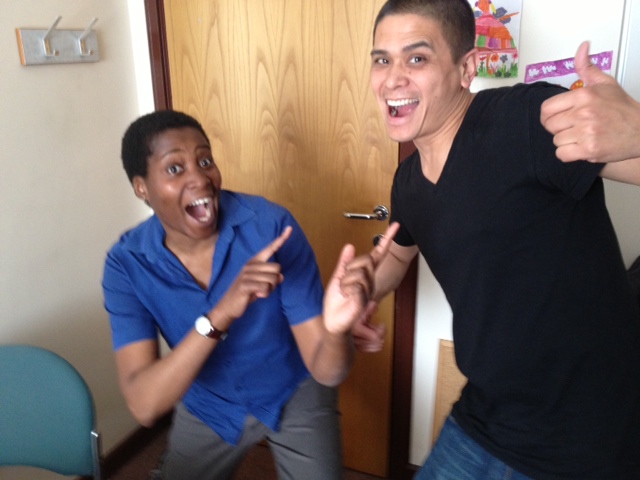
Ibidun Fakoya, Andrew Spieldenner
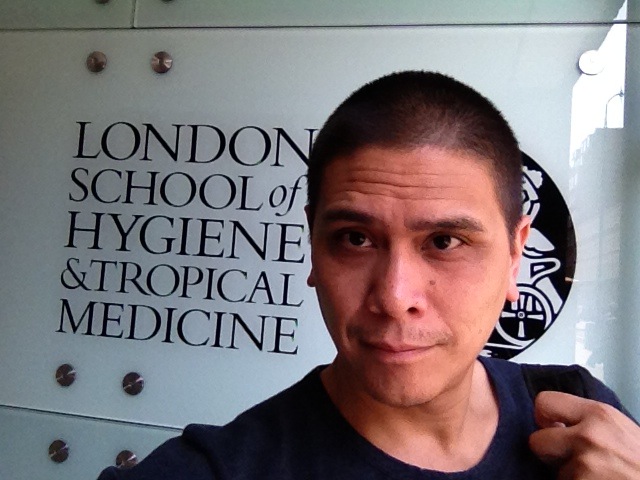
Trip itinerary My colleagues were generous with their time. I visited University College London, Birkbeck College and the London School of Hygiene and Tropical Medicine. Each meeting opened up other doors to consider – with other researchers, community groups, medical providers, and health policy institutions.
Ibidun “Ibi” Fakoya and Dr. Fiona Burns of University of College London aMASE project were my primary hosts. Ibi and I met with the Community Mobilization Coordinator to discuss the Community Advisory Group and the implementation of the research survey in multiple countries in clinic and community settings. We brainstormed on possible community partners to achieve the target survey populations in the United Kingdom (UK), Germany, Spain and Italy. I was able to review the processes that aMASE has implemented to get a shared research tool and protocols across all partner sites. In addition, Ibi and I reviewed social marketing and health messaging in order to develop marketing materials. Ibi was instrumental in coordinating with the other researchers for my trip.
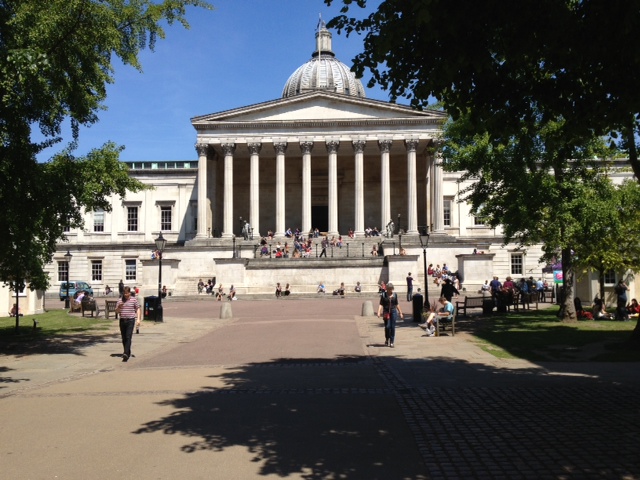
At the University College London, I met with Professor Graham Hart on HIV and gay men in the London and New York City, focusing on the vastly different healthcare systems in the two countries. Professor Hart is Dean of the School, and he has extensively researched HIV and gay men. Professor Hart was interested in how the differing healthcare systems and social attitudes about health impact the treatment and service environment for gay men of varied racial/ethnic and socioeconomic backgrounds. He gave several referrals to visit community groups and health policy institutions.
Professor Matthew Weait of Birkbeck College is an expert on HIV criminalization laws. We discussed the ways that HIV criminalization laws operate in various countries, and how cultural views frame the laws. We also examined the concurrent passage of gay marriage legislation in Maryland alongside an enhancement of the state’s HIV criminalization law. We discussed the importance of translating research and policy into accessible language in order to mobilize community members.
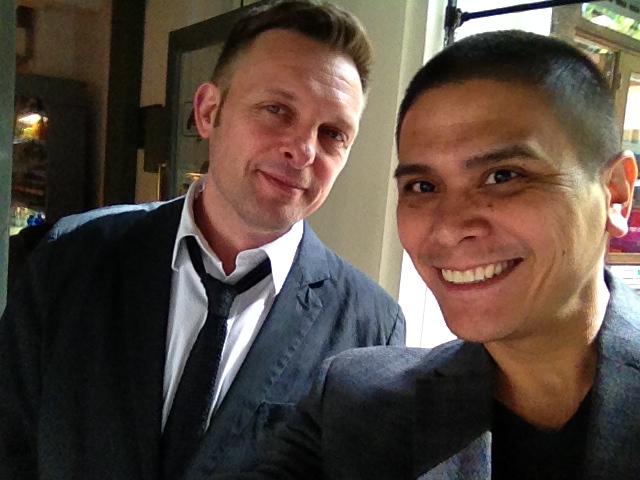
Matt Weait, Andrew Spieldenner
Dr. Catherine Dodds and Dr. Ford Hickson of the Sigma Research Group are currently housed at the London School of Hygiene and Tropical Medicine. The Sigma Research Group has been on the forefront of research in the UK on gay men and HIV. They have conducted surveys at gay prides in the UK for over a decade, and have implemented several Community-Based Participatory Research (CBPR) projects alongside community partners. We had an intense discussion about harm reduction in HIV, the limits to current public health discourse on gay men and HIV, methods of conducting CBPR projects (including the use of Skype), and how communication – as a field – can be used in public health research.
Further activities There are several future activities possible in the future. Many of these involve future correspondence and research support. We acknowledged that there were several meetings about HIV and our respective fields that may be of interest to the others. Dr. Hickson, Dr. Dodds and Professor Weait committed to ongoing communication about projects and possible next dates for meetings when we happened to be in the same event (such as the International AIDS Conference 2014).
Ibidun Fakoya and I sketched out two different research projects to advance, and we are looking to collaborate over the next two years on these projects.
Finally, I plan to return to Europe summer of 2014 on another project, where I will be renewing my relationships with these researchers.
[NOTE: Andrew Spieldenner’s original project proposal is available here.]
Dr. Andrew R. Spieldenner, of the School of Communication at Hofstra University, received one of the National Communication Association’s micro grants in Fall 2012 to travel to London to meet with Dr. Fiona Burns (principal investigator) and Ibidun Fakoya (research fellow), of University College London, to discuss, plan and learn from a community engagement research project started there. Communication methods still have not been used to look at HIV biomedical community engagement. The particular community engagement research project – advancing Migrant Access to health Services in Europe (aMASE) – looks specifically at migrants and immigrants across Europe in health disparity research, with a special focus on HIV/AIDS and gay men. Spieldenner will review research protocols, conduct interviews with Community Advisory Board members and research partners, assess tools for adaptability to the United States framework, and give a presentation on current state and challenges of community engagement in the US. He hopes that this is the beginning of ensuring that the best practices are developed to engage racial/ethnic minority gay men in life-saving HIV/AIDS services.
Background to the project: Even with the advancement of HIV treatment, African American and Latino gay men in the United States still suffer disproportionately from poor HIV-related health outcomes – including infection, late-stage diagnosis and higher mortality – compared to their White counterparts. With the expansion of HIV biomedical interventions, racial/ethnic minority gay men – as well as their service providers – need to be educated on the science, eligibility, solutions and challenges of these interventions. HIV biomedical interventions require community acceptance, access and affordability in order to ensure adherence and success. Community engagement is an ongoing communication process that involves community members, key opinion leaders, service providers and researchers in the identification of issues, barriers and solutions. Research has shown that ongoing community engagement can play a critical role in the community acceptance of HIV biomedical interventions, such as vaginal microbicides, but there is a dearth of activities specifically targeting gay men. In addition, much of this information is framed by clinical practice rather than social science. Communication, as a practice, is ideally situated to provide more relevant theoretical and analytical contributions to community engagement processes.

 Lecturer in Sociolinguistics for Language Education, Centre for Applied Linguistics, University College London, UK. Deadline: 14 November 2018.
 Center for Intercultural Dialogue