UNESCO: Intercultural Learning at Museums and Heritage Sites (France but Remote)

“JobIndividual Specialist on Intercultural Learning at Museums and Heritage Sites, UNESCO, ​France (but remote). Deadline: 31 December 2024.

In the framework of the “Fostering Positive Social Transformations in AlUla” project in partnership with the Royal Commission for AlUla (Saudi Arabia), UNESCO is developing a set of activities to create a vision and guidance for promoting intercultural dialogue and learning at museums and heritage sites. While supporting AlUla’s aspiration of becoming a global destination for art, culture and nature tourism and creating the world’s largest Living Museum, this initiative will also develop a longer-term vision for promoting intercultural understanding through heritage, thus contributing to UNESCO’s strategic objective of building inclusive, just and peaceful societies. This project is also in line with the UNESCO’s Recommendation concerning the Protection and Promotion of Museums and Collections, their Diversity and their Role in Society, adopted in 2015, which underlines the key role of museums and heritage preservation in fostering intercultural dialogue, social integration and cohesion.

One of the key objectives of this project is to promote the role of museums and heritages sites as spaces for intercultural dialogue and learning by designing a visitor experience that would enable the participants to develop intercultural competencies through engaging in live dialogue and sharing their cultural inheritance with each other. This experience will be designed during the Intercultural Training Week for museum and heritage site management professionals that will be held in Paris on 17-21 February 2025.

In particular, this experience will build upon UNESCO’s work to promote intercultural competencies through the UNESCO Story Circles methodology which has been used for several years to equip individuals with knowledge, skills and attitudes for effective and appropriate communication across differences, such as listening, empathy, critical thinking, cultural self-awareness, respect for diversity, and a sense of common humanity.

As part of this project, UNESCO will produce a publication which will serve as a guide for museums and heritage sites in promoting intercultural dialogue and learning.

Under the overall authority of the Chief of the Section for Inclusion, Rights and Intercultural Dialogue and the direct supervision of the Programme Specialist, and in close coordination with the Associate Project Officer, the Individual Specialist shall:

  • Lead the design and development of the publication exploring the role of museums and heritage sites in promoting intercultural learning – through examining the existing case studies and developing future guidance;
  • Make sure the publication describes key approaches and methodologies in intercultural learning;
  • Highlight the role of museums and heritage sites as key spaces for intercultural dialogue and learning;
  • Provide an overview of the existing initiatives promoting intercultural learning at museums and demonstrating how heritage can foster dialogue through an evidence-based approach;
  • Ensure the publication features several successful case studies promoting intercultural understanding at scale from around the world;
  • Outline the methodology and proposed impact assessment tools for the visitor experience designed as part of this project, providing a structured algorithm for replicating this experience in various cultural and institutional contexts.

The final publication will be launched at UNESCO at the end of the project will be freely accessible through the UNESCO Digital Library.

The Individual Specialist will work remotely. The period of assignment is approximately 90 days distributed over the period of 11 months from 1 February to 31 December 2025, to ensure that the publication captures the key stages of project development.

UNESCO: Associate Project Officer: PEACE Project (Cambodia)

“JobAssociate Project Officer, Communication and Information Sector, UNESCO, ​Phnom Penh, Cambodia. Deadline: 18 November 2024.

Under the overall authority and the direct supervision of the UNESCO Representative in Cambodia, in close coordination with the Programme Specialist in Culture, the Associate Project Officer will be responsible for the overall management and implementation of the PEACE Project. In particular, the incumbent will:

  • Provide technical assistance for the overall project management and implementation to deliver the desired project activities and outcomes.

  • Manage the project team to ensure effective performance management to achieve programme objectives, including identifying subject experts and partners, developing Terms of References for experts and institutions, procuring and managing international and national experts and service providers, and ensuring close supervision and quality assurance for deliverables, products and services to implement programme activities.

  • Monitor the timely implementation and delivery of the project workplans and budget plans to achieve the identified project objectives and targets. This includes regular monitoring and supervision of missions and meetings, developing and maintaining monitoring and evaluation worksheets of project targets and progress, and knowledge products.

  • Ensure the timely preparation and submission of all progress reports, in line with KOICA’s reporting requirements.

  • Develop and implement visibility and outreach strategies to maximise the project results and impact, including through developing and disseminating communications and visibility materials such as articles, press releases, social media posts, posters, visual data, brochures, project presentations, among others.

  • Identify, maintain and expand strategic partnerships with relevant partners, including MoCFA, TSGM, Choeung Ek Genocidal Centre, line ministries, research and education institutes, CSOs, development partners, foundations, and the private sector to facilitate innovative project implementation and overall relevance and alignment of project outcomes.

  • Maintain UNESCO’s strategic role in promoting peacebuilding and human rights and addressing hate speech through archives preservation and digitization, culture conservation and peace education. This includes leading/participating and providing inputs in relevant UN inter-agency initiatives, working closely with the UN Country Team in joint advocacy, convening multi-stakeholder engagement with government entities, CSOs, international organizations, development partners, and academia, in line with the UN Sustainable Development Cooperation Framework (2024-2028).

Other current openings with UNESCO available here.

Update: UNESCO International Forum on the Futures of Education 2024 (Republic of Korea)

EventsUpdate: Renewing Education to Transform the Future: UNESCO International Forum on the Futures of Education, Suwon, Gyeonggido, Republic of Korea, 2-4 December 2024.

In November 2021, the International Commission on the Futures of Education issued a report titled “Reimagining our futures together: A new social contract for education” following a two-year worldwide consultation and reflection facilitated by UNESCO.

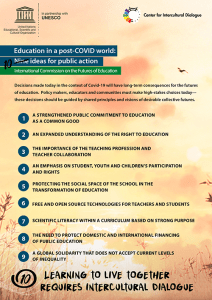
CID Poster 14: 10 IdeasThis Center was one of the organizations consulted; see the report of our conclusions. Basically we argued for including intercultural dialogue as one of their goals. The final UNESCO report, Reimagining our Futures Together, is available as well by now.

The UNESCO International Forum on the Futures of Education 2024 provides an opportunity to continue framing, inspiring and reinvigorating global dynamics to remain publicly and politically active around the urgency to renew education to transform the future.

Objectives

  • To exchange and share contextualized experiences in innovative policy, practice and research to transform education in line with the recommendations of the 2021 report of the International Commission on the Futures of Education.
  • To provide a platform through which Member States and the global community can strengthen knowledge sharing, peer learning and cooperation in relation to the Futures of Education initiative.

Expected Outcomes

  • Forum Synthesis Report: The Forum Report will synthesize the main insights from the three-day event.
  • Thematic Futures of Education Briefs: The Forum Synthesis Report will be complemented by 10 thematic Futures of Education Briefs, each succinctly encapsulating a framing of the core themes serving as the focus of the parallel sessions. Insights gleaned from the contextualized experiences and dialogue at the parallel thematic sessions will be integrated into the Briefs, providing a holistic overview of the Forum’s deliberations. The thematic Futures of Education Briefs will serve as a knowledge-sharing resource to a wider range of education practitioners, researchers and policy makers beyond the participants of the Forum.

UNESCO: Programme Specialist Education (France)

“JobProgramme Specialist (Education), Education Sector, UNESCO, Paris, France. Deadline: 5 August 2024.

Under the overall authority of the Assistant Director-General for Education (ADG/ED), the guidance from the Director of the Division for Peace and Sustainable Development and the direct supervision from the Chief of Section of Global Citizenship and Peace Education, the incumbent will serve as Programme Specialist for UNESCO’s activities on global citizenship, peace and human rights education. Further, s/he will ensure the development and delivery of a wide spectrum of activities and projects in line with the established priorities of the Section. S/he will coordinate UNESCO’s follow-up efforts to the adoption of the Recommendation on Education for Peace, Human Rights and Sustainable Development (2023), oversee the reporting process on the Recommendation and related monitoring activities, and advise and support countries in their implementation efforts, notably as concerns educational planning. This can include designing and coordinating research and developing policy guidance documents and briefs with a variety of internal and external partners, individual experts and institutions. S/he will mobilize resources to support the Section’s work plan through the preparation of project proposals (draft and budget), cooperation frameworks, and negotiation with funding entities. S/He will develop and sustain productive partnerships that expand the visibility and reach of UNESCO’s work in this area.

UNESCO: National Programme Officer (multiple countries)

“JobNational Programme Officer, Social and Human Sciences Sector, UNESCO, Paris, France (but positions are based in  multiple countries). Deadline: varies.

Multiple positions available in different countries:

Sri Lanka, deadline: 8 July 2024. Must be a national of Sri Lanka.

Interventions for this project will be guided by the data for Sri Lanka from UNESCO’s Framework for Enabling Intercultural Dialogue which shows that whilst many of the preconditions for intercultural dialogue to thrive towards peacebuilding objectives are strong in the country, comparing favourably to the world average – including horizontal equality, freedom of expression, and governance and citizenship – challenges remain in critical areas, including as relates to inclusion and representation, social cohesion, and to a lesser extent leadership and organization.

Tashkent, Uzbekistan, deadline 5 July 2024. Must be a national of Uzbekistan.

Quito, Ecuador, deadline 8 July 2024. Must be a national of Ecuador.

The focus of the Social and Human Sciences Sector (SHS) at UNESCO is to foster inclusive societies and economies, and to ensure the ethical development of emerging technologies, including of Artificial Intelligence (AI). In November 2021, UNESCO’s Member States adopted the Recommendation on the Ethics of AI, a global standard aimed at leveraging the positive impact of AI while addressing its inherent risks. Getting AI governance right is one of the most consequential challenges of our time, and countries around the world are now in the process of implementing the Recommendation, with UNESCO supporting them through various capacity-building efforts. In addition, SHS strives to accomplish its fundamental humanist mission that calls for enhancing the efforts against racism and discrimination, deploying the power of sports for social inclusion, promoting intercultural dialogue and supporting youth empowerment and gender equality. SHS collaborates with Member States to advance UNESCO’s 2017 Recommendation on Science and Scientific Researchers, focusing on the protection of scientists and enhancing the science-policy nexus via the Management of Social Transformation (MOST) programme.

UNESCO Internships (Various Locations)

Professional OpportunitiesVarious internships, UNESCO, various locations around the world. Deadlines: various.

UNESCO offers internships at multiple levels, and in multiple offices around the world. Here are a few examples:

Office of the Director-General Internships
Paris, France, 1-6 months, deadline: 30 June 2024

Under the authority of the Cabinet Coordination Officer, and under the supervision of one of the Director-General’s advisors, the intern will assist the Advisor in preparing files on subjects related to the fields of competency of UNESCO (education, science, culture, social and human sciences and communication). In this way, the intern will gain knowledge of UNESCO’s working environment and operations (including its mandate and cooperation with specialized UN agencies). They will also develop an understanding of UNESCO’s interactions with other international institutions (the United Nations system and the 2030 Agenda).

All Sectors/Bureaus Internships
Headquarters, Field Offices, and Institutes, 1-6 months, deadline: 31 December 2024

An internship with UNESCO will give you experience of the daily working environment of the United Nations specialized agency. You will be working in a team from one of the Programme Sectors or Central Services (the support services) of the Organization, at Headquarters, in one of the Field Offices, or in a Category I Institute. You will be part of a team in which you will be exposed to a range of colleagues, making a meaningful contribution to the work of the team and the Organization. Successful candidates will have the opportunity to improve an array of technical and professional skills in a multi-cultural environment. Interns carry out a variety of tasks, depending on the team in which they are working and the particular needs at the time. Activities will vary depending on the requirements of the assignment, and the specific Terms of Reference and learning objectives will be provided by the supervisor with whom you will be working.

There are also internships available specifically in the Communication and Information Sector, or in the Education Sector.

UNESCO: Programme Specialist (France)

“JobProgramme Specialist, Social and Human Sciences Sector, UNESCO, Paris, France. Deadline: 13 June 2024.

Under the overall authority of the Assistant Director-General for Social and Human Sciences Sector (ADG/SHS), strategic guidance from the Director for Research, Ethics and Inclusion and direct supervision of the Chief of Inclusion, Rights, and Intercultural Dialogue Section, the Programme Specialist is responsible for analyzing, implementing and monitoring projects and activities within the inclusion, rights and intercultural dialogue Section, leading work to promote dialogue for social cohesion, resilience, accountability, civic empowerment and conflict transformation; and contributing to work to enhance social and gender inclusion through the empowerment of vulnerable and marginalised communities and the fight against racism and discrimination.

The incumbent, working within the frameworks of UNESCO’s Medium Term Strategy (C/4), the approved Programme and Budget (C/5) and global development plans such as the 2030 Agenda for Sustainable Development, will guide the technical development of sectional, cross-sectional and divisional projects and activities, financed by core and voluntary funding; provide recommendations on project feasibility and possible collaborations; engage with substantive developments in relevant technical fields; and manage relationships with key internal and external stakeholders to provide expert technical advice.

UNESCO Youth Eyes on the Silk Roads Photo Contest 2024

Photo ContestYouth Eyes on the Silk Roads Photo Contest, UNESCO, Paris, France. Deadline: 14 July 2024.

The annual Youth Eyes on the Silk Roads International Photo Contest offers an exciting opportunity for young people from all over the world to capture their understanding of the shared heritage of the Silk Roads through the lens of their camera. As the visual arts, and in particular photography, are so often used by today’s youth as a powerful tool for communication and self-expression, images have the potential to play a significant role in raising awareness of the key issues facing our contemporary world and help promote peace and understanding. The photo contest provides an opportunity for young people to connect with one another in a digital space and share their creativity and vision for our future.

Organized within the framework of the UNESCO Silk Roads Programme, and in line with the objectives of the UNESCO Youth Programme, by UNESCO’s Social and Human Sciences Sector, the 2024 edition of the Youth Eyes on the Silk Roads photo contest is open for entries from 2 May to 14 July 2024. The Silk Roads are an expansive region composed of a network of maritime and land routes. Originating in East Asia, South Asia, and Southeast Asia the Silk Roads cross the Central Asian sub-continent, the Russian steppe, the Iranian and Anatolian plateaus, and the Arabian Peninsula. They also stretch through North Africa and Northeast Africa, from Tanzania to Morocco. Additionally, they pass through Eastern and Southern Europe, before reaching France and the Iberian Peninsula.

The Youth Eyes on the Silk Roads Photo Contest is an opportunity for young people who live or have travelled within these regions to share their perceptions and further their understanding of the common cultural heritage and pluralistic identities emerging from the interactions and exchanges taking place along the Silk Roads. The contest encourages the use of photography to extend these cultural interactions and encounters in the contemporary world, to foster mutual understanding and promote peace amongst the diverse populations encompassed by the Silk Roads.

The contest is divided into two age categories: 14-17 year olds, and 18-25 year olds. For the 6th edition of the contest this year participants are invited to submit their photographs that best encapsulate the shared heritage of the Silk Roads the theme of “Life Celebrations”. The Selection Committee members will then examine these submissions and select the winners from each of the age categories. Examples of some of the very best photographs from the previous contests can be found here.

First place winners will receive a professional camera. Second place winners will receive a semi-professional camera, and the prize for third place will be a standard-model digital camera. Around 60 of the best photos from the contest will appear in a professional photo album “Youth Lens on the Silk Roads” and might be showcased in exhibitions held worldwide.

UNESCO International Forum on the Futures of Education 2024 (Republic of Korea)

EventsUNESCO International Forum on the Futures of Education, Suwon – Gyeonggido, Republic of Korea, 2-4 December 2024.

(So far, very little information is available describing this event, beyond the announcement of the date, and that it will be in person rather than online. What has been published is information about what has led to the event.)

In November 2021, the International Commission on the Futures of Education issued a report titled “Reimagining our futures together: A new social contract for education” following a two-year worldwide consultation and reflection facilitated by UNESCO. This Center was one of the organizations consulted; see the report of our conclusions. Basically we argued that they needed to include intercultural dialogue as one of their goals.

CID Poster 14: 10 Ideas

The full UNESCO report, Reimagining our Futures Together, is available as well.

6th World Forum on Intercultural Dialogue (Azerbaijan)

Events6th World Forum on Intercultural dialogue, Baku, Azerbaijan, 1-3 May 2024.

The 6th World Forum on Intercultural Dialogue, operating under the theme “Dialogue for Peace and Global Security: Cooperation and Interconnectivity,” is being held in Baku, Azerbaijan, co-sponsored by the government of Azerbaijan, UNESCO, UNAOC, and other organizations. The primary objective is to explore the critical intersections between dialogue facilitation, cooperative frameworks, leadership efficacy, and the complex dynamics of interconnectedness, all in the service of advancing global peace and security. A number of the panels are being recorded, and are being made available on UN Web TV.

Wendy Leeds-Hurwitz participated in the first of these World Forums, and wrote about it at the time, including photos.