New Europe College IAS: Fellowships 2025-26 (Romania)

FellowshipsFellowships, Institute for Advanced Study, New Europe College, Bucharest, Romania. Deadline: 10 January 2025.

New Europe College – Institute for Advanced Study in Bucharest (Romania) launches the annual competition for the 2025/2026 NEC Fellowships. Romanian and international postdoctoral scholars in all fields of the humanities and social sciences (including law and economics) are invited to apply. About 20 – 25 fellowships are available.

What they offer: A monthly stipend of 850 Euros (tax free); accommodation in Bucharest, comprising living quarters and working space; reimbursement of travel costs from the home/residence country to Bucharest and back. Depending on the program, fellows are offered a lump sum for a research trip to an institution of their choice. Fellows have free access to the NEC library and electronic resources.

What they expect: Fellows are expected to work on their projects and take part in the scientific events organized by NEC; presence at the weekly seminars discussing the progress of the Fellows’ work is compulsory. At the end of their Fellowship, Fellows are expected to hand in a research paper, reflecting the results of their work over the duration of the Fellowship. The papers will be included in the NEC yearbook.

Eligibility: NEC Fellowships are open to postdoctoral level scholars, Romanian and international, in all fields of the humanities and social sciences.

Duration: For Romanian citizens: a full academic year (10 months, starting in October 2025); for non-Romanian citizens: a full academic year or one term (5 months, starting in October 2025 or March 2026).

Video Exhibition: Roma for Romania (Romania)

Applied ICD

Marica, Irina. (2 November 2023). Roma personalities in focus at Bucharest subway exhibition. Romania Insider.

The subway in Bucharest hosts this month a special video exhibition dedicated to outstanding personalities of the Roma culture. A total of 11 short videos about each personality are set to run on screens in subway stations until November 30.

The video exhibition aims to change mindsets, reduce stereotypes in Romanian society as a whole and contribute to the development of intercultural dialogue.

Some of the personalities included in the project are jazz singer Anca Parghel (1957-2008), violinist Ion Voicu (1923-1997), artist Anton Pann (1790-1854), footballer Bănel Nicoliță (born 1985), musician Barbu Lăutaru (1780-1858), singer Connect-R (born 1982), and actress Alina Șerban born 1987).

The exhibition is part of the “Roma for Romania” campaign, which the National Agency for Roma, the National Center for Roma Culture – Romano Kher and the “Pro-Europa” Roma Party Association have been running since April 2023.

CFP Multicultural Discourses (Romania but Online)

ConferencesCall for papers: 7th International Conference on Multicultural Discourses: Multicultural Discourses in a Turbulent World, Cluj-Napoca, Romania, October 24-26, 2020. Deadline: September 1, 2020.

UPDATE: Due to COVID-19, the submission deadline has been extended, and the conference will be held online.

The successful international conferences on Multicultural Discourses organized in China, Brazil, and the Netherlands, respectively, have reinforced the importance of Cultural Discourse Studies in contemporary social science and the humanities. The 7th International Conference on Multicultural Discourses, under auspices of the International Association of Multicultural Discourses, will be co-organized by the English Department of the Faculty of Letters, Babeş-Bolyai University, Cluj-Napoca, Romania and the School of Contemporary Chinese Communication Studies, Hangzhou Normal University, China. The event will be hosted at the Faculty of Letters, Babes-Bolyai University in Cluj-Napoca, Romania from October 24-26, 2020.

Mankind is witnessing yet again the centennial moment of global transformation and the world is ridden with grave challenges and great opportunities. To answer to these uncertain winds of change, scholars from various fields such as communication, media, language, literature, society, culture, international relations, etc. are encouraged to offer their insights into topics including, though not restricted to, the following:

  • Multicultural discourses of (anti)globalization, diversity, connectivity, globalism
  • Multicultural discourses of security, conflict, war, peace
  • Multicultural discourses of protectionism, (in)tangible borders, immigration, racism
  • Multicultural discourses of development, the Developing World, the Global South
  • Multicultural digital, multimodal, literary, cinematic discourses
  • Multidisciplinary, multicultural approaches to human discourses

CFP Constructions of Identity (Romania)

ConferencesConstructions of Identity 10, Anniversary Edition: History, Memory, and Accomplishment, October 24-26, 2019, Cluj-Napoca, Romania. Deadline: September 15, 2019.

In 2019 the Faculty of Letters in Cluj and the Department of English proudly celebrate 100 years since professor Petre Grimm took on the position of lecturer of English, marking the beginning of what was to become the Department of English Language and Literature. In the context of a century of English studies in Cluj, under the overarching theme of “History, memory and accomplishment”, papers are invited in the area of English literary and cultural studies, literary theory, linguistics, on the following, but not only, topics:

  • literature and history, a complicated contemporary relationship;
  • histories and anniversaries: morphologies of accomplishment;
  • narratives and archive: memorial modalities;
  • forgotten histories;
  • (cultural) memory, amnesia, and the ethics of remembering and commemoration;
  • historical memory and life-writing;
  • writing (in) the gaps: history, trauma, and the ethics of memory;
  • the translating eye: travel writing and historical memori(es);
  • cultural memory and recovering silenced histories;
  • cultural memory and the ethics of translation;
  • celebrating the past: public sites of memory;
  • new memorial technologies;
  • prospective memory and “archaeologies of the future”;
  • studies of English literature in non-English speaking countries;
  • the study of English, translation, and national literatures;
  • cross-linguistic perspectives on syntactic and semantic issues;
  • challenging syntactic and semantic models;
  • theoretical, general or comparative approaches to interface phenomena;
  • the diachrony of English and other languages;
  • understanding language acquisition;
  • contributions to linguistic typology;
  • pragmatics and oral discourse;
  • monolingual and bilingual speech.

CFP From West to East: Metamorphoses of Discourses in Europe (Romania)

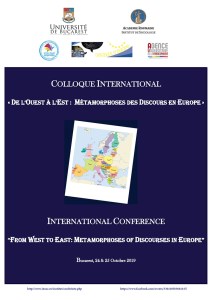
ConferencesCall for Papers: From West to East: Metamorphoses of Discourses in Europe, Bucharest, Romania, 24-25 October 2019. Deadline extended to 26 May 2019.

In a European context marked by the development of antagonistic positions, actors, strategies and discourses, where our interactions have shifted more and more into a virtual environment, this conference aims at questioning the current meanings of the discourses on West-East relationship in the European Union, as well as its transformation, given the local, regional and European contexts and challenges. The scientific interest of the conference aims to revisit the central theme of the European idea which has both brought together and divided for a number of centuries, the different regions of Europe, making possible the European construction of present days. The latter seems to have assumed a sensitive mission of perpetual discursive transformation, again challenged by the new media – an exogenous factor that causes true metamorphoses of European discourses circulating from the West to the East, from the North to the South and vice versa. An emerging discourse, taking various forms, often translated into counter-speech, seems to dominate and challenge the European public sphere under construction. Its scientific examination remains difficult to determine, if studied from the point of view of a single discipline. This is why the interdisciplinary opening within the large field of social sciences and humanities is to be considered the scientific challenge of this conference.

The languages of the conference are French and English, so there are two calls for papers, one in French and one in English.

UPDATE: The conference website now  has programs in both French and English.


CFP Qualitative Research in Communication (Romania)

Conferences3rd International Conference
Qualitative Research in Communication
October 4‐6, 2017 Bucharest, Romania

This conference will explore qualitative research as an approach to social scientific investigation that enriches our understanding of communication and of social phenomena. It will provide a venue for discussing and reflecting upon theories and methods currently used  in qualitative research in communication, as well as trends likely to impact the work being done in this field. The  conference will focus on sharing and examining qualitative research methodologies, research topics, questions and applications, with a consistent emphasis on their potential and limitations as inquiry tools for the study of communication. QRC  is  not, however,  limited to methods, methodologies or theoretical debates on methods; we welcome studies that focus on qualitative research in communication and related fields.

A primary goal of this conference is to provide a stimulating interdisciplinary environment for discussing current collaborations and planning  future  projects. QRC is an opportunity to exchange and expand ideas about the way we use qualitative research in our academic work.

We invite communication scholars and researchers and their colleagues in the humanities and the social  sciences to contribute papers that address the theoretical and methodological aspects of qualitative research or empirical findings supported by qualitative methods and tools.

Papers accepted to this conference can be presented either within one of four sponsored panels, or in the open sessions. The four panels hosted this year by QRC are the following:

1.          Crossing borders, crossing boundaries? ‐ cross‐cultural perspectives in research on age
Panel head: Monika Wilińska, School of Health and Welfare, Jönköping University, Sweden
2.          Communication in inter‐organizational collaboration
Panel head: Marta Najda‐Janoszka, Jagiellonian University in Krakow, Poland
3.          Capturing biographical work
Panel head: Ionela Vlase, “Lucian Blaga” University of Sibiu, Romania
4.          Why Europe? Narratives and Counter‐narratives of European Integration
Special  Panel  organized by  the  ECREA  Temporary  Working  Group “Communication and the European Public Sphere”
Panel head: Alina Bârgăoanu, National University of Political Studies and Public Administration, Romania

Important deadlines
June 30, 2017 abstract submission; July 17, 2017 notification of authors.


CFP European Television and Nations (Romania)

Call for proposals
European television and nations: Between centers and peripheries, 1950-1980
9-10 November 2017, Bucharest, Romania

Since the end of the 2000s, research into television history has
revealed different realities depending on the country (Bignell & Fickers
2008, see also Socialist Television Studies). Far from being limited
to the development of main television (British, German, or French), the
European television landscape seems to have been configured along a
number of dividing lines: the classical divisions (East / West, public
service / commercial TV) overlapped with new dichotomies (North / South (Bourdon 2011), democratic / authoritarian systems (Goddard 2013)).

In order to evaluate the relevance of these taxonomies and to account
for different dynamics which were thus created, our symposium aims at
exploring the less known history of the television referred to here as
peripheral in relation to pre-existing television models (continuing
Wallerstein’s world economy theory, 1974). The symposium is meant to
explore the attraction, imitation and diffusion of practice and content
between central and/or peripheral television. Particular attention will
be given to the period of emergence and development of television
institutions and to the established or presumed relationships between
television operators and national construction.

We are welcoming contributions which will analyze the influence,
convergence or opposition between European television, from different
perspectives:
-television techniques (introduction of color TV, modes of transmission
and recording etc.);
-institutional organization (regulation of relations between political
authorities and public television, recruitment of staff etc.);
-formation or practice of television professionals;
-design of broadcast schedules;
-circulation and possible adaptation of the program formats (fiction or
non-fiction);
-dissemination of national or international content;
-reception of programs by trans-border audiences.

Contributions may also address methodological issues or the problem of
access to television archives, in so far as these issues form the basis
of future research.

Lecturers:
Prof. Jérôme Bourdon, University of Tel Aviv
Géraldine Poels, responsible for scientific development, INA, Paris

The abstracts, in French or English, up to 250 words, are to be sent to
the following e-mail addresses: anne.roekens@unamur.be, romina.surugiu@fjsc.ro, amatei25@yahoo.com, by 10 April 2017. The languages of the symposium will be French and English.

Participation fee: 50 euros.

Organized by CEREFREA Villa Noël and the Faculty of Journalism and Mass Communication of the University of Bucharest within the trilateral Belgium(Wallonie)-Bulgarian-Romanian project “Television and nations in the European semi-periphery: Establishing a national identity through television (1958-1980)”

CFP Beyond Words & Into the Message (Romania)

Beyond Words and into the Message. Building Communication across Languages, Media and Professions
10-Nov-2016 – 11-Nov-2016
Research Centre for Specialised Translation and Intercultural Communication
Bucharest, Romania

Meeting Description:
Our world is basically made up of words, the very essence of communication. These words find their way among us in one big conversation. In James W. Carey’s words: “Life is a conversation”. This holds good even more so when it comes to conveying our thoughts across the borders of language, culture, country and profession. The conversation between individuals on different sides of these borders is enlarged by an instance of otherness while crossing into many instances of translation.

We invite you to discuss these topics in the following sections of the conference:

1) Communication and Language Studies:
The growing need for mediation and communication across cultures for a variety of professionals in a broad range of fields calls for a fresh theoretical framing of practices involving social activities. These are not to be relegated to fixed and separate systems for, in the words of Mahatma Gandhi, “No culture can live if it attempts to be exclusive”.

This section of our conference welcomes papers on topics including, but not limited to:
– Communication theory and theories
– Digital media and online communication
– Professional communication
– Media and education
– Visual and non-verbal communication
– Cross-cultural communication
– Language learning and teaching
– Discourse analysis and applied linguistics
– New trends in linguistics

2) Literature and Cross-Cultural Studies:
“Great literature is simply language charged with meaning to the utmost possible degree.” (Ezra Pound). In one way or another literature has accompanied mankind for thousands of years. The need to tell and listen to stories is inherent to human nature, just as language and cognition are intertwined. Nevertheless, several questions should be addressed, such as: How much have the topics of literature changed and diversified? To what extent has modern narration influenced storytelling? What is its cross-cultural impact on literature?

In order to provide answers these questions (and others) this section welcomes papers on topics including, but not limited to:
– Media and cultural identity
– Postcolonial studies
– Gender studies
– Minority literature
– Literary and political relations in cross-cultures
– Historical approaches to literary studies
– Comparative literature

3) Translation and Interpreting Studies:
In the last two decades, the contribution of translators and interpreters has become essential in the coherent transfer of (specialized) information. Today the concept of translation goes deep beyond the simple knowledge of terminologies and has expanded to cover a wide range of factors, which can only be learned, understood and applied efficiently by means of a thorough academic training.

This section aims at debating over the following areas in connection with the role of translation and interpreting:
– Translating and interpreting as mediating between cultures
– Conference interpreting: trends and developments
– Ethical issues in translation across cultures
– Training and practice in translation and interpreting
– Literary vs. specialized translation: competition or compatibility?
– New media support in translation
– Social network language and its impact on speaking and translating

ProEtnica Intercultural Festival (Romania)

The Centre for Interethnic Youth Education Sighisoara (ibz) together with the Department for Inter-Ethnic Relations present the preliminary programme of the 14th edition of ProEtnica – Intercultural Festival Sighisoara which takes place from August 18 – 21, 2016.

Proetnica 2016

This year’s edition takes place under the patronage of the President of Romania, Klaus Werner Iohannis. There are going to be more than 50 artistic performances on the main stage as well as an arts and crafts fair featuring traditional craftworks manufactured by the national minorities. Further, a fine arts exhibition displays the works from ten contemporary artists belonging to the national minorities and is supplemented by three film screenings addressing the topic of intercultural dialogue.

In times of increased global migration, interethnic dialogue steadily gains importance within international peace negotiations. The ibz decided to dedicate this year’s edition of ProEtnica to the topic of interreligious dialogue. Eight events, i.a. scientific presentations and a symposium, address this subject matter from different perspectives and encourage further discussion on the challenges to intercultural peace in today’s world.

ProEtnica brings together more than 600 representatives of the 20 national minorities in Romania and offers them an opportunity to share their customs and actively engage in intercultural dialogue through different channels, e.g. the arts, scientific research or roundtable discussions. ProEtnica is an instrument which promotes the rights of cultural expression of the national minorities and, at the same time, strengthens cultural dialogue. Thus, ProEtnica contributes to the preservation and creation of the intercultural peace in a pluralistic and democratic society.

The ibz was founded in 2000. Its mission is to promote dialogue and interaction between people to foster mutual understanding and strengthen acceptance of ethnocultural differences.

Preliminary programme of ProEtnica –Intercultural Festival Sighisoara

International Conference on Intercultural Management (Romania)

International Conference on Intercultural Management, Iasi, Romania, 2016

The Conference is organized by the Center for Socio-Economic Studies and Multiculturalism together with “Nutrigrup” Romania Association and other partners. The conference will bring together scholars and practitioners in order to support the dialogue between theory and practice in intercultural management and global leadership. The conference will combine academic and practitioner presentations with workshops. The conference will host 6 keynote speakers. Noted business, academic and community leaders are invited to use the conference as a forum to share their expertise, experience, and research in diverse areas. The conference is aimed at presenting current approaches to intercultural management and global leadership with emphasis on the new challenges for Eastern Europe.

The goals of the conference are:
• To draw attention to the new and important challenges of globalization for Eastern European countries
• To provide scholars, educators, business professionals and practitioners from different countries with opportunities to interact, network and benefit from each other’s research and expertise related to intercultural management and global leadership issues
• To share resources, ideas, and best practices for building intercultural management competence and engage in dialogue on how to tap into the positive sides of cultural diversity , and how companies and institutions can realize its potential.
• To synthesize research perspectives and foster interdisciplinary scholarly dialogues for developing integrated approaches to complex problems of communication and understanding across cultures
• To disseminate through volumes and websites the results of research and practice to other practitioners and professionals in the field of intercultural management
• To educate the general audience on intercultural issues and on the results of research and practice in intercultural management and leadership