SciencesPo: Political Science (France)

“JobAssistant Professor in Political Science, SciencesPo, Paris, France. Deadline: 15 February 2025.

The Centre for International Studies at SciencesPo, Paris, seeks a candidate working on the political and ecological issues of the oceans, seas and coasts, in an innovative way. The environmental issues specific to these areas are at the heart of many situations of violence and conflict, linked to the predation of resources and their entry into trade circuits, which raises both economic and political issues. Possible research topics include, but are not limited to, practices conceptualised as ‘blue grabbing’ to indicate the dispossession of local communities of resources linked to the sea, the struggles and conflicts between protection,
conservation, exploitation and grabbing of maritime and coastal spaces, the politicisation and judicialisation of pollution and contamination issues, as well as the claims and practices of ‘blue justice’, involving a variety of actors: local communities, multinationals, NGOs, national and international public actors and institutions, as well as groups involved in piracy practices.

In methodological terms, the research programme is expected to be based on an expertise in one or more fields (particularly in the global South) as a starting point for comparative reflection. In terms of discipline, the profile is open-ended: in addition to the sub-disciplines of political science (particularly comparative politics and international relations), other social science disciplines inclined to dialogue with political science are welcome, such as anthropology, geography, sociology and history. An interest in interdisciplinary openness towards maritime environmental science disciplines will be considered an asset.

U Southern Denmark: PHD Scholarships in Political Science (Denmark)

“Studentships“3-4 Ph.D. Scholarhips in Political Science, University of Southern Denmark, Odense, Denmark. Deadline: 15 October 2024.

The Department of Political Science and Public Management, University of Southern Denmark invites applications for 3 to 4 PhD scholarships within the research areas political science, public administration, international and regional politics, welfare studies or journalism studies as of January 1, 2025, or as agreed.

As a PhD student, you will be affiliated with one of the department’s three research sections: Public Administration, Welfare and Politics (PAWP), International and Regional Politics (IRP), or Journalism (JOUR). For more information about the department organization, strategy, research, and teaching, please visit the website.

The Public Administration, Welfare and Politics research section is comprised of the two research fields public administration and welfare studies. The scholars focus on various research areas within public management and administration, comparative welfare studies and social policy as well as comparative politics and political economy. The section also provides high-quality, research-based teaching and supervision in the political science study program and the two professional master study programs in public management, and they disseminate research-based knowledge to key stakeholders.

The International and Regional Politics research section consists of the Center for War Studies, the Centre for Border Region Studies, and the Danish Centre for Rural Research. They conduct research on different areas such as contemporary security issues, the changing characteristics of war and the relationship between war and peace; European border regions in the past and present; as well as understanding and improving life in rural areas.

The Journalism research section, consisting of the Centre for Journalism, is centered around two joined research networks; one is focused on rhetoric and journalistic usage of language, the other on social, societal, and political aspects of journalism. The Centre for Journalism offers both bachelor and graduate degrees in journalism, short-term, mid-career courses for journalists, and trains doctoral students.

U Oslo: PHD Research Fellowships in Political Science (Norway)

“Studentships“1-3 Ph.D. Research Fellowships in Political Science, University of Oslo, Oslo, Norway. Deadline: 1 September 2024.

The Department of Political Science is recruiting 1-3 Ph.D. Research Fellows. They invite applications from excellent candidates in all sub-fields of political science, including public policy and administration, comparative politics, political theory, international relations and research methods. The appointment is for a fixed, non-tenured term of 4 years, and has a 25% teaching component. The Department teaches in all the sub-fields mentioned above, and directs study programmes in Political Science, Peace and Conflict Studies, International Studies, and Public Administration and Leadership. The successful candidate will be part of the Faculty’s PhD programme. The work is expected to lead to a PhD in political science.

CFP Hellenic Conference of Political Science (Greece)

ConferencesCall for Papers, International Hellenic Conference of Political Science: New Challenges, New Answers (HEPO2019), 17-20 April 2019, Athens, Greece. Deadline: 12 March 2018.

HEPO 2019

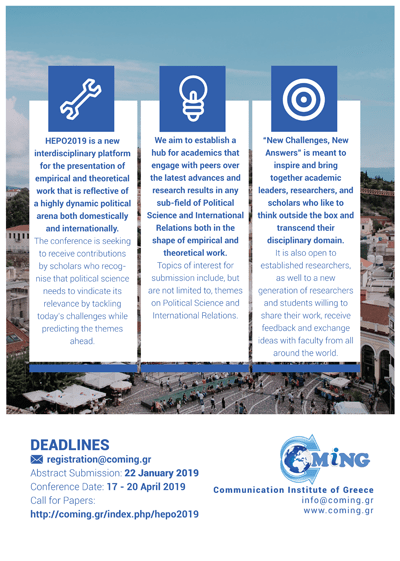
The International Hellenic conference of political science: New Challenges, New Answers (HEPO2019) is a new interdisciplinary platform for the presentation of empirical and theoretical work that is reflective of a highly dynamic political arena both domestically and internationally. The conference is seeking to receive contributions by scholars who recognise that political science needs to vindicate its relevance by tackling today’s challenges while predicting the themes ahead. We aim to establish a hub for academics that engage with peers over the latest advances and research results in any sub-field of Political Science and International Relations both in the shape of empirical and theoretical work. The theme of the conference is meant to inspire and bring together academic leaders, researchers, and scholars who like to think outside the box and transcend their disciplinary domain. While offering a forum to established academics we also like to see proposals from a new generation of researchers as well as outstanding research students who like to share their work, receive feedback and exchange ideas with faculty from all around the world.

Pontifical Catholic U Job: International Relations (Chile)

Job adsAssistant or Associate Professor in International RelationsPontifical Catholic University of Chile – The Institute of Political Science, Closes: November 1, 2017

The Institute of Political Science (ICP) of the Pontificia Universidad Católica de Chile invites applications for a full-time tenure-track position (Assistant or Associate Professor) in International Relations. The University strongly values diversity and we encourage members of all nationalities and backgrounds to apply.

The ICP is among the highest ranked political science departments in Latin America.  Comprised of a highly international group of scholars, it is a hub of theoretical, empirical and applied research in the region. The ICP offers undergraduate, M.A. and Ph.D. programs. It admits the most talented Chilean students to its undergraduate and graduate programs, and hosts a large number of exchange students and a steady stream of visiting professors from all over the world.  Santiago is a vibrant metropolitan area and a short drive from Chile’s renowned pacific coast and spectacular Andean mountain range.

Applicants must demonstrate a strong commitment to high quality research, publication and teaching.  Teaching obligations are limited to three courses per year.  Fluency in Spanish is valued, but candidates who express the willingness to perfect basic proficiency are encouraged to apply. The ICP offers financial support for language classes and courses may initially be taught in English.

CFP Internet Governance in China

Call for papers
China Perspectives / Perspectives Chinoises: Special Feature on Internet Governance in China
Deadline for proposals: 31 July 2014

Edited by Séverine Arsène, Ph.D.
chief editor of China Perspectives

The exponential increase of Internet connectivity in China has generated a great deal of journalistic and scholarly works, which have essentially documented the emergence of the Internet as an unprecedented, though censored, platform for public expression. Analyses have focused on the emergence of online public opinion, youth popular cultures, online dissent and civil society organizations, as well as their interactions with the authorities and the media. Much attention has been paid to censorship and propaganda.

Much less is known, however, about the more diversified forms of power that are embedded in Internet governance, broadly conceived as the incremental conception, implementation, regulation, management and uses of Internet networks and services. Political positions and ideological visions are embedded in technological choices, from the layout of physical networks and routers to the development of applications like search engines or expression platforms. The crafting, implementation and interpretation of regulatory measures are also of crucial importance in framing the users’ agency, and so do business models, funding or pricing issues among other aspects.

These issues are not only in the hands of central and local governments, but also of a variety of more or less independent agencies like registrars, self-regulation associations, private companies, individual developers and hackers. Users, either individually or collectively, also contribute to building the characteristics of the Chinese Internet, as they may adopt or not online services, complain about particular features or even use them in a way that was not foreseen by the developers or regulators. In other words, these various aspects of Internet governance offer insights on the complex and often ambiguous (power) relationships between the local and central government, private actors and Chinese citizens.

It is all the more important to further document these aspects as China has become more assertive on the global stage, and now strives to push Chinese interests through technological standards, economic and cultural domination and global Internet governance schemes. As a result, Chinese positions carry increasing weight on such global issues as net neutrality, copyright, privacy, or freedom of speech, to mention but a few.

China Perspectives  thus plans to publish a special feature on Internet governance in China, which will cover these aspects from a multidisciplinary perspective, including law, political science, political economy, political sociology, communication, or international relations.

Contributions are welcome on such topics as:
– the political and ideological foundations of Internet development in China
– the political stakes of technological choices
– the central / local relationship within the Chinese administration and Internet service providers
– the role of businesses
– the political economy of the Internet in China
– the motivations and stakes of the Chinese positions on global Internet governance
– innovative usage of Internet services, apps etc.
– the maker / hacker movement and its role in the development of the Chinese Internet
(list not exhaustive)

In conformity with China Perspectives‘ editorial policy, papers should be rigorous, original contributions to their respective disciplines, while providing readable insights on contemporary China for the general public and scholars from other scientific backgrounds. Submissions are particularly welcome from researchers at an early stage of their careers.

Format of submissions:
Full name, title and institutional affiliation
Contact details
800-1000 words abstract

Submissions must be sent to Séverine Arsène. Upon acceptation, full papers of 8000 words shall be written according to China Perspectives’ Style guide.

Timeline:
31 July 2014: deadline for proposals
15 August 2014: notification of accepted contributions
01 December 2014: deadline for full papers
Expected publication date: Summer 2015

All full papers will need to pass the double blind peer-review process. Final acceptance of papers cannot be confirmed until their validation by both peer-reviewers and the editorial committee.

About the editor:
Séverine Arsène holds a Ph.D in political science from Sciences Po, Paris. Her work focuses on Internet uses and Internet governance in China. She is currently a researcher at CEFC and chief editor of China Perspectives. She previously held positions at Georgetown University (Yahoo! Fellow), the University of Lille 3, and France Telecom R&D Beijing.

About the journal:
An interdisciplinary quarterly journal published in both French and English, China Perspectives provides insightful analysis of the latest political, economic, social and cultural trends in the Chinese world. China Perspectives is an anonymously peer-reviewed academic journal. Its authority is ensured by an editorial board made up of reputed scholars. A serious yet readable journal, China Perspectives has already proven essential for sinologists and Asia analysts, but its broad scope and highly informative articles may be of interest to anyone keen on improving their knowledge about Greater China.

About the CEFC:
The French Centre for Research on Contemporary China (CEFC) is a public research centre with a regional remit (Mainland China, Hong Kong, Taiwan,) supported by the French ministry of Foreign Affairs and the CNRS (National Centre for Scientific Research).

[Original publication: China Perspectives website]