Ping Yang holds a PhD in Linguistics from Macquarie University in Australia, and is Senior Lecturer in the School of Humanities and Communication Arts at Western Sydney University.
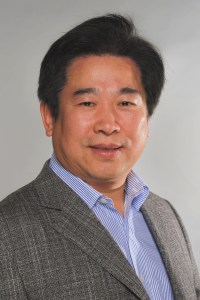
His teaching and research areas of expertise are intercultural verbal and nonverbal communication, socio-cultural linguistics, educational linguistics, TESOL teacher education, and translation studies. He also publishes and supervises PhD candidates in these areas.
Dr. Yang is an associate editor of international peer-reviewed journals, such as SAGE Open, Current Trends in Translation Teaching and Learning E and Humanities & Social Sciences Communications. He is an editorial board member of Australian Review of Applied Linguistics and English Language Teaching. He has been invited to peer-review book manuscripts for world-renowned publishers, including Routledge, SAGE, and Springer Nature. He is also an internationally recognised reviewer for many peer-reviewed journals of different disciplines. See details at https://orcid.org/0000-0002-3646-438X.
Selected publications:
Yang, P. (2024). Interpreting ethics in crisis in the conflict zones: A focus on the Afghanistan War. In C. J. M. Declercq & K. Kerremans (Eds.), The Routledge handbook of translation, interpreting and crisis (pp. 187-199). Routledge. https://doi.org/10.4324/9781003207580-16
Susilo, A., Yang, P., & Qi, R. (2023). Developing critical intercultural awareness through video clip-assisted intercultural tasks. Higher Education Pedagogies, 8(1).
https://doi.org/10.1080/23752696.2023.2235337
Yang, P. (2022). Co-constructing intercultural identity in the work-integrated learning: Pre-service TESOL teachers’ professional development. In K. Sadeghi & F. Ghaderi (Eds.), Theory and practice in second language teacher identity: Researching, theorising and enacting (pp. 121-135). Cham, Switzerland: Springer International Publishing. https://doi.org/10.1007/978-3-031-13161-5_9
Yang, P. (2020). Intercultural responsiveness: Learning languages other than English and developing intercultural communication competence. Languages, 5(2), 1-13.
https://doi.org/10.3390/languages5020024
Yang, P. (2020). Informal learning: Approaching Chinese language and culture in authentic contexts. In M. Tian, F. Dervin, & G. Lu (Eds.), Academic experiences of international students in Chinese higher education (pp. 101-124). New York: Routledge.
https://doi.org/10.4324/9781003026143-7
Alkhlaifat, E., Yang, P., & Moustakim, M. (2020). Code-switching between Arabic and English in Jordanian GP consultations. Crossroads: A Journal of English Studies, 30(3), 4-22.
https://doi.org/10.15290/CR.2020.30.3.01
Yang, P. (2019). Intercultural dialogue as constructive and positive communication: From intercultural communication to global peacebuilding. In P. Samuel (Ed.), Intercultural and interfaith dialogues for global peacebuilding and stability (pp. 30-49). IGI Global.
https://doi.org/10.4018/978-1-5225-7585-6.ch002
Yang, P. (2016). Intercultural communication between East and West: Implications for students on study abroad programs to China. In D. M. Velliaris & D. Coleman-George (Eds.), Handbook of research on study abroad programs and outbound mobility (pp. 755-777). Hershey, PA: IGI Global. https://doi.org/10.4018/978-1-5225-0169-5.ch030
Yang, P. (2010). Managing miànzi (face) in Mandarin Chinese talk-in-interaction: A nonverbal perspective. Semiotica, 181(1/4), 179-223. https://doi.org/10.1515/semi.2010.041
Work for CID:
Ping Yang is the author of KC112: Intercultural Nonverbal Communication and is participating in an expert group organized by the Center. He also has served as a reviewer of translations into Simplified Chinese.

 The next issue of Key Concepts in intercultural Dialogue is now available. This is KC112: Intercultural Nonverbal Communication, by Ping Yang. Click on the thumbnail to download the PDF. Lists organized chronologically by publication date and number, alphabetically by concept in English, and by languages into which they have been translated, are available, as is a page of acknowledgments with the names of all authors, translators, and reviewers.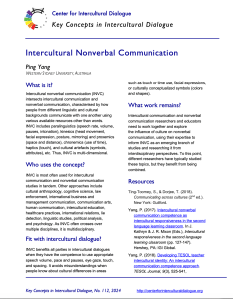

 Center for Intercultural Dialogue