Call for papers: Two overlapping conferences, Communication Institute of Greece (COMinG), Athens, Greece. Deadline: 14 March 2023 (may be extended – will be revised on this post if so).
The (SCOPUS/ISI) GLOCAL COMELA 2022 theme, ‘Bounded Languages … Unbounded,’ encapsulates the ongoing struggle throughout Mediterranean and European regions. As tensions between demarcation and legitimization of languages, language ideologies, and language identities, enter a new era, flexible citizenship now operates well within, and not only across, language communities, to unbind languages, and to create new boundaries, unlike those ever seen throughout history.
The (SCOPUS/ISI) GLOCAL COMELA 2022 invites work which addresses the shifting boundedness of Language Communities of The Mediterranean and Europe. Papers and posters should acknowledge and describe processes of language shape, change, and ideology, pertinent to social, cultural, and political histories and futures, of Mediterranean and European regions.
Presenters must register before July 13, 2022 to guarantee a place in the program.
Call for papers: Two overlapping conferences, Communication Institute of Greece (COMinG), 2022, Greece but online. Deadline for both has been revised: 1 August 2022.
This workshop will demonstrate how teaching literature in the foreign language classroom can provide a platform for students to start a dialogue over a contentious subject that they would not approach otherwise. Examples will be presented from francophone literature alongside their translations. The workshop will run in English.
Led by the Vice-president of Research and Academic Affairs of the Communication Institute of Greece and Associate Professor in Education UCL Institute of Education University of London, UK, Dr. Fotini Diamantidaki.
Theme – Bounded Languages … Unbounded / Περιορισμένες Γλώσσες … Απεριόριστες, a theme highly pertinent to Europe and Mediterranean at the current time, encapsulates the ongoing struggle throughout Mediterranean and European regions. As the continuous tension between demarcation, and the concurrent legitimization, of languages, language ideologies, and language identities, enters an era where new modes of interactivity require language communities to take on roles superordinate to the past, flexible citizenship now operates within, and not only across, language communities, to unbind languages, and to create new boundaries, unlike those ever seen throughout history.
Over 450 scholars globally will gather to present papers and to engage in progressive discussion on the Linguistic Anthropology, Language and Society, Sociolinguistics, and related fields of Europe and Mediterranean. The GLOCAL COMELA is fully Non-Profit, assisting scholars in impeded economic positions, who require funding to access the COMELA Conference, and who display strong ability in their work. GLOCAL COMELA proceedings are SCOPUS / ISI (AHCI / SSCI / CPCi) indexed and contribute to ranked and cited publications for all those accepted to present. The GLOCAL COMELA publishes papers presented at the GLOCAL COMELA 2021 in Top Tier Journal Publication Special Issues.
Call for papers: Three conferences, Communication Institute of Greece (COMinG), August 2021, both online and face-to-face in Athens, Greece. Deadline for all: 16 March 2021.
The International Conference on Multilingualism officially launches the first annual meeting of professionals and the general public, with an interest in both bilingualism and multilingualism. It aims to bring together leading authors, influencers, scientists, academics, and educators who focus on research and methods, as well as the benefits and the pitfalls of raising bilingual and multilingual children.
The Exelixis Institute, an NGO working with youth in Greece, and the Embassy of Norway in Greece joined together to create and distribute a pseudo-drug, Xenophobil, as part of a creative public campaign against xenophobia and racism starting in 2013. Packages are still being distributed in 2019, most recently at the the European Day of Languages celebration held at the Norwegian Embassy in Greece.
NOTE: The video is in Greek, because this is a Greek project.
The main focus of the campaign is to defend the right to diversity and the value of peaceful coexistence. Xenophobil, a “drug” that relieves the symptoms of xenophobia and treats patients with a satirical recipe which makes everybody smile while reading the leaflet and tasting the sweet chewing gum, has been distributed by the thousands.
Excerpt from the pamphlet in the box:
“Xenophobic Symptoms”:
* Patients consider civilizations and cultures as fixed entities that cannot be changed evaluating their own culture as the most important of the scale and underestimating the other cultures.
* Patients translate the term “immigrant” into the term “outsider”.
* Patients’ behavior toward the others depends on the predefined characteristics, due to his/hers religion, culture or mentality.
* Patients have the tendency to idealize their own image.

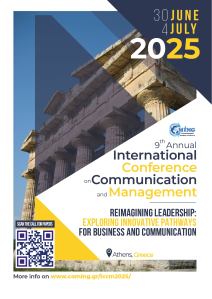 The 9th International Conference on Communication and Management (ICCM2025), Reimagining Leadership: Exploring Innovative Pathways For Business and Communication, 30 June – 4 July 2025, in Athens, Greece.
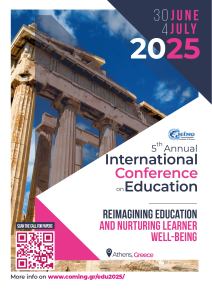 The 5th International Conference on Education (EDU2025), Reimagining Education and Nurturing Learner Wellbeing, 30 June – 04 July 2025, in Athens, Greece.
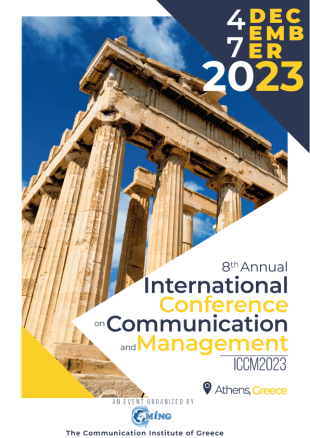 The
The 


 Center for Intercultural Dialogue