CFP UNESCO Futures of Education Ideas LAB

“UNESCO”
Call for short think pieces on What will shape the future of international cooperation for education? for the Futures of Education Ideas LAB, UNESCO. Deadline: 10 November 2025.

UNESCO’s Futures of Education IdeasLAB invites short think pieces (1500 words maximum) that reimagine, interrogate and analyze recent changes in global governance, multilateralism and international cooperation in education. They welcome contributions from all who engage with governance or education – including researchers, policy-makers, futures thinkers, public servants, private sector actors, educators, youth and civil society.

Multilateralism is in a moment of deep transition. The international system that optimistically pledged its commitments to ‘Education for All’ in 1990 appears less recognizable today. The frameworks and shared vision that once provided firm foundations for international cooperation in education have frayed, and in mid-2025 they appear more fragile than in past decades. At the same time, new imaginaries and solidarities offer opportunities to reimagine multilateralism, international cooperation and governance at all levels. How can we think about this present moment? What has changed, and what trajectories – both promising and perilous – appear ahead?

NOTE: The Center for Intercultural Dialogue held focus groups as part of the information gathering stage of the Futures of Education project, preparing what we learned as a report for UNESCO, in 2021.

Article about UNESCO Futures of Education 2025

“UNESCO”

Fritsch, W., Werkstetter Caravaca, A., Berger, T., & Waldow, F. (2024). Why and how they listen: on the (im) possibility of inclusion in the global governance of education. Globalisation, Societies and Education, 1-13. (open access)

Abstract: “International Organisations in the field of education face increasing demands for greater inclusivity by and of those affected by their work. IOs respond by carrying out various forms of consultations in order to maintain their legitimacy, which leads to tensions with the largely expert-driven, ‘technocratic’ mode of operation of most IOs and potentially disrupts their organisational coherence and identity. This paper examines how UNESCO and OECD navigate this tension in two recent landmark initiatives: UNESCO’s Futures of Education (2019–2022) and OECD’s Future of Education and Skills 2030 (2015-present). We argue that IOs favour ‘additive’ over ‘disruptive’ inclusion to maintain organisational coherence, raising questions about the possibility of ‘disruptive’ inclusion within global governance.”

For the purposes of this paper, we distinguish between two kinds of inclusion, which we call ‘additive’ and ‘disruptive’ inclusion, respectively . . . In processes
of additive inclusion, previously excluded actors are brought into the central narrative (as disseminated e.g. through landmark reports), yet their substantive position(s) do not substantially alter the vision of the future of education promoted by the report. . .

In contrast, disruptive forms of inclusion link the inclusion of previously excluded actors to substantial
revisions of dominant understandings of education. . .

In the cases we studied here, additive inclusion proceeded without the realisation of a disruptive agenda.

NOTE: The Center for Intercultural Dialogue held focus groups as part of the information gathering stage of the Futures of Education project, preparing what we learned as a report for UNESCO, in 2021.


Update: UNESCO International Forum on the Futures of Education 2024 (Republic of Korea)

EventsUpdate: Renewing Education to Transform the Future: UNESCO International Forum on the Futures of Education, Suwon, Gyeonggido, Republic of Korea, 2-4 December 2024.

In November 2021, the International Commission on the Futures of Education issued a report titled “Reimagining our futures together: A new social contract for education” following a two-year worldwide consultation and reflection facilitated by UNESCO.

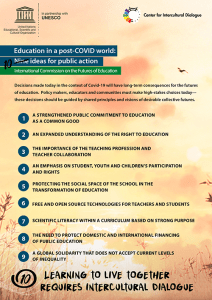
CID Poster 14: 10 IdeasThis Center was one of the organizations consulted; see the report of our conclusions. Basically we argued for including intercultural dialogue as one of their goals. The final UNESCO report, Reimagining our Futures Together, is available as well by now.

The UNESCO International Forum on the Futures of Education 2024 provides an opportunity to continue framing, inspiring and reinvigorating global dynamics to remain publicly and politically active around the urgency to renew education to transform the future.

Objectives

  • To exchange and share contextualized experiences in innovative policy, practice and research to transform education in line with the recommendations of the 2021 report of the International Commission on the Futures of Education.
  • To provide a platform through which Member States and the global community can strengthen knowledge sharing, peer learning and cooperation in relation to the Futures of Education initiative.

Expected Outcomes

  • Forum Synthesis Report: The Forum Report will synthesize the main insights from the three-day event.
  • Thematic Futures of Education Briefs: The Forum Synthesis Report will be complemented by 10 thematic Futures of Education Briefs, each succinctly encapsulating a framing of the core themes serving as the focus of the parallel sessions. Insights gleaned from the contextualized experiences and dialogue at the parallel thematic sessions will be integrated into the Briefs, providing a holistic overview of the Forum’s deliberations. The thematic Futures of Education Briefs will serve as a knowledge-sharing resource to a wider range of education practitioners, researchers and policy makers beyond the participants of the Forum.

UNESCO International Forum on the Futures of Education 2024 (Republic of Korea)

EventsUNESCO International Forum on the Futures of Education, Suwon – Gyeonggido, Republic of Korea, 2-4 December 2024.

(So far, very little information is available describing this event, beyond the announcement of the date, and that it will be in person rather than online. What has been published is information about what has led to the event.)

In November 2021, the International Commission on the Futures of Education issued a report titled “Reimagining our futures together: A new social contract for education” following a two-year worldwide consultation and reflection facilitated by UNESCO. This Center was one of the organizations consulted; see the report of our conclusions. Basically we argued that they needed to include intercultural dialogue as one of their goals.

CID Poster 14: 10 Ideas

The full UNESCO report, Reimagining our Futures Together, is available as well.

UNESCO Futures of Education Update

“UNESCO”

Negotiating the Future of Education: The UNESCO’s Futures of Education-initiative and the OECD’s Future of Education and Skills 2030-initiative, Humboldt University, Berlin, Germany.

Researchers at Humboldt University (Germany) are studying the entire process of the UNESCO Futures of Education initiative, and they contacted CID to learn more about our involvement in that project. They were interested in our participation for 2 reasons: our focus group was uncommonly diverse, and we proposed a 10th point of action, rather than just discussing the 9 points that the draft proposal outlined. We suggested that

Learning to live together requires intercultural dialogue

and produced a poster showing the relationship between their 9 ideas and our 10th.

Here are further details about the research project:

“In the project “Negotiating the Futures of Education”, we want to analyse how visions of the future of education are negotiated and contested, looking at how narratives about the future of education are constructed by UNESCO and OECD in two currently running projects, Futures of education (UNESCO) and Future of education and skills 2030 (OECD). Our main focus is on understanding the micropolitical “backstage” processes involved in constructing these narratives. We are particularly interested in whether and how formerly marginalized voices and groups are integrated in the process and whether and in which ways these challenge reigning “orthodoxies” in the liberal education script. The project employs a qualitative approach, relying particularly on ethnographic methods, narrative and discourse analysis.”

When the report appears, this post will be updated to include a link.

NOTE: The Center for Intercultural Dialogue held three focus groups as part of the information gathering stage of the Futures of Education project, preparing what we learned as a report for UNESCO, in 2021. A few months later they requested concrete examples from around the world, and we prepared an addendum.

UNESCO: Programme Specialist in Education (France)

“JobProgramme Specialist in Education, UNESCO, Paris, France. Deadline: 28 April 2023.

Under the overall authority of the Assistant Director-General for Education and the direct supervision of the Director of the Future of Learning and Innovation team, the incumbent will be responsible for the Education Research and Foresight programme. Serving as a think tank to reimagine education and leverage knowledge for just and sustainable futures, the Future of Learning and Innovation team comprises three strands of work:

(1) Education research and foresight which aims to shape global policy debate on the future of education;

(2) Technologies and learning which aims to steer human-centered digital transformations in education, and

(3) Knowledge and innovation which aims to encourage interdisciplinary research through university networks.

The incumbent will lead the Education, Research and Foresight programme in close cooperation with the Division’s other two strands of work. Building on a continuous review of research production, an analysis of both global education policy and emerging megatrends, as well as consultations with various constituencies, the Education research and foresight programme reinforces UNESCO’s observatory function in education. Through more synergetic research and foresight, the programme activities aim to strengthen UNESCO’s capacity to guide, inform and lead the global debate on the future of education.

Article about UNESCO Futures of Education

“UNESCO”

Sobe, Noah W. (2022). The future and the past are unevenly distributed: COVID’s educational disruptions and UNESCO’s global reports on educationPaedagogica Historica, DOI: 10.1080/00309230.2022.2112244

“the future is already here – it’s just not very evenly distributed”

Willian Gibson

“For half a century the UN’s principal agency on education, UNESCO, has sought to shape the world’s educational landscape through a once-every-generation global report (e.g. the Faure report of 1972 and the Delors report of 1996). The latest of these reports – the Sahle-Work Commission’s “Reimagining our futures together: A new social contract for education” – was developed and released amidst the COVID-19 pandemic. This article considers the ways the pandemic entered into the production of educational futures – and pasts – in this tradition of UNESCO global reports. It argues that the uneven distribution of pasts and futures is one of the key, already- existing systems of difference that set the stage for a disruptive event like the COVID-19 pandemic.” (Sobe, 2022, p. 1)

“The core of the proposed transformation agenda is the call for building “a new social contract for education” that consists of agreed-upon core principles, a redesign of education on multiple dimensions, and a rethinking of the actions and actors that implement and manage educational institutions, programmes and processes.” (Sobe, 2022, p. 8)

As more than one of the Sahle-Work Commission members has noted, the word “together” is the most important word in the report’s title. (Some, 2022, p. 10)

NOTE: The Center for Intercultural Dialogue held focus groups as part of the information gathering stage of the Futures of Education project, preparing what we learned as a report for UNESCO, in 2021.