During the event, she will share key insights from the book, including:
🔹 A brief overview of Camfranglais
🔹 Why this topic matters now more than ever
🔹 Reflections on language, identity, and belonging in migratory contexts
There will also be time for comments and questions, to connect and discuss this topic.
The Center for Intercultural Dialogue publishes a series of short briefs describing Key Concepts in Intercultural Dialogue. Different people, working in different countries and disciplines, use different vocabulary to describe their interests, yet these terms overlap. Our goal is to provide some of the assumptions and history attached to each concept for those unfamiliar with it. As there are other concepts you would like to see included, send an email to the series editor, Wendy Leeds-Hurwitz. If there are concepts you would like to prepare, provide a brief explanation of why you think the concept is central to the study of intercultural dialogue, and why you are the obvious person to write up that concept.
The Center for Intercultural Dialogue publishes a series of short briefs describing Key Concepts in Intercultural Dialogue. Different people, working in different countries and disciplines, use different vocabulary to describe their interests, yet these terms overlap. Our goal is to provide some of the assumptions and history attached to each concept for those unfamiliar with it. As there are other concepts you would like to see included, send an email to the series editor, Wendy Leeds-Hurwitz. If there are concepts you would like to prepare, provide a brief explanation of why you think the concept is central to the study of intercultural dialogue, and why you are the obvious person to write up that concept.
The Center for Intercultural Dialogue publishes a series of short briefs describing Key Concepts in Intercultural Dialogue. Different people, working in different countries and disciplines, use different vocabulary to describe their interests, yet these terms overlap. Our goal is to provide some of the assumptions and history attached to each concept for those unfamiliar with it. As there are other concepts you would like to see included, send an email. If there are concepts you would like to prepare, provide a brief explanation of why you think the concept is central to the study of intercultural dialogue, and why you are the obvious person to write up that concept.
Constance Mbassi Manga earned her Ph.D. from Lancaster University, UK, and wrote her thesis on Camfranglais in use by diasporic Cameroonians living in Western cities, from a sociolinguistic and ethnographic perspective.
Photo credit: Ewane Nja Kwa
A French native of Cameroonian origin, she was raised multilingual and has been working in the field of language for 30+ years, in various capacities (from working as a freelance translator and interpreter, then heading her own translation agency, and later as a Team Lead/an Account Director in Marketing Communications). Moreover, she spent her childhood in a highly multilingual country (Cameroon, where over 250 languages are spoken), speaking 4 languages (2 African languages, English, French) from birth, learning a 5th (German) from the age of 10. She has always been fascinated by language practices and by the unique and powerful link that people draw between the language(s) they speak and who they are.
In terms of academic study, she was introduced to the study of multilingualism and sociolinguistics during her Masters at Kings College London; her Masters thesis focused on ‘Language Practices of Francophone Cameroonians in London.’ Since that time, she has been interested in language practices of non-European background adults in diasporic contexts, and how these tie in with ideologies of language, home and ‘belonging’.
Selected Publications:
Mbassi Manga, C. (2025). Language, home and belonging in migratory contexts: The case of Camfranglais. London: Routledge. (To be published June 10th, 2025)
Mbassi Manga, C. (2019). A case study of Camfranglais in superdiverse contexts: France, the UK and the USA. In R. Siebetcheu & S. Machetti (Eds.), Le camfranglais dans le monde global Contextes migratoires et perspectives sociolinguistiques (175-191). Paris, France: L’Harmattan.
Work for CID:
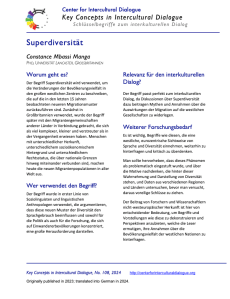
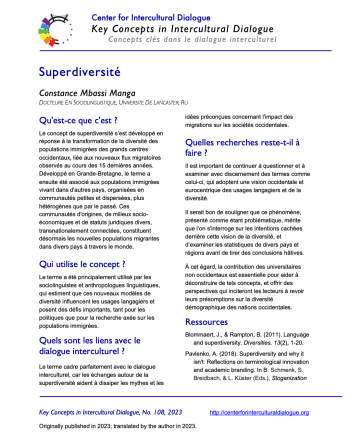
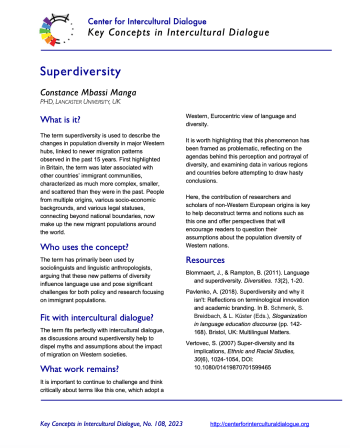
Constance Mbassi Manga is the author of KC108: Superdiversity, has translated that into French, translated KC23: Afrocentricity into French, and also has served as a reviewer for French.

 Constance Mbassi Manga will hold a virtual launch for her new book, Language, Home, and Belonging in Migratory Contexts, on 10 June 2025, at 7 pm GMT+1.



 Center for Intercultural Dialogue