U Pennsylvania: Global Programs Manager (USA)

“Job

Global Programs Manager, University of Pennsylvani, Philadelphia, PA, USA. Deadline: open until filled; posted 13 August 2024.

Reporting to the Senior Global Programs Manager, the Global Programs Manager (GPM) is responsible for the coordination and administration of Penn Abroad’s outbound programming and advising on a portfolio of semester abroad programs. In close collaboration with on-campus academic partners and overseas partners, the GPM administers the student application, selection, and admissions related to the semester abroad portfolio. The GPM coordinates and delivers student advising, outreach, and info sessions for semester abroad, leads student pre-departure programming, and manages student communications and support at all phases of their experience, from pre-departure through their return to campus. With oversight from the Senior Global Programs Manager, this position manages partner engagement and relationships within their assigned portfolio.

Asian Cultural Council: Director of Development & Communications (USA)

“Job

Director of Development and Communications, Asian Cultural Council, New York, NY, USA. Deadline: 31 August 2024.

The Director of Development and Communications will be a member of the Asian Cultural Council (ACC) leadership team, responsible for building, managing, and leading a comprehensive fund development and communications program to ensure ACC’s ongoing success, growth, and sustainability. The successful candidate will focus on developing strong relationships with diverse constituencies to drive major gift commitments from funders and meet ambitious fundraising goals.

The Director will provide the necessary leadership, motivation, and support to identify new opportunities in addition to developing and executing effective cultivation and solicitation strategies for existing funders. He/she/they are responsible for raising a minimum of $2 million in philanthropy support annually—and increasing that goal exponentially over time—in addition to an ongoing endowment campaign ($20 million goal with $11 million raised to date) and other special initiatives.

The Asian Cultural Council (ACC) advances international dialogue, understanding, and respect through cultural exchange activities in Asia and the United States to create a more harmonious and peaceful world. The mission is accomplished through fellowships and other programs that support individual artists, scholars, and arts professionals. Established by John D. Rockefeller, 3rd in 1963 as the Asian Cultural Program of the JDR 3rd Fund to support cultural exchanges between Asia and the U.S. through grants to individuals and organizations working in the visual and performing arts, ACC incorporated as a 501(c)(3) not-for-profit in 1980. Since then, ACC has enabled more than $100 million in grants to support cultural exchange. To date, ACC has supported nearly 6,000 exchanges across 26 countries and regions in 16 artistic disciplines.

ICA25 Regional Hub Application

ConferencesCall for proposals: ICA25 Regional Hub Application. Deadline: 30 August 2024.

In conjunction with ICA’s 75th Annual Conference on 12-16 June 2025 in Denver, Colorado (USA), the organization welcomes proposals for ICA Regional Hubs worldwide to host events concurrent with the annual ICA conference.  While there is no substitute for an in-person experience at an ICA conference, they recognize that a significant and growing proportion of current and potential ICA membership resides in the Global South, making travel to in-person attendance inaccessible due to fiscal, political, environmental, health, and other hurdles.

In response to these concerns, ICA’s Regional Hubs Initiative offers a window into ICA – its community and scholarship. The Regional Hubs also provide communication scholars in various Regions around the world an opportunity to foster community and build intellectual networks. It reflects ICA’s commitment to welcome and support a broader global community of communication scholars. Since its inception at the virtual ICA 2021 and continuing at the hybrid conferences in ICA22, ICA23, and ICA24, each year, around 10 ICA Regional Hubs have been hosted.

Regional Hubs host sessions for regional submissions, with some Hubs receiving over 100 submissions, from which some were selected for oral presentation and others for posters. Most of the Hubs hosted themed workshops and invited lectures from local and global scholars, including some who joined from other Regional Hubs and others from the main ICA Conference location. Some Hubs live-streamed presentations and sessions from the primary conference location (Paris in 2022, Toronto in 2023, Gold Coast in 2024) and organized local panels to facilitate discussion around them. A few organized Blue Sky workshops or workshops on special topics such as scholarly publishing, submitting grants, and scholarship applications. Some Hubs live-streamed their locally-originated events on platforms such as Facebook and YouTube and often garnered considerable local media coverage. In some cases, the Hubs hosted those presenting papers selected for the ICA conference remotely from their locations. Finally, after the selection of Hubs, some Hubs collaborated on organizing joint Hub-to-Hub sessions.

In support of this initiative, ICA provides the opportunity to apply for modest financial support to host a Regional Hub. For instance, a university may want to propose a Regional Hub and invite the participation of local attendees from a city, region or country. Hosts are also encouraged to secure additional funding to complement support from ICA.


U Oslo: PHD Research Fellowships in Political Science (Norway)

“Studentships“1-3 Ph.D. Research Fellowships in Political Science, University of Oslo, Oslo, Norway. Deadline: 1 September 2024.

The Department of Political Science is recruiting 1-3 Ph.D. Research Fellows. They invite applications from excellent candidates in all sub-fields of political science, including public policy and administration, comparative politics, political theory, international relations and research methods. The appointment is for a fixed, non-tenured term of 4 years, and has a 25% teaching component. The Department teaches in all the sub-fields mentioned above, and directs study programmes in Political Science, Peace and Conflict Studies, International Studies, and Public Administration and Leadership. The successful candidate will be part of the Faculty’s PhD programme. The work is expected to lead to a PhD in political science.

AIEA Conference Internship (USA)

Professional OpportunitiesCall for Applications – Paid conference internships, Association of International Education Administrators, Houston, TX, USA, 2-5 March 2025. Deadline: 16 September 2024.

AIEA is currently accepting applications for interns to assist at their annual conference, taking place March 2-5 in Houston, Texas. They are seeking multiple interns, including a conference communications intern. AIEA conference interns will gain practical experience in organizing and managing a large-scale conference, overseeing student volunteers, handling session and speaker logistics, and supporting educational leaders and the AIEA secretariat staff. Responsibilities include pre-conference preparation through mandatory planning meetings, active involvement at registration desks, directing attendees, and assisting with logistical tasks.

​The conference communications intern will play a crucial role in recruiting and coordinating volunteers, maintaining regular communication with volunteers and other interns, and creating content to share with members during the conference.

Although interns are responsible for their travel and lodging expenses, some meals during the conference will be provided, as well as a modest stipend.

CFP Televisual Dissidence in an Era of Information Warfare

“Publication

Call for chapters for Televisual Dissidence in an Era of Information Warfare: Separatism, Terrorism and the Screen Media in Africa. Deadline for abstracts: 15 November 2024; full chapters will be due 15 March 2025.

Editors: Dr. Floribert Patrick C. Endong (University of Dschang, Cameroon), and Dr. Augustus Onchari Nyakundi (Chuka University, Kenya).

Since the independence period, the African continent has been home to various insurgent and separatist movements. Some of these violent movements include the Oromo Liberation Front (of Ethiopia), the Al-Shabaab militia (of Somalia and the Horn of Africa), the Islamic Salvation Army (of Algeria), the Casamence Liberation Movement (of Senegal), the Indigenous People of Biafra and the Boko Haram movements (of Nigeria), the Ambazonia Defence Forces and the Ambazonia Restoration Forces (of Anglophone Cameroon) and the FLEC guerrilla (of Angola) among many others. The movements mentioned above have through their military activities and their media-assisted propaganda constituted destabilising forces and threats to the cooperate existence of the nations in which they subsist. They have of recent entrenched the culture of using clandestine television stations and other screen media for separatist and/or terrorist purposes. African central governments’ efforts to counter the above mentioned clandestine screen media-based campaigns have led to a new and complex information warfare which, so far, has been understudied.

Previous research has mainly focused on separatist insurgents’ and terrorist groups’ use of the social media for terror, online extremism, or rebel diplomacy. No serious scholarly attention has been devoted particularly to television and the other screen media as a battlefield for both pro and anti-separatism forces. Meanwhile, television remains a key tool for both central states and insurgents’ efforts towards reaching and controlling the minds of local audiences in particular. According to Article 19, television is the most controlled medium in Africa. How have separatist insurgents and terrorist movements challenged this government control of television in Africa is still grossly understudied. Understanding the ramifications of this struggle to control the minds of local screen media audiences may enable better policy formulation in African states confronted by separatist and terrorist movements. In view of filling the gap mentioned above, the current volume seeks to examine how government institutions’ and separatist movements’ efforts towards controlling television and other screen media in African territories, is giving birth to new broadcasting policy and practices as well all as postmodern televisual cultures and aesthetics. Against this background, the present project focuses on engaging academics in various disciplines to interrogate television broadcasting and other screen media as a site of the information war opposing African governments and separatist groups since the independence period.

KC88 Critical Cultural Linguistics Translated into German

Key Concepts in ICD

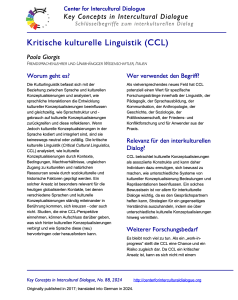
Continuing translations of Key Concepts in Intercultural Dialogue, today I am posting KC88: Critical Cultural Linguistics, originally written by Paola Giorgis for publication in 2017, and now translated by Marlena Pompino into German.

As always, all Key Concepts are available as free PDFs; just click on the thumbnail to download. Lists organized chronologically by publication date and numberalphabetically by concept in English, and by languages into which they have been translated, are available, as is a page of acknowledgments with the names of all authors, translators, and reviewers.

Giorgis, P. (2024). Kritische kulturelle Linguistik. (M. Pompino, trans.) Key Concepts in Intercultural Dialogue, 88. Available from:

The Center for Intercultural Dialogue publishes a series of short briefs describing Key Concepts in Intercultural Dialogue. Different people, working in different countries and disciplines, use different vocabulary to describe their interests, yet these terms overlap. Our goal is to provide some of the assumptions and history attached to each concept for those unfamiliar with it. As there are other concepts you would like to see included, send an email to the series editor, Wendy Leeds-Hurwitz. If there are concepts you would like to prepare, provide a brief explanation of why you think the concept is central to the study of intercultural dialogue, and why you are the obvious person to write up that concept.


Creative Commons License
This work is licensed under a Creative Commons Attribution-NonCommercial-NoDerivatives 4.0 International License.

U York: Research Fellow (UK)

“JobResearch Fellow, University of York, York, England, UK. Deadline: 30 August 2024.

The University of York wishes to recruit a fulltime, 27-month Research Associate to conduct research into the political dynamics of local vaccine manufacturing in South East Asia under the supervision of Dr Peg Murray-Evans. They are looking for an excellent candidate trained in the social sciences, with expertise in at least one of the following: (1) the political economy of global trade and production; (2) the politics of global health; (3) political economy/public policy in South East Asia. Knowledge of the pharmaceutical sector and/or vaccine manufacturing will also be an advantage.

The post holder will be part of a team working with Dr Murray-Evans as part of the UK-South East Asia Vaccine Manufacturing Research Hub, funded by the Department of Health and Social Care and the Engineering and Physical Sciences Research Council (EPSRC) as part of the UK Vaccine Network (UKVN).

In addition to the Vaccine Hub team, you will join a strong and vibrant postdoctoral community in the Department of Politics and International Relations. You will be given the opportunity to bring your own research interests to the project and your career trajectory will be supported through mentoring, peer support and professional development and training. The post is available from 1 January 2025.

CFP WSCA Intercultural Communication (USA)

Conferences

Call for papers: Intercultural Communication Interest Group, Western States Communication Association, Albuquerque, NM, 14-17 February 2025. Deadline: 2 September 2024.

The Intercultural Communication Interest Group (ICIG) invites submissions from intercultural communication teachers, scholars, and practitioners who examine different cultural phenomenon within trans/national contexts that can provide us with a nuanced understanding of the world we live in. ICIG also supports co-sponsored programs with other interest groups that consider the conference theme.

The 2025 convention theme is support. “Support” encompasses critical ideologies, acts, practices, and sites of inquiry for us to carefully examine how we view, understand, and make sense of the meaning and capacity of communicating through differences. Specifically, interrogating the role of support in challenging the historical continuum of power and envisioning the equitable and accessible care for marginalized communities is particularly urgent in today’s world more than ever, given ongoing institutional barriers such as #CommunicationSoWhite, restriction on academic freedom, anti-DEI and anti-trans legislatures, and policed anti-war protests. Therefore, ICIG asks members to critically engage with the role of support (in its various forms) in intercultural communication in order to foster constructive academic conversations and actions, advocating for social (in)justices and creating inclusive and equal space.

Howard U: Rangel Fellowships in Foreign Service for 2025 (USA)

FellowshipsGraduate Fellowships in Foreign Service, Charles B. Rangel International Affairs Program, U.S. Department of State, Washington, D.C., USA. Deadline: 19 September, 2024.

The Rangel Graduate Fellowship is a program that aims to attract and prepare outstanding young people for careers in the Foreign Service of the U.S. Department of State in which they can help formulate, represent, and implement U.S. foreign policy. The Rangel Program selects outstanding Rangel Fellows annually in a highly competitive nationwide process and supports them through two years of graduate study, internships, mentoring, and professional development activities. This program encourages the application of members of minority groups historically underrepresented in the Foreign Service, women, and those with financial need. Fellows who successfully complete the program and Foreign Service entry requirements will receive appointments as Foreign Service Officers, in accordance with applicable law and State Department policy, one of the most exciting and rewarding careers available.

In 2025, the Rangel Program plans to award 45 fellowships of up to $42,000 annually for a two year period for tuition, room, board, books, and mandatory fees for completion of a two-year master’s degree.