South Asia’s Youth at Risk – Multimedia Storytelling by Young Journalists
International Center for Journalists (ICFJ)
Journalists from Afghanistan, Bangladesh, Bhutan, India, Nepal, Pakistan, Sri Lanka and the Maldives are invited to apply to a program that aims to connect 21-30 year old journalists in South Asia for joint reporting projects that will explore topics relating to youth and the risks young people face in the region, while also training the journalists on responsible reporting in the digital age. The program, run by the International Center for Journalists (ICFJ) and sponsored by the U.S. Department of State, has two main components.
ICFJ will conduct a six-week online course for 80 journalists on digital expression. During the interactive course, participants will receive an introduction to in-depth reporting, weekly individual feedback from trainers on story progress, and lessons on Internet and document research. They will also learn interview techniques, how to generate support for a complex story in one’s newsroom, how to harness social media for reporting, and how to plan and execute a story plan and a multimedia package. Participants are required to propose story ideas related to the youth in their countries prior to starting the course so that they can rely on the online training to help them develop their stories for more in-depth reporting. The course will be conducted in four languages: English, Hindi, Pashto and Urdu. Daily translation will allow those of all languages to share ideas with the group.
ICFJ will follow the online course with a five-day conference in Colombo, Sri Lanka that will bring together the 30 best participants from the online course who propose the best projects. The projects will be grouped together for regional cooperation. The groupings will help each of the young journalists report their stories in a more responsible and informed way, and create a lasting change in the journalists’ understanding of one another’s cultures. Through these joint reporting projects, audiences throughout the region will benefit from more nuanced and in-depth reporting on critical cultural, religious and social issues. Project selections will be made before the Colombo conference, giving the journalists an opportunity to plan their reporting together. They will also present their projects to the larger conference group. The conference in Colombo will also include panel discussions, site visits and small group breakout meetings.
To apply for this program in English, click here. Applications are due January 1, 2013.

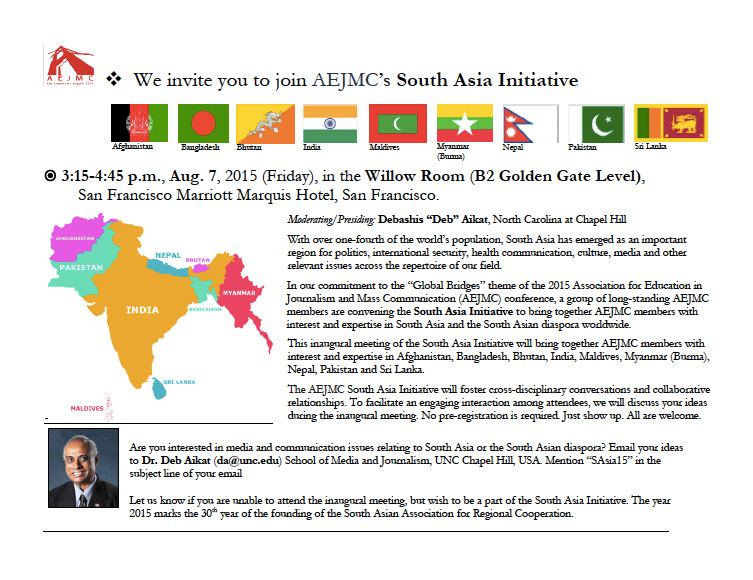 Greetings from the UNC-Chapel Hill School of Media and Journalism! By way of introduction, my name is Deb Aikat. I am a faculty member in UNC-Chapel Hill’s School of Media and Journalism. Read my bio here.
 Center for Intercultural Dialogue