Peace Education SIG, AERA: Call for Papers
San Francisco, California, April 27 – May 1, 2013
(Proposal Submissions Accepted: June 1 – July 22, 2012)
The Peace Education Special Interest Group of the American Educational Research Association warmly invites you to submit a proposal for the Annual General Meeting of the American Educational Research Association in San Francisco, California April 27- May 1, 2013. The theme of the conference is “Education and Poverty: Theory, Research, Policy and Praxis.”
Education has long been seen as a way out of poverty. Educational systems also perpetuate cycles of poverty and wealth. Poverty interacts with education through local, national, and international systems of financial markets and the global knowledge economy. The goal is to consider the relationships of education and poverty. The theme is conceived broadly to include the ways that education theory, research, policy, and praxis contribute to alleviating economic, intellectual and moral poverty.
The purpose of the Peace Education Special Interest Group (SIG) of the American Educational Research Association (AERA) is to create a global forum for scholars from diverse backgrounds and with varied perspectives to critically explore educational research and promote constructive changes in the areas of peace keeping, peace making, peace building, peace education, nonviolent conflict resolution, reconciliation, mediation, and more. Our work often addresses compelling, complex and politically charged topics and is informed by both sophisticated and sensitive analyses. Consequently, we welcome innovative as well as traditional theoretical and methodological approaches to research, and we encourage collaboration among members.
We welcome research papers from a very wide range of conceptual, methodological, experiential and international perspectives that represent theoretical advances; that analyze the complex social, cultural, political, historical and economical contexts within which peace education develops; that heighten individual and collective consciousness and inspire transformative practice to more effectively connect education and peace building and further the institutionalization of peace education. We encourage you to indicate in your proposal your engagement with the peace education literature and to clearly demonstrate the wider lessons that can be learned from your particular context. We particularly welcome papers that draw on interdisciplinary research data and that reflect the conference theme of education and poverty.
Proposals should be submitted through the AERA proposal submission system ( www.aera.net ) and identified as for the Peace Education Special Interest Group.
Please make sure to register as a member of the PEACE SIG when submitting the AERA proposal. Joining as members allows the PEACE SIG to extend its academic activities at the AERA conference. It also strengthens an intellectual community connected by a commonality of interests and encourages more collaboration.
Candice C. Carter, AERA Peace Education Special Interest Group – Program Chair
Zvi Bekerman, AERA Peace Education Special Interest Group – Chair

 The next issue of Key Concepts in intercultural Dialogue is now available. This is KC116: Peace education, by Phill Gittins. Click on the thumbnail to download the PDF. Lists organized chronologically by publication date and number, alphabetically by concept in English, and by languages into which they have been translated, are available, as is a page of acknowledgments with the names of all authors, translators, and reviewers.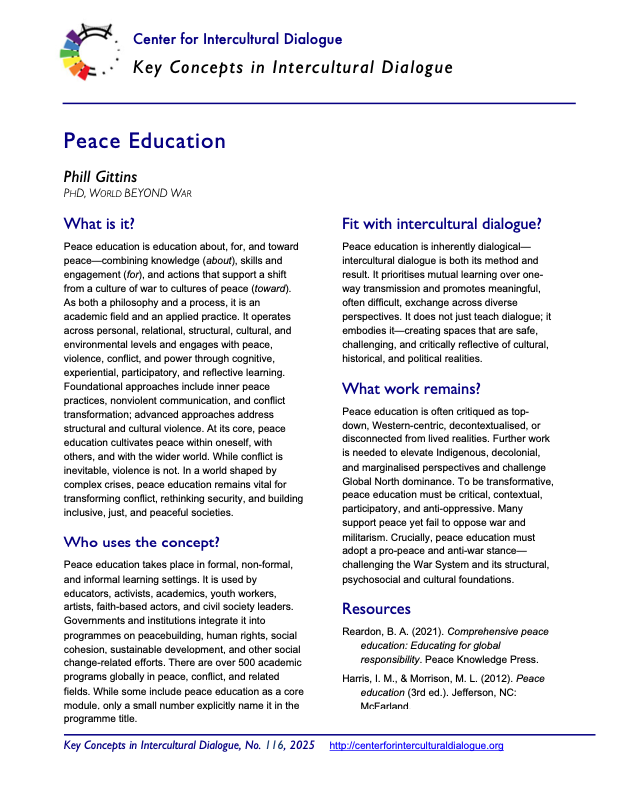


 Center for Intercultural Dialogue