Maria Flora Mangano: Standing for Peace Without Weapons

Guest PostsStanding for Peace Without Weapons. Guest post by Maria Flora Mangano.

In 2025, we are celebrating the eightieth anniversary of several events related to the end of World War II, including the launch of the bombs which devastated Japan. Oppenheimer immediately realized the need to avoid global destruction, and soon he stepped back from atomic weapons, instead promoting disarmament and peace among the international community of physicists and scientists. His commitment to peace encountered strong opposition among the political and government contexts of that time. At the end of the war, he was removed from government and academic positions, and he charged with supporting communism through his pacifist ideas. He was rehabilitated, teaching in the US before his death. A few months after the creation of the atomic bomb, Oppenheimer delivered a speech in the same place where the group of physicists worked and helped to create the Association of Los Alamos Scientists. They, in turn, mobilized the scientists of the world to support a peaceful use of science and knowledge, arguing for global disarmament.

What may his words suggest to us, in this tragic and dark time for the whole world, when it seems that history has taught us nothing?

Are we really powerless and inexorably in the hands of our politicians’ choices, as the obvious vision of the world seems to suggest? Do we really believe that the end of the wars come from those with the loudest voices and as a result of weapons?

Download the entire post as a PDF.

Maria Flora Mangano: Gratitude is My Attitude

Guest PostsGratitude is My Attitude. Guest post by Maria Flora Mangano.

Thankfulness may become mutual, as it is focused on our approach to the Other.

Working with students can be more than a job; it may become a life choice, an answer to a call, which we choose every day. It may turn into an attitude, a perspective on reality, a vision of the world centered on the Other rather than on us. This approach may also change our relationship to our students, and, far more broadly, with our daily lives.

…If we can shift the center of gravity from ourselves to the Other, we may experience gratitude as a pure feeling which does not depend on us, thus on our abilities, successes, or results. It reminded me of the I-Thou relationship as theorized by Martin Buber (1937), thus, the basic idea that the relationship lies in the between, perhaps in the hyphen between, the I and the Thou (Mangano, 2018, p. 27). It is a space which depends neither on the I, nor on the Thou; it is in the middle, in the between, in the “space of us.”

When we are able to decenter ourselves and put the Other at the center of the scene, we may also see what already exists, rather than what is missing. We may experience wonder, as we do not expect a gift: the Other may already be a gift, and we do not need any additional expectation. This approach, that of an unexpected surprise, may provide a new perspective on reality as a glass half-full; sometimes even completely full. In this attitude, gratitude sounds likely to be close to hope, an endless source of water although just a few drops may be enough, as they can guarantee the strength to carry on.

Download the entire post as a PDF.

In Dialogue: CID Occasional Papers 2: When the Letters Sing and the Numbers Jump: Education as a Space of Relationship

Key Concepts in ICDAfter a gap of several years, In Dialogue: CID Occasional Papers is back, with a thoughtful essay on applying intercultural dialogue to an educational context. We present: When the Letters Sing and the Numbers Jump: Education as a Space of Relationship by Maria Flora Mangano.

Occasional Paper 2: When the letters sing and the numbers dance by Maria Flora Mangano


This occasional paper aims to deepen the meaning of education as a space of relationship across, among, and beyond cultures, fields of study, and student ages. A “homemade” and “home based” one-to-one teaching of second-generation children and teenagers in difficulty is described. Vol-unteer, replicable, and feasible activities complementing formal education were conducted with and for students and their families. This approach may be a challenge for scholars and educators having little prior experience with children. Nevertheless, it provides potential for (re)thinking education as a combination of learning and teaching, involving indoor and outdoor cultural activities; it becomes an accessible and free space, where students, families, and teachers may meet and grow together.

Mangano, M. F. (2024). When the letters sing and the numbers jump: Education as a space of relationship. In Dialogue: CID Occasional Papers, 2. https://centerforinterculturaldialogue.org/2024/11/11/in-dialogue-cid-occasional-papers-2-when-the-letters-sing-and-the-numbers-jump-education-as-a-space-of-relationship/

As with prior publications, these will are available as free PDFs; just click on the thumbnail to download. As with prior publications, the Occasional Papers may be downloaded, printed, and shared as is, without changes, without cost, so long as there is acknowledgment of the source.

If you are  interested in publishing in this series, contact the series editor, Wendy Leeds-Hurwitz. If you are new to CID, please provide a brief resume.


Creative Commons License
This work is licensed under a Creative Commons Attribution-NonCommercial-NoDerivatives 4.0 International License.

Maria Flora Mangano: Seeds of Dialogue

Guest PostsSeeds of Dialogue. Guest post by Maria Flora Mangano.

NOTE: As someone who has received a set of the “seeds of dialogue” described here, this post is particularly meaningful to me. It’s a lovely gesture, and something that would be particularly easy for others to replicate.

This idea of a symbolic gift for students at the end of a course occurred to me in 2017. At that time, I was teaching transcultural dialogue to undergraduates, in addition to a course in communication of scientific research intended for doctoral students.

I prepared “seeds of dialogue,” as I called them, by using the seeds of seasonal fruit I had at home (such as oranges or apples), which I washed, dried, and stored. It was also a sustainable gift, as I packed the seeds using recycled materials: transparent cellophane and strand of raffia for the envelope, which I stapled onto cards made of reused wallpaper.

The intent was to wish for the students to continue to plant “seeds of dialogue” in the Other, as we had experienced during the course. The proposal was to place them beyond our class, and beyond the academic context, with the aim, far more broadly, to give these seeds a place in our everyday lives.

They are only seeds of fruit, but the meaning of the seeds as symbol is immediate: each of us, wherever and whenever, may begin to create a relationship with the Other by building a bridge, by planting a seed. .

Download the entire post as a PDF.

Maria Flora Mangano: Saturday Morning (Intercultural) School

Guest PostsSaturday Morning (Intercultural) School. Guest post by Maria Flora Mangano.

NOTE: Maria Flora Mangano has previously written about dialogue as a space of relationship (2020, 2018, 20172014) as long-term followers of this site will remember. 

Since the end of 2021, I have been involved in an after-school activity for 4 to 12-year-olds. This volunteer work supports pupils doing their homework once a week, on Saturday mornings. This activity was created by a teacher at the beginning of the current school term, in October 2021, and it takes place in a parish of the city center of my town, Viterbo, near Rome. The initial aim was to reach non-Italian children from the city center, which is mostly inhabited by non-native families. In a short time, additional children arrived from different zones of the town and the surroundings.

What the children experience at home, with relatives and friends of their parents’ culture, often coexists, interacts, and enriches – we may say “is in dialogue” – with what they experience at school, as well as in this after-school activity. At the same time, their daily sharing with Italian and non-Italian people (peers, teachers, or neighbors, for instance) feeds their knowledge, and it frequently provides precious input to their families. Some, in fact, help their parents in improving their understanding of the Italian language, in talking, reading, or writing; others assist Italian people (even us) to better understand their parents’ and family’s needs.

Download the entire post as a PDF.

Communication of Scientific Research 2021 (Italy)

Study AbroadSummer School in the Communication of Scientific Research, taught by Maria Flora Mangano, August 3-5, 2021, Viterbo, Italy. Deadline: June 20 2021.

The CSR summer school is dedicated to the theory and practice of communication of scientific research, by providing basic instructions on the construction of written and oral text, with analysis in class of written and oral contributions by the participants. This year’s class is particular addressed to non-Italian young researchers, and will be taught in English.

The training in communication of scientific research is an interdisciplinary postgraduate offering dedicated to professionals of science: people who conduct research within the international academic community. The CSR teaching program is addressed to young researchers (PhD students and post-doctoral fellows) drawn from different fields in the natural, social, and human sciences.

Since 2020, a CSR fund has been established, which intends to facilitate the participation of young researchers. The fund has been developed by Italian CSR alumni who wish to help their peers to have access to the CSR training. This year the CSR fund offers two grants of € 150 each which are intended for highly motivated young researchers who cannot cover the whole cost of the CSR school. Priority will be given to those who live in the Mediterranean area (especially the Balkans, Maghreb and the Middle East), as well as to the young researchers who live in Central and Southern Africa, and in Central and Southern America.

Maria Flora Mangano: Space of Relationship as a Space of Distance

Guest PostsSpace of relationship as a space of distance: A new proximity. Guest post by Maria Flora Mangano.

NOTE: Maria Flora Mangano has previously written about dialogue as a space of relationship (2018, 20172014) as long-term followers of this site will remember. She suggested this might be a good time to think about what is now being called “Social distancing” and how it relates to the space of relationship that is required for intercultural dialogue to occur.  

Among the measures for controlling the infection of Coronavirus disease 2019 (COVID-19) is the need to avoid interaction among human beings, and, when that is not possible, to fix a distance of at least one meter, according to the World Health Organisation. In addition to the medical masks, in almost every part of the world, this measure implies a prohibition on shaking hands, or hugging and kissing. The warnings stress the need to interact with others without having any contact, especially of hands and face, the parts of the human body which, more than others, may transmit the infection. These two also are the parts of the body which, more than others, transmit the message, thus play a central role in communication.

During these last few days, the global news media have reported several alternatives to greetings and physical contacts created by many people around the world, involving touching elbows, or feet. Also, people have rediscovered the use of non-touching hand gestures, as with namaste, the Buddhist greeting, where hands are put together, or even blinking, as ways to respect a safe distance, yet still acknowledge another person.

The COVID-19 infection is introducing a new space of relationship among individuals, related to our interpersonal communication. This is affecting everyday life at the moment and will probably have effects in the future on human communication. A “new distance” is arising, which may be added to the original four proposed by the anthropologist Edward Hall in 1966 in The Hidden Dimension. He distinguished four levels of distance in spatial interrelationships among humans, which vary by such factors as culture, education, gender, and status. We might now add what has been popularized as “social distancing”) to the intimate, the personal, the social, and the public spaces proposed by Hall.

Despite Hall’s emphasis on cultural differences, as the new distance is required for global safety reasons, this relationship of distance between individuals is the same all over the world. Therefore, it cannot, and it is not supposed to be, different depending such factors as culture, age, education, gender, or status. What may change is the resilient capacity of human beings to find alternatives, to adapt themselves to (almost) every condition, and to try to find an answer, even when it seems hard, as during this time.

The challenge to us all will be to consider this necessary distance imposed on individuals as an opportunity to rethink the space of relationship as a space of proximity to the Other. Distance, as well as proximity, are terms generally related to a physical space of relationship among humans. What happens when this space is dramatically and unexpectedly avoided or altered, as it imposes another dimension, even a fixed measure of separation among individuals?

The opportunity which this social distancing offers is to consider distance, and consequently proximity, unbound from a physical space of relationship. Distance may become another term for proximity, if we will be able to look at the face of the Other even through a medical mask, and from one meter. We may still be touched by the Other’s call, even without touching her/him with our hands.

If we will be able to overcome a physical space of relationship – in the sense of going beyond it, rather than over it – we might also discover a new sense for proximity. It may sound like a paradox, and probably it is, as the challenges required to the human behaviour which affect our daily life. If we will be able to accept the paradox of distance and proximity as one, we may discover that the safe distance established by social distancing can be overcome, in a way, not because we violate the prohibitions, but as we are able to go beyond ourselves towards the Other.

The Latin term alter literally refers to “the other than two”; social distancing is offering us all the chance to alter our perspective of the Other, every Other than us: close or distant, with a medical mask or without, by touching her/him or without using our hands. This implies the opportunity to modify the distance at which we stand from the Other, in terms of prejudices rather than medical or safety prescriptions. It might be surprising to realise, when the COVID-19 epidemic will eventually end, that we have reduced our mental and heart distance from the Other, in addition to again being able to reduce our physical distance.
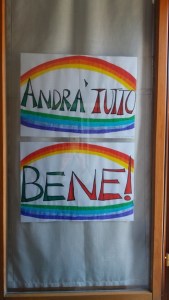
In these new and solitary days, in our creative country [Italy], a spontaneous proposal was born. It was soon shared among the people and became viral (in every sense!): find a way to encourage the others, with messages posted on the windows and the balconies. The sentence proposed was: “Andrà tutto bene,” or “Everything is going to be fine.” The idea was to write on white sheets, drawing the rainbow. It was soon made by children and families. I thought to draw it on paper and I posted the design on my window facing the road.

Download the entire post as a PDF.

Communication of Scientific Research 2019 (Italy)

Study Abroad

Communication of Scientific Research Summer School, 27-30 August 2019, University of Tuscia, Italy. Deadline: 15 June 2019.

The CSR summer school will be held from 27 to 30 August 2019 at the Centro Studi Alpino of the University of Tuscia (Italy), located in the surroundings of Trento (Pieve Tesino). The summer school will be taught in Italian and is addressed to young researchers (PhD students and post-doctoral fellows) drawn from the natural, social and human sciences. The course will be taught by Maria Flora Mangano.

Relationship as a Space “In Between”

Resources in ICD“ width=Mangano, M. F. (2018). Relationship as a space “in between”: A transcultural and transdisciplinary approach mediated by dialogue in academic teaching. Bergamo, Italy: University of Bergamo Press.

What is special and uncommon about Maria Flora Mangano’s research is her clear focus on dialogue as a space of relationship. Often intercultural dialogue has been viewed as occurring at the global, international level, typically involving politicians. Maria Flora is one of a very few scholars to become interested in how intercultural dialogues occur within face-to-face interactions, thus at a more personal level. Dialogue more easily develops among those who have already succeeded in establishing a relationship, rather than between strangers.

The metaphor of creating a social space in which dialogue can occur is not unique to Maria Flora, but it is uniquely appropriate to her concerns. The data which form the body of the project demonstrate praxis in this case, her actual teaching experience, where she creates a space of relationship in the classroom, permitting dialogue to occur. This should encourage others to follow where she has led, since sufficient details are provided which others can immediately use.

In sum, Maria Flora Mangano not only studies dialogue, she demonstrates it in a way others can easily follow. And her theoretical argument clearly explains why they should do so. As the conclusion suggests: “dialogue needs relationship to be realized, and, at the same time, dialogue creates relationship” (p. xiv). May we all learn to create a space for dialogue in our relationships.

Maria Flora Mangano has frequently been mentioned on this site, contributing a number of publications (Key Concepts in Intercultural Dialogue, 81 on dialogue as a space of relationship, Constructing Intercultural Dialogues, 2 on reconciliation, and CICD 9 on intercultural dialogue as an activity of daily living), translations into Italian (KC1, KC14, KC37KC81, CICD 2), and guest posts (A space of relationship for dialogue among cultures, and Example of dialogue among cultures).

NOTE: This post is a shortened version of my Foreword to this book, appearing on pp. v-vi.

Constructing ICD #9: ICD as an Activity of Daily Living

Constructing ICD

Constructing intercultural Dialogues is now available, “Intercultural Dialogue as an Activity of Daily Living” by Maria Flora Mangano. Her goal is to expand her vision of dialogue as a space of relationship by helping us see how it fits into our lives even in brief interactions, rather than only during formally organized events.

As a reminder, the goal of this series is to provide concrete examples of how actual people have managed to organize and hold intercultural dialogues, so that others may be inspired to do the same. As with other CID series, these may be downloaded for free. Click on the thumbnail to download the PDF.

Constructing ICD 9Mangano, M. F. (2018). Intercultural dialogue as an activity of daily living. Constructing Intercultural Dialogues, 9. Retrieved from:
https://centerforinterculturaldialogue.org/wp-content/uploads/2018/04/constructing-icd-9.pdf

If you have a case study you would like to share, send an email to the series editor, Wendy Leeds-Hurwitz.


Creative Commons License
This work is licensed under a Creative Commons Attribution-NonCommercial-NoDerivatives 4.0 International License.