

Call for papers for a special issue of the Journal of Intercultural Communication Research on The ecological turn in Intercultural Communication: State of the art and avenues for future research. Deadline: extended abstract, 1 September 2024.
Special issue editors:
Mélodine Sommier (University of Jyväskylä, Finland)
Diyako Rahmani (Massey University, New Zealand)
Alice Fanari (Northeastern University, USA)
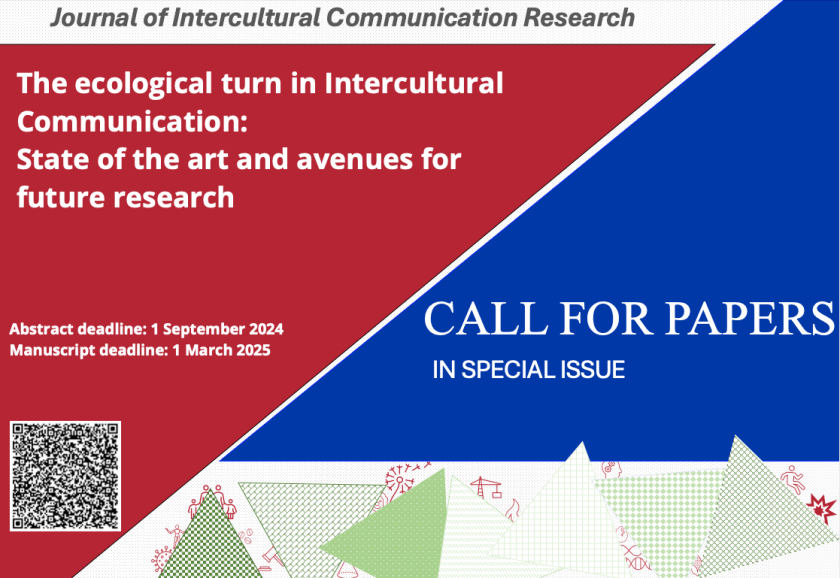
This special issue hopes to tease out and strengthen the connections between interculturality and ecology by showing what such a dual focus can bring to light. Specifically, the issue editors invite articles engaging with, but not limited to, the following questions and areas of inquiry:
- How are notions and discourses about culture, identity, community, and borders constructed and mobilized to talk about the ecological collapse?
- How can a dual focus on interculturality and ecology be used to renew the field of intercultural communication and some of its central concepts such as competence, dialogue or reflexivity?
- How can a dual focus on interculturality and ecology be applied in research various contexts such as education (e.g. sustainability (language) education), interpersonal relationships (e.g. interspecies dialogue), mediated communication, health etc.?
- How can the study of interculturality and ecology benefit from and contribute to other lines of work such as decolonial scholarship, environmental justice, pluriversality and post-humanism?
- What methods and paradigms are particularly useful to explore the interplay between interculturality and ecology?
- How can the ecological turn in intercultural communication be used to move the field away from the Euro-western-centric production of knowledge and give room to indigenous and marginalized academic voices?
 This special issue offers a platform to discuss theories that have shaped the field of intercultural communication and consider how they may need to be adapted to reflect major contemporary issues. Authors are invited to submit original manuscripts that focus on the development of intercultural communication theorizing that contribute to our understanding of individual-level and societal-level phenomena at the international, intercultural, or cross-cultural level. The editors encourage manuscripts from a wide range of scholarly areas and welcome all methodological approaches. Both empirical research reports and theoretical or conceptual essays are welcomed. In addition to an emphasis on methodological pluralism, they encourage submissions that reflect global, underrepresented, and/or marginalized experiences.

 Center for Intercultural Dialogue