CFP ICA Preconference: Rethinking Global Discourses of Racial Inequality (South Africa)

ConferencesCall for abstracts: Preconference: Rethinking Global Discourses of Racial Inequality, 4 June 2026, Cape Town South Africa. Submission deadline: 15 February 2026.

Organizers invite submissions for an in-person pre-conference titled, “Rethinking Global Discourses of Racial Inequality,” at the International Communication Association’s 2026 meeting, jointly organized by the Language & Social Interaction (LSI), Intercultural Communication (ICC), and Ethnicity & Race in Communication (ERIC) divisions.

This pre-conference responds to the current global moment, marked by intersecting discourses of racism, resistance, justice, and empowerment. Across societies, renewed attention to racial inequalities has sparked calls to reimagine the conceptual and methodological tools we use to study how race is constituted, normalized, and contested in communication practices.

Their aim is to create an interdisciplinary and supportive space where all participants (particularly students and early-career scholars) can share their work, receive constructive feedback, and build networks for collaboration across divisions and disciplines. By bringing together scholars from LSI, ICC, and ERIC, organizers seek to advance cross-divisional dialogue and develop innovative approaches to understanding and transforming global discourses of race and inequality.

CFP ICA 2026: Intercultural Communication Division (South Africa)

ConferencesCall for papers: Intercultural Communication Division, International Communication Association, Cape Town, South Africa, 4-8 June 2026. Deadline: 1 November 2025.

“The Intercultural Communication (ICC) Division welcomes research that applies, extends, or develops theory, method, and analysis to explore how communication intersects with culture in local, national, international, and transnational contexts. We are committed to supporting interdisciplinary research that examines culture, identity, history, and geopolitical relations, and especially invite work grounded in non-Western, decolonial, Indigenous, and underrepresented perspectives from across the globe.

This year’s conference theme, “Communication and Inequalities in Context,” calls on us to reckon with how communication both reflects and reproduces the deep structural inequalities that mark our world. For intercultural communication scholars, this theme underscores the urgency of examining how power operates across and within cultural boundaries through colonial legacies, migration policies, linguistic hierarchies, digital divides, and uneven access to resources. These dynamics are not abstract: they shape people’s lives, sense of belonging, and ability to communicate with dignity and agency.

We therefore invite submissions that interrogate how intercultural communication research can confront, resist, or reimagine these inequalities. What communicative practices foster solidarity, healing, and justice across borders? How do marginalized communities navigate cultural difference amid systemic oppression? What responsibilities do scholars bear in addressing epistemic, material, and institutional imbalances within the field itself? How can our work amplify the voices, languages, and knowledges that are often silenced?

In line with the theme, the ICC Division seeks submissions that ask bold, justice-centered questions and that push our field to think more critically about how we engage difference, power, and global inequities. We particularly encourage contributions that attend to intercultural communication as a site of both struggle and possibility in the face of rising authoritarianism, climate crisis, digital surveillance, and social unrest.”

CFP ICA 2026: Regional Hubs

ConferencesCall for proposals of Regional Hubs to complement International Communication Association convention, Cape Town, South Africa, 4-8 June 2026. Deadline: 1 November 2025.

In conjunction with the 76th Annual ICA Conference (ICA26) on 4-8 June 2026 in Cape Town, South Africa, ICA will once again welcome Regional Hubs worldwide to host events concurrent with the annual ICA conference. ICA’s Regional Hubs offers a window into ICA – its community and scholarship. They provide communication scholars in various regions around the world an opportunity to foster community and build intellectual networks. It reflects ICA’s commitment to welcome and support a broader global community of communication scholars.

While there is no substitute for an in-person experience at an ICA conference, organizers recognize that a significant and growing proportion of current and potential ICA membership resides in the Global South, making travel to in-person attendance inaccessible due to fiscal, political, environmental, health, and other hurdles.

In response to these concerns, ICA’s Regional Hubs Initiative offers a window into ICA – its community and scholarship. The Regional Hubs also provide communication scholars in various Regions around the world an opportunity to foster community and build intellectual networks. It reflects ICA’s commitment to welcome and support a broader global community of communication scholars. Since its inception at the virtual ICA 2021 and continuing at the hybrid conferences in ICA22, ICA23, ICA24, and ICA25, each year, the organization has hosted around 10 ICA Regional Hubs.

Regional Hubs host sessions for regional submissions, with some Hubs receiving over 100 submissions, from which some were selected for oral presentation and others for posters. Most of the Hubs hosted themed workshops and invited lectures from local and global scholars, including some who joined from other Regional Hubs and others from the main ICA Conference location.

Some Hubs live-streamed presentations and sessions from the primary conference location (Paris in 2022, Toronto in 2023, Gold Coast in 2024, and Denver in 2025) and organized local panels to facilitate discussion around them. A few organized Blue Sky workshops or workshops on special topics such as scholarly publishing, submitting grants, and scholarship applications. Some Hubs live-streamed their locally-originated events on platforms such as Facebook and YouTube and often garnered considerable local media coverage. In some cases, the Hubs hosted those presenting papers selected for the ICA conference remotely from their locations. Finally, after the selection of Hubs, some Hubs collaborated on organizing joint Hub-to-Hub sessions.

Call for Nominations: Editor, Journal of Communication 2026

Professional OpportunitiesCall for Nominations: Editor of the Journal of Communication. Deadline: 31 January  2026.

The ICA Publications Committee is soliciting applications for the next editor(s) of the Journal of Communication (JOC). The four-year term will begin with a transition in September 2026.

The Journal of Communication is the flagship journal of the International Communication Association, bringing to its readers the most important and cutting-edge findings in the field of communication studies. Spanning all methods and areas of scholarly inquiry, articles published in JoC are conceptually and methodologically sound, socially meaningful, clearly written, and thoughtfully argued. JoC also features the JoC Forum, which publishes multi-book review essays, as well as occasional article responses and roundtables.

More details about the journal can be found at https://academic.oup.com/joc.

The Publications Committee seeks applications from individuals or small teams of scholars from the ICA membership. The successful applicant(s) will be expected to build an editorial structure that reflects the diversity of the communication discipline around the globe. Multiple factors are considered when evaluating candidate applications, including, but not limited to:

● Clear understanding of the mission of the journal

● Clear articulation of an intellectual and operational vision for the journal
● Demonstrated openness to a range of epistemologies and methodologies appropriate for the scope of the journal
● Demonstrated interest and/or experience in theoretical development
● Demonstrated interest and/or openness to interdisciplinary work
● Demonstrated communication skills and diplomacy
● Reputation and excellence of academic output
● Editorial, managerial or administrative experience
● Tenure or advanced rank
● Institutional support

Team submissions should also demonstrate successful past collaboration and an articulation of how the workflow will be managed among team members.

CFP ICA 2026: Communication and Inequalities in Context (South Africa)

ConferencesCall for papers: Communication and Inequalities in Context, International Communication Association, Cape Town, South Africa, 4-8 June 2026. Deadline: 1 November 2025.

The ICA 2026 conference theme invites critical reflection on the dynamics between communication and inequality and its tensions across different social, cultural and geographical backgrounds. As such, it is a call to engage with research exploring the deep divisions and existing interpersonal, institutional, and structural inequalities in our societies.

In a world shaped by the unequal distribution of political, economic, societal, cultural, and communication resources, considering the complex architecture of global inequalities remains a critical issue. Communication scholars have long recognized how structural divides shape all communication processes, from persistent barriers rooted in historical inequities to emerging forms of digital exclusion and fragmentation. Today, as disinformation, extremism, polarization, hate, oppression, and algorithmic discrimination pose global challenges, the specific contexts in which people encounter these phenomena–including political institutions, media systems, regulatory capacity, and social norms—may fundamentally shape their lived experiences. Thus, it becomes crucial to examine how and under what conditions these forces unevenly affect different communities and individuals across multiple domains of life and in various geographical and cultural settings. For example, communication barriers may impact disaster preparedness and response in vulnerable individuals; the increasing complexity of digital literacy requirements constitutes a significant threat to inclusion, and global internet governance and infrastructure decisions create and amplify disparities between and within different nations and communities.

Such inequalities and power dynamics are also expressed within/across communication research. From gender gaps in publications and language barriers for scholars from non-English-speaking countries to the invisibility of knowledge produced in the Global South and calls to de-Westernize communication research, several divides in communication in terms of the subject of study, the body of evidence, analytical frameworks, and academic cultures limits our ability to gain insights relevant to the current global social and political condition.

In this spirit, organizers invite submissions for papers and panel proposals that address the conference theme along the lines outlined here. Submissions may address, but are not limited to, the following issues and topics:

*The evolving landscape of the relationship between communication and inequality.
*Conceptualizations and theorizations of communication inequality and inclusion/exclusion.
*The dynamics and implications of enduring inequalities and new divides for communication scholarship in different settings.
*Broader social and communicational outcomes of communication divides.
*Tensions and intersectionality of power hierarchies in communication.
*Algorithmic biases and marginalization (e.g., algorithmic decisions reinforcing disparities faced by marginalized groups; societal implications of algorithmic; data inequality, algorithmic fairness).
*Cross-border communication inequalities.
*Inequalities across and within communication research, including power imbalances in knowledge production within the field, and differences in opportunities, resources, and capacities among researchers, institutions, and regions.

New ICA Journal: Global Perspectives in Communication

“Publication

New open-access journal just established: Global Perspectives in Communication.

The International Communication Association (ICA) is pleased to announce the launch of its new open-access journal, Global Perspectives in Communication (GPC). The journal is dedicated to fostering diverse perspectives, fresh insights, and open-ended inquiries that drive communication research forward. GPC’s streamlined, high-quality peer-review process will ensure the rapid publication of scientifically rigorous research across all areas of communication.

GPC will encompass a broad range of topics, including but not limited to: Communication and media studies; Interpersonal and intercultural communication; Organizational communication; Political communication; Health communication; Environmental communication; Science communication; Digital, AI, and social media communication; Human-computer communication; Journalism and mass communication; Advertising and public relations; Media and communication history; Information science and cybernetics; Popular culture; Visual communication.

Under the leadership of inaugural editor Nick Bowman (Syracuse U), GPC will welcome various submission formats, including traditional manuscripts, short papers, essays, position papers, registered reports, review articles, and book reviews. The journal also encourages diverse methodological approaches, including quantitative, qualitative, digital, and mixed-methods research. Additionally, GPC seeks to explore emerging research formats and media, such as video and audio recordings.

GPC is set to begin accepting submissions in the lead-up to ICA’s 75th Anniversary at ICA25 in Denver, and is actively recruiting for reviewers. If you are interested, please email the editor.

Open Access and Funding Model: To promote inclusivity and accessibility, GPC will waive the Article Processing Charge (APC) for unfunded articles. Articles with allocated funding-whether through a transformative deal or other means-will carry an APC. Additionally, articles from researchers in developing countries recognized by Research4Life (Tier 3) will have their APCs waived in alignment with ICA’s partnership through Oxford University Press (OUP). Authors may publish under a CC-BY or CC-BY-NC-ND license.

CFP ICA Virtual Preconference: Media and Communication in Global Latinidades

Conferences

Call for extended abstracts: Media and Communication in Global Latinidades, International Communication Association VIRTUAL Preconference, 11 June 2025. Deadline: 15 February 2025.

This preconference examines the production, distribution, and consumption of media and communication in global Latinidades. It follows up to the six preconferences held in the context of the 2019, 2020, 2021, 2022, 2023, and 2024 Annual Meetings of the International Communication Association – on “Digital Journalism in Latin America” in 2019, on “Digital Media in Latin America” in 2020, on “Digital Media in Latinx and Latin America” in 2021, and on “Media & Communication in Global Latinidades” in 2022, 2023 and 2024.

In this seventh edition, we continue to center on media and communication practices of the Latinx and Latin American experience globally. Despite its long history, research about Latinx and Latin American topics — largely made by Latinx and Latin American researchers worldwide — tends to be underrepresented in communication scholarship in general and in ICA in particular. As such, the preconference will address the theme of media and communication in local, global, and/or transnational Latinx and Latin American experiences, such as those related to access issues, practices, representations, markets, technologies, and more.

Organizers think it is important to provide a platform that incentivizes community, the flow of information and scholarship, and equitable participation across the globe. As such, and in recognition of the often unsurmountable structural differences that exist among different national contexts concerning resources for traveling to international academic conferences, organizers will again hold the edition of the preconference virtually with a social in-person component that will be determined in due time.

Media and communication issues have increasingly featured more prominently in the global experiences of Latinidad. Thus, it is critical to inquire into the experience of these communities, which tend to be understudied and underrepresented, and to examine whether the specificity of Latinx and Latin American experiences might entail differences from those of other communities.

CFP ICA 2025: Disrupting and Consolidating Communication Research (USA)

ConferencesCall for papers: ICA@75: Disrupting and Consolidating Communication Research, Denver, Colorado, USA, 12-16 June 2025. Deadline: 1 November 2024.

Addressing the International Communication Association’s 75th anniversary, the 2025 conference theme is an invitation to critically reflect on communication studies as a discipline and ICA as an agent and site of disciplinary development. Theme sessions will take stock of our past, critically review present developments, and chart out future avenues for communication research. Organizers particularly welcome contributions speaking to three important aspects of the theme: communication scholarship as a transformative and stabilizing force in society, as a research practice that can be both revolutionary and consolidating, and communication studies as a disrupted and resilient discipline. In all these contexts, elements of disruption and consolidation are not necessarily antithetical but may productively be framed as a dialectical relationship.

ICA has made significant strides in amplifying the visibility of communication scholarship beyond academia. From democratic backsliding to climate change and conflict transformation, our discipline is poised to provide relevant answers to many burning questions of our time. Through public scholarship, communication scholars can make themselves useful by addressing the problems of the world’s current polycrisis. They may act as a transformative voice in society (by advocating social change) and as a stabilizing force (by maintaining democracy or social justice). A key issue in this context is the sometimes troubled relationship between scholarship and advocacy.

The public impact of scholarship is typically connected to a discipline’s ability to generate original knowledge. During the past 75 years, communication research has exponentially grown in terms of quantity. However, across a variety of disciplines and academic fields, such expansion is mostly attributed to the growth in studies that consolidate existing knowledge, pushing aside disruptive and revolutionary scholarship that forges new directions and breaks existing paradigms. The progressive fragmentation of the discipline may have contributed to this trend, along with persisting social and global inequalities in academia as well as a publication and review culture that tends to disadvantage certain types of research and scholarly communities, including those from the Global South.

Communication research is facing these issues while itself being disrupted on multiple fronts and, perhaps, with unprecedented consequences. AI-based technologies have started revolutionizing scholarly practice with vast implications for the way we conduct and evaluate scholarship. In addition to high levels of insecurity and precarity, researchers face growing demands to publish in prestigious venues, obtain large grants, and participate in reviewing and evaluations, all putting heavy mental strain on scholars. Through this call, we encourage the discipline to think about possible ways to consolidate our research environment by growing resilience and developing effective coping strategies.

In this spirit, organizers invite submissions for papers and panel proposals that address the conference theme along the lines of the outlined three areas. Submissions may address, but are not limited to, the following issues and topics:

  • Strategies to increase the visibility and impact of communication scholarship addressing the problems of our time
  • The relationship between scholarship and advocacy as well as obstacles to public scholarship and ways to overcome them
  • Research-based disruptions of dominant theories guiding communication inquiry
  • Historical trajectories of communication scholarship that have disrupted other fields of research and where communication studies has been disrupted by other disciplines
  • The cross-fertilization of communication research through disruptions originating from within
  • Research-based disruptions of dominant modes of communication inquiry from the Global South
  • The impact of AI on the conduct and evaluation of communication scholarship
  • The political economy of scholarship for the discipline’s ability to generate original knowledge
  • Assessments of growing academic demands and the resulting mental toll
  • Strategies to grow resilience and cultivate solidarity networks among various academic communities

ICA Regional Chapters

“Collaborative

Regional Chapters, International Communication Association, USA.

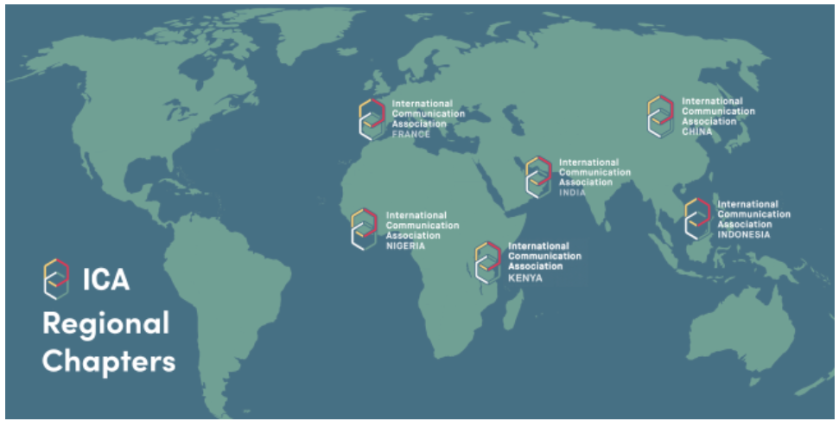
International Communication Association Regional Chapters mapThe ICA Regional Chapters Program is currently in a three-year pilot phase. No additional chapters will be approved during the pilot so that all resources can be devoted to making the six original chapters as successful as possible. The six regional chapters are: Indonesia, Nigeria, China, Kenya, France, and India.

CFP South Asia Communication Association at ICA: Communication & Global Human Rights 2024 (Australia)

Conferences

Call for Papers: South Asia Communication Association: Communication and Global Human Rights: Media Research on South Asia & Its Diaspora Worldwide, research session at International Communication Association, Goldcoast, Australia, 19-24 June 2024. Deadline: 20 January 2024.

Organizers invite you to present your research at the 2024 South Asia Communication Association (SACA)’s refereed-research session at the 74th annual conference of the International Communication Association (ICA),  in Gold Coast, Australia, Jun. 19-24, 2024. SACA will host an interactive research session, and the ICA 2024 conference program will feature the SACA session. The ICA 2024 conference promises to be an
innovative, interactive and engaging event.

You are invited to submit your research on media and communication
in South Asia or its diaspora worldwide. Organizers welcome a wide range of perspectives and approaches. Please feel free to email Dr. Jatin Srivastava if you have any questions about your research relating to the scope of the SACA research session.