CFP UNESCO Memory of the World International Register

“UNESCO”
Call for nominations for the UNESCO Memory of the World International Register for 2026-27, UNESCO, Paris, France. Deadline: 30 November 2025.

UNESCO is inviting new nominations for its Memory of the World International Register, which lists documentary heritage items of world and historical significance. Any person or organization, with the prior written consent of the owners or custodians, may submit nominations  through the National Commission for UNESCO or, in the absence of a National Commission, the relevant government body in charge of relations with UNESCO. Nominators are also encouraged to involve Memory of the World National Committees where possible. International organizations meeting the criteria set out in the General Guidelines of the Memory of the World Programme may also submit nominations.

UNESCO Global Report on Cultural Policies | Culture: The missing SDG

“UNESCO”
UNESCO Global Report on Cultural Policies | Culture: The missing SDG. Paris, France: UNESCO.

UNESCO launched the first edition of the UNESCO Global Report on Cultural Policies | Culture: The missing SDG during the UNESCO World Conference on Cultural Policies and Sustainable Development – MONDIACULT 2025, on 29 September 2025, in Barcelona, Spain.

UNESCO Global Report on Cultural Policies

Amid growing recognition of culture’s essential role in shaping inclusive, sustainable societies, the inaugural UNESCO Global Report on Cultural Policies | Culture: The Missing SDG presents a first global snapshot of cultural policies across regions and sectors. Based primarily on over 1,200 national and local reports submitted between 2019 and 2024, the report maps how countries are advancing culture through public policy.

The landmark publication is the first of its kind to cover all regions and cultural domains, offering the most comprehensive global analysis of cultural policies to date and providing an evidence base to guide new agendas and strengthen multilateral cooperation. The Global Report draws on 1,200 national and local reports and 200 case studies submitted between 2019 and 2024. It highlights key regional and global trends. It underscores the importance of culture for sustainable development, peace and security, and calls for an independent goal for culture in the post-2030 global agenda.

CFP UNESCO Futures of Education Ideas LAB

“UNESCO”
Call for short think pieces on What will shape the future of international cooperation for education? for the Futures of Education Ideas LAB, UNESCO. Deadline: 10 November 2025.

UNESCO’s Futures of Education IdeasLAB invites short think pieces (1500 words maximum) that reimagine, interrogate and analyze recent changes in global governance, multilateralism and international cooperation in education. They welcome contributions from all who engage with governance or education – including researchers, policy-makers, futures thinkers, public servants, private sector actors, educators, youth and civil society.

Multilateralism is in a moment of deep transition. The international system that optimistically pledged its commitments to ‘Education for All’ in 1990 appears less recognizable today. The frameworks and shared vision that once provided firm foundations for international cooperation in education have frayed, and in mid-2025 they appear more fragile than in past decades. At the same time, new imaginaries and solidarities offer opportunities to reimagine multilateralism, international cooperation and governance at all levels. How can we think about this present moment? What has changed, and what trajectories – both promising and perilous – appear ahead?

NOTE: The Center for Intercultural Dialogue held focus groups as part of the information gathering stage of the Futures of Education project, preparing what we learned as a report for UNESCO, in 2021.

UNESCO Training Program in ICD

“UNESCO”
UNESCO just launched its first training program focusing on intercultural dialogue, UNESCO, Paris, France.

The United Nations Educational, Scientific and Cultural Organization (UNESCO) launched its first training program focusing on intercultural dialogue at the end of August 2025. The program targets professionals working in museums and heritage site management, in partnership with the Royal Commission for AlUla (RCU), as part of the project “Fostering Positive Social Transformations in AlUla.”

The training sessions will be held every Thursday from September 18 to October 16 between 12:00 p.m. and 2:00 p.m. GMT+2 via Zoom. Participants include representatives of museums and World Heritage sites, particularly those engaged in public interaction, learning, and education.

The program covers key concepts in intercultural communication theory and practical applications to facilitate dialogue under the “Live Museum model,” which seeks to support the role of museums and heritage sites as platforms for exchange and understanding among visitors, while drawing on heritage and handicrafts as a driving force for dialogue between diverse cultures.

UNESCO Youth for Peace 2025-6 Update

“UNESCO”
Youth for Peace: UNESCO Intercultural Leadership Programme: 50 Emerging Leaders Selected, UNESCO, Paris, France.

UNESCO’s Social and Human Sciences Sector (SHS) has selected 50 young and emerging leaders from around the world to take part in the inaugural Youth for Peace: UNESCO Intercultural Leadership Programme.

This flagship initiative brings together UNESCO’s work on intercultural dialogue and on youth as an organization-wide priority, with the aim of equipping emerging leaders with the knowledge, skills, and tools to transform dialogue into action, using intercultural cooperation as a powerful driver of peace and social cohesion in an increasingly complex world.

From an exceptional pool of 8,250 applicants from every region of the globe, a final group of 50 participants – aged 25 to 45 – was chosen through a rigorous review by an international technical jury of 22 experts – both from within UNESCO and its field offices, as well as from external academics in the field of intercultural dialogue. The final group reflects strong gender balance and geographic diversity, with participants coming from every region, and bringing together a wealth of experiences, perspectives, and innovative ideas. Coming from a wide range of backgrounds, sectors, and professions, the participants include leaders from the fields of education, arts, business, non-profit management, sport, mediation, politics, medicine, academia, culture, and strategic communication. These inspiring grantees embody the spirit of collaborative leadership needed to address the challenges of our time.

The programme officially begins on 28 August 2025, marking the start of a journey of learning, collaboration, and leadership development. Over the course of the year, each grantee will receive USD 10,000 in funding to implement innovative intercultural projects in their communities, alongside tailored training, mentoring, and peer exchange. The programme will combine customized online training with opportunities for peer-to-peer learning and will culminate in April 2026 at the UNESCO Global Youth Leaders Dialogue for Peace in Guangzhou, China.

Article about UNESCO Futures of Education 2025

“UNESCO”

Fritsch, W., Werkstetter Caravaca, A., Berger, T., & Waldow, F. (2024). Why and how they listen: on the (im) possibility of inclusion in the global governance of education. Globalisation, Societies and Education, 1-13. (open access)

Abstract: “International Organisations in the field of education face increasing demands for greater inclusivity by and of those affected by their work. IOs respond by carrying out various forms of consultations in order to maintain their legitimacy, which leads to tensions with the largely expert-driven, ‘technocratic’ mode of operation of most IOs and potentially disrupts their organisational coherence and identity. This paper examines how UNESCO and OECD navigate this tension in two recent landmark initiatives: UNESCO’s Futures of Education (2019–2022) and OECD’s Future of Education and Skills 2030 (2015-present). We argue that IOs favour ‘additive’ over ‘disruptive’ inclusion to maintain organisational coherence, raising questions about the possibility of ‘disruptive’ inclusion within global governance.”

For the purposes of this paper, we distinguish between two kinds of inclusion, which we call ‘additive’ and ‘disruptive’ inclusion, respectively . . . In processes
of additive inclusion, previously excluded actors are brought into the central narrative (as disseminated e.g. through landmark reports), yet their substantive position(s) do not substantially alter the vision of the future of education promoted by the report. . .

In contrast, disruptive forms of inclusion link the inclusion of previously excluded actors to substantial
revisions of dominant understandings of education. . .

In the cases we studied here, additive inclusion proceeded without the realisation of a disruptive agenda.

NOTE: The Center for Intercultural Dialogue held focus groups as part of the information gathering stage of the Futures of Education project, preparing what we learned as a report for UNESCO, in 2021.


UNESCO Memory of the World

“UNESCO”
Memory of the World: Why Documentary Heritage Matters, UNESCO, Paris, France.

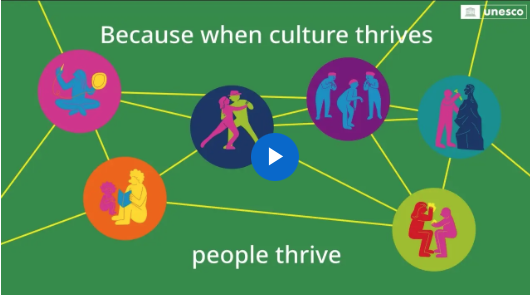
In this animation film the Memory of the World Committee of the Netherlands shows the importance of documentary heritage and the rationale behind Unesco’s Memory of the World Programme.

The film was created by Studio Noord (www.studionoord.nl | CC BY-NC-ND). It was commissioned by the Memory of the World Commitee of the Netherlands and the Netherlands Commission for Unesco. Images have been used of documents that have a Memory of the World designation. The Netherlands MoW Committee wishes to thank the affiliated institutions for making these images available for this film.

For further information about the project, see The Future of Collective Memory: Preserving the Past in a Digital Age. The Memory of the World International Register is available here.

CFP: UNESCO Youth for Peace 2025

“UNESCO”
Youth for Peace: UNESCO Intercultural Leadership Programme, UNESCO, Paris, France. Deadline: 22 June 2025.

Empowering young leaders to drive change through intercultural dialogue

The Youth for Peace: UNESCO intercultural leadership programme is an initiative designed to equip emerging leaders with the skills, knowledge, and resources to champion intercultural dialogue as a strategy to address pressing global challenges. Through this programme, UNESCO is cultivating a new generation of champions for dialogue, cohesion, and peace, empowering them to lead transformative action at local, national, and global levels. In its first year of operation, the theme for the Programme will be ‘Learning to collaborate for a shared future: Using dialogue to foster social cohesion in a world on the move’.

Selected participants will become part of a dynamic, international network of young leaders and changemakers, gaining the opportunity to champion intercultural dialogue and drive meaningful impact in their communities. This immersive journey includes capacity-building, financial grants, ongoing mentorship and an opportunity raise your voice on an international platform. More importantly, it fosters long-term engagement in a community of leaders committed to using dialogue to drive solutions and shape policies that promote cohesion and foster peace. The programme is a key part of UNESCO’s “Road to Peace: Dialogue and Action for Tolerance and Intercultural Understanding” initiative, amplifying youth-led action and contributing to systemic change worldwide.

UNESCO Intercultural Competencies for Peacemaking VI

“UNESCO”

Sixth Regional Expert Consultations on Intercultural Competencies for Peacemaking: North America, UNESCO, 29 September 2023, 15:00 to 17:00 GMT+2, (Paris, France, but online).

UNESCO’s Social and Human Sciences Sector has launched the UNESCO Series of Regional Expert Consultations on Intercultural Competencies for Peacebuilding. Through these consultations, UNESCO aims to explore the potential of the development of intercultural and socio-emotional skills to serve as an enabler for peace in fragile, conflict-affected and post-conflict contexts.

The sixth, and final, regional edition in a series of online expert consultations will focus on North America and will be held on Friday 29 September 2023, from 15:00 to 17:00 GMT+2 (via Zoom). The sixth edition will bring together experts and practitioners to discuss the main challenges to intercultural understanding in the region, the role of intercultural skills in building trust among different parties, and ways of improving intercultural competence to better promote peacebuilding efforts, paying particular attention to the role of women and youth.

To register for the online event, please click here.

UNESCO Intercultural Competencies for Peacemaking V

“UNESCO”

Fifth Regional Expert Consultations on Intercultural Competencies for Peacemaking: Arab States, UNESCO, 21 September 2023, 15:00 to 17:00 GMT+2, (Paris, France, but online).

UNESCO’s Social and Human Sciences Sector has launched the UNESCO Series of Regional Expert Consultations on Intercultural Competencies for Peacebuilding. Through these consultations, UNESCO aims to explore the potential of the development of intercultural and socio-emotional skills to serve as an enabler for peace in fragile, conflict-affected and post-conflict contexts.

The fifth of the six regional editions of online expert consultations will focus on Arab States and will be held on Thursday 21 September 2023, from 15:00 to 17:00 GMT+2 (via Zoom). The fifth edition will bring together experts and practitioners to discuss the main challenges to intercultural understanding in the region, the role of intercultural skills in building trust among different parties, and ways of improving intercultural competence to better promote peacebuilding efforts, paying particular attention to the role of women and youth.

To register for the online event, please click here.