

CFP Interculture Journal: Special Issue 2025

“Publication

Call for papers: Interculture journal special issue, to be published in 2025; articles may be in English, German, French, Spanish, or Portuguese. Deadline: 30 August 2024.

“Embracing a Relational Paradigm to Navigate Cultural Complexity.” Organizers invite scholars from diverse disciplines, including but not limited to cultural studies, communication studies, organizational theory, anthropology, sociology, psychology, and philosophy, to contribute conceptual contributions, empirical studies, interviews and reviews that explore a relational view on cultural complexity and its conceptual and practical implications. Topics of interest include but are not limited to:

• Mapping the current developments and trends in intercultural communication under the lens of a relational paradigm • Overview of relational concepts in the field of intercultural communication (e.g. Bolten 2020, etc.)
• Theoretical frameworks for understanding the creation of shared meaning and action
• The role of relational processes in shaping culturally complex events and practices
• Strategies for navigating cultural complexity in organizational contexts
• Innovative approaches to cross-cultural communication, management and cooperation
• Implications of cultural complexity for inter- and transcultural competence and training
• The impact of globalization and digitalization on inter-, cross- and transcultural practices
• Methodological approaches for studying relational aspects of cultural complexity
• Teaching and learning concepts building on a relational view on cultural complexity.

Submissions should engage with contemporary debates and offer insights into the potentials of a relational paradigm for the fields of intercultural communication, multicultural teamwork or transcultural cooperation.
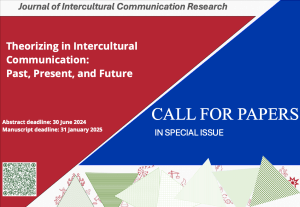
CFP JICR: Theorizing in Intercultural Communication: Past, Present, and Future

“Publication

Call for papers for a special issue of the Journal of Intercultural Communication Research on Theorizing in Intercultural Communication: Past, Present, and Future Deadline: abstract only, 30 June 2024.

Special issue editors:
Alice Fanari (Northeastern University, USA)
Diyako Rahmani (Massey University, New Zealand)
Mélodine Sommier (University of Jyväskylä, Finland)

JICR Special Issue posterThis special issue offers a platform to discuss theories that have shaped the field of intercultural communication and consider how they may need to be adapted to reflect major contemporary issues. Authors are invited to submit original manuscripts that focus on the development of intercultural communication theorizing that contribute to our understanding of individual-level and societal-level phenomena at the international, intercultural, or cross-cultural level. The editors encourage manuscripts from a wide range of scholarly areas and welcome all methodological approaches. Both empirical research reports and theoretical or conceptual essays are welcomed. In addition to an emphasis on methodological pluralism, they encourage submissions that reflect global, underrepresented, and/or marginalized experiences.

CFP Bordering in Translingual Space, Languaging in Bordered Space

“Publication

Call for papers for a journal special issue on Bordering in translingual space, languaging in bordered space: Re-framing ‘languages’ in
the post-Yugoslav space. Deadline: abstract only, 30 June 2024.

Special issue editors:
Kristof Savski (Prince of Songkla University, Thailand)
Ana Tankosić and Eldin Milak (Curtin University, Australia)

In this special issue, editors propose to collect examples of scholarship on the post-Yugoslav space, a geographic area in which the study of translingual practice (Canagarajah, 2012) demands an approach sensitive to events in the recent past. By ‘post-Yugoslav space’, they refer to the territories formerly part of Kingdom of Yugoslavia (1918-1941) and to the Socialist Federal
Republic of Yugoslavia (1945-1991), as well as cross-border areas in which the languages associated with this region are spoken – among others, these include Albanian, Bosnian, Croatian, German, Hungarian, Italian, Macedonian, Montenegrin, Romani, Serbian and Slovene. A key challenge to the study of translingualism in this space is that it must account for the existence of numerous linguistic continua, including the well-documented Bosnian-Croatian-Serbian-Montenegrin continuum as well as those found in minoritized regions (e.g., Slovene-Croatian-Italian in Istria). In these continua, borders imposed by historic political processes exist in continuous tension with different forms and levels of mutual intelligibility, facilitated by linguistic similarity and ongoing cultural contact, but often obstructed by antagonistic narratives of belonging.

CFP International Review of Sociology: Precarity and Peacebuilding

“Publication

Call for papers for a special issue of the International Journal of Sociology on Precarity and Peacebuilding: Sociological Insights into Global Challenges and Local Responses. Deadline: abstract only, 30 May 2024.

Special issue editor:
Tamanna M. Shah (Ohio University)

The concept of precarity, primarily examined within the economic and labor domains, symbolizes the instability and vulnerability faced by individuals and communities across various societal dimensions. This special issue aims to reframe precarity within the sociological discourse of peacebuilding, exploring how precarity not only influences but also intersects with efforts to build peace in regions marred by conflict and instability. It aims to extend the conversation beyond economic conditions to include cultural, political, and social factors that contribute to precarity and impact peacebuilding processes. The issue is motivated by an understanding that precarity transcends geographical and cultural boundaries, presenting a global challenge that requires sociological insight and innovative policy responses.

This special issue calls for submissions that unpack the complex dynamics of conflict, peace, and instability through a sociological lens. It will examine existing policies and social movements, identify best practices, and explore innovative approaches to peacebuilding to make recommendations for policymakers, practitioners, and civil society actors working in conflict-affected areas. These recommendations may include policy reforms, grassroots initiatives, community-based interventions, and advocacy campaigns aimed at addressing the root causes of conflict, promoting dialogue and reconciliation, and building sustainable peace from the ground up. By situating the discussion within varied geopolitical contexts – from armed conflicts and political violence to economic crises and social unrest – this issue aims to contribute to positive social change, enhance resilience, and promote peace and stability in precarious contexts around the world.

CFP CIDOB International Yearbook 2024

“Publication

Call for papers by young researchers: CIDOB International Yearbook 2024. Deadline: 10 May 2024.

The CIDOB International Yearbook is an annual volume devoted to the analysis and study of international relations and politics. Published continuously since 1990, over its 33 editions the Yearbook has become a standard volume for experts and academics studying international affairs and a key Spanish-language tool for analysing international dynamics, drivers of change and future challenges in international politics, security and economics.

With the aim of giving young researchers a voice, CIDOB is launching its 5th Call for Papers on the Analysis of International Relations, which is addressed to students, experts and analysts under the age of 30 in order to encourage a renewed vision of today’s international challenges.

The articles presented should fit into one of the following thematic categories:

  • The Global South in the international order
  • The rise of the new international right
  • The age of insecurity

Since the call is explicitly aimed at young researchers, the authors must be a maximum of 30 years of age on May 10th 2024.

Papers should be 1,200 words in length in English, and 1,500 in Spanish/Catalan.

CFP Reconciliation: The Final Step in Achieving Nonviolent Social Change

“Publication

Call for submissions: Reconciliation: The final step in achieving nonviolent social change. Deadline: abstract and outline: 1  June 2024; entire chapter: 1 November 2024.

Volume Editors: Amy Aldridge Sanford (Middle Tennessee State University), Kathryn B. Golsan (University of Northern Iowa), Kristina M. Scharp (Rutgers University), and Stephen A. Spates (Michigan State University)

Reconciliation: The Final Step in Achieving Nonviolent Social Change is the working title for an edited collection that will feature writings dedicated to the final step of Rev. Dr. Martin Luther King, Jr.’s “Six Steps of Nonviolent Social Change.”

The editors are seeking chapters related to social justice reconciliation in (a) interpersonal relationships, (b) geographic spaces, and (c) institutions. Co-authored chapters that include both scholars and practitioners are especially welcome. Academic training and credentialing could come from many areas, including social sciences, humanities, behavioral sciences, business, education, law, etc.

Abstracts and skeletal outlines are due by June 1, 2024. If selected, authors will be given four months to submit a chapter of about 6,000 words. The editors are under contract with Cognella Academic Publishing and plan to debut the book at NCA 2025.

To view the full call, which includes a full list of editors, the inspiration and vision, how the book is organized, and a tentative timeline for the process, visit here.

Please direct any questions to Amy Aldridge Sanford.

CFP Global South Diasporic Voices

“Publication

Call for Papers for a special issue of Journal of Global Diaspora & Media: Global South Diasporic Voices: Rethinking Praxis and Theory in Communication for Development. Deadline: for abstracts: 26 April 2024; for manuscripts: 19 September 2024.

Issue editors: Carolyn Walcott (Clayton State University), Maha Bashri (United Arab Emirates University), and Farooq Kperogi (Kennesaw State University).

The special issue aims to spotlight the crucial roles of diasporas from the Global South in shaping development narratives through information and communication technologies (ICTs) and beyond.

As the world witnesses significant shifts in global migration patterns, the voices of the diaspora emerge as potent agents in redefining the landscape of Communication for Development (C4D). This call seeks to explore how diasporic interventions challenge existing C4D paradigms by integrating indigenous knowledge systems and leveraging digital diasporas.

Editors invite contributions that:

  • Offer theoretical reconceptualizations of C4D within the diaspora and transnational contexts.
  • Provide case studies on the use of media and ICTs by diasporas in development, including social media’s impact.
  • Analyze the challenges and opportunities of digital diasporas in shaping development agendas.
  • Critically examine diaspora negotiations of identity, representation, and politics in media narratives around development.

CFP Navigating Perspectives: Finding Balance between Self-regard and Greater-regard in Conflict

Conferences

Call for proposals: Navigating Perspectives: Finding balance between self-regard and greater-regard in conflict, High Density Panel for the Peace and Conflict Communication Division of the National Communication Association. Deadline: 29 March 2024.

Volume Editors: Jennifer Sanmiguel (University of Texas, Dallas), Elvis Nshom (California State University, San Marcus),  Erica Knotts (Southern Oregon University)

In the intricate and multifaceted terrain of conflict, the concept of positionality stands pivotal yet is frequently overlooked. Understanding positionality and its various lenses (the individual, group, social, cultural, economic, etc.) is crucial for comprehending the dynamics of conflicts, as it influences how parties perceive themselves, each other, and the issues at stake. Failure to acknowledge and account for positionality can and may lead to misunderstandings, biases, and ineffective conflict resolution strategies. Therefore, understanding positionality as a whole is essential for navigating the complexities of conflicts and fostering meaningful dialogue and reconciliation.

Central to this discussion, the editors hope to explore the notion that effective communication in conflicts requires a balance between empathy and compromise for others, (communication with greater regard) while still maintaining one’s self-regard. While it is critical to empathize and engage with different positions and perspectives, It is equally important to uphold one’s own identities, values, and convictions. What are the strategies for balancing these two? How do we enable individuals to navigate and communicate conflicts with greater regard for both selves and others? How do we foster constructive dialogue and mutual respect within divergent and polarizing viewpoints?

CFP Global Perspectives on Soccer and the Media and Entertainment Industry

“Publication

Call for submissions: Global Perspectives on Soccer. Deadline: abstract: 17  March 2024; entire chapter: 9 June 2024.

Volume Editor: Dr. Floribert Patrick C. Endong (University of Dschang, Cameroon)

Over the years, the political significance of football in the world has tremendously grown. This is so irrespective of the fact that national and international footballing authorities – notably the FIFA and the African Football Confederation – have most often claimed to be apolitical. In countries across the world, footballing bodies, clubs and supporters have tended to lean left or right; some have been key voices in the promotion of religious identities and ethnocentrism.

Big sporting events such the FIFA World Cup tournament have similarly been highly politicised. The World Cup in particular has been a site of political protests that have sometimes resulted in boycotts and scandals.

Although a good number of scholars have researched the interaction of football with politics, very little scholarly attention has particularly been given to how this interaction seriously inspires media and artistic/cultural production in the world. In order to fill this gap in knowledge, the present book seeks to explore the interaction between political football and cultural production in the fields of mass media and the entertainment/creative industries.

This book is aimed at providing different perspectives on the interactions between political football and global media and entertainment industries. These perspectives may be historical, religious, socio-cultural and political among others. The book equally seeks to explore representations of football politics in diverse media notably cinema, television, games, magazines, comics, photojournalism, advertising and online platforms among others.

CFP Football Politics and Cultural Production in Africa

“Publication

Call for submissions: Football Politics and Cultural Production in Africa: Issues and Discourses. Deadline: abstract: 30  April 2024; entire chapter: 30 August 2024.

Volume Editor: Dr. Floribert Patrick C. Endong (University of Dschang, Cameroon)

In the popular imaginary, sports and politics do not mix. In line with this, most international footballing authorities – notably the International Governing Body of Association Football (FIFA), and the African Football Confederation (CAF) – claim to be apolitical in their modi operandi. They also claim not to be involved in the political affairs of countries. Yet, football remains one of the most politicised phenomena in the world. Football in Africa has likewise been political or politicised at all levels.

Against this background, the present project focuses on engaging academics in various disciplines to interrogate the interaction between political football and cultural institutions in Africa. Specific attention is given to the media and the creative industries in Africa. The editor, therefore, calls for chapters relating to:

 Football politics and the African creative artist
 Football politics and media production/programming in Africa
 Football politics, hate speech and the social media in Africa
 Football art and political activism in Africa
 Football politics, xenophobia and media diplomacy
 Politics and the organisation of football events in Africa
 Politics, football management and the socialites in Africa
 The opening ceremonies of football competitions and political propaganda in Africa
 Football politics and dance in Africa
 Football politics and cultural activism in Africa
 The representation of football politics in African cinemas
 The representation of football politics in visual arts
 Football politics and musical production in Africa
 Football politics, advertising and branding
 Football politics and traditional media in Africa
 Football politics and diasporic cultures
 Football, the arts and technological innovation
 Football politics, the arts and sustaining peace in Africa
 Football politics, gender and the arts in Africa