CFP JALT: Intercultural Competencies and Higher Education

“Publication

Call for submissions to a special issue of the Journal of Applied Learning and Teaching on Intercultural Competencies and Higher Education. Deadline for abstracts: 31 December 2024; full papers will be due 30 April 2025.

Guest Editor: Dr. Kyriaki Koukouraki.

In today’s globalized world, fostering intercultural understanding and skills in higher education is more crucial than ever. This special issue aims to explore innovative approaches, research, and practices that enhance intercultural competencies among students, educators, and institutions. Potential submissions may include: research articles, opinion pieces, brief articles, case studies, and book reviews

Topics of Interest Include (but are not limited to):
– Intercultural Competencies and Faculty Development
– Intercultural Competencies and Assessment
– Intercultural Competencies and Global Citizenship
– Non-Western approaches to Intercultural Competencies

CFP ALF Knowledge for Action

“Publication

Call for proposals for Anna Lindh Foundation Knowledge for Action. Deadline: 9 September 2024.

The ALF Knowledge for Action Programme is designed to promote the production of evidence-based and policy-oriented research that addresses relevant dimensions of Intercultural Dialogue in the Euro-Mediterranean region through presenting recommendations to facilitate policymaking by evaluating policy options regarding a specific issue. The Programme seeks to enhance collaboration between research/academic institutions (think-tanks, specialised centers, and universities) and civil society organisations.

Briefs or papers adressing the following topics:

  • Peacebuilding, conflict resolution/prevention, coexistence and inclusive dynamics
  • Disinformation and misinformation in the Euro-Mediterranean region
  • Living together promoting tolerance and understanding in the Euro-Mediterranean context
  • Youth engagement in participatory dialogues and decision-making processes in the Euro-Med
  • Ethics and governance of Artificial Intelligence technologies in the Euro-Mediterranean region
  • Social innovation as a catalyst for social inclusion in culturally diverse Euro-Med societies
  • Empowering women in the Euro-Med region as a way to challenge gender stereotypes and beyond
  • Integrating social dimensions in climate change policies in the EuroMed region
  • International cultural relations and cultural diplomacy to bridge both shores of the Mediterranean
  • Creative industries and arts

CFP Televisual Dissidence in an Era of Information Warfare

“Publication

Call for chapters for Televisual Dissidence in an Era of Information Warfare: Separatism, Terrorism and the Screen Media in Africa. Deadline for abstracts: 15 November 2024; full chapters will be due 15 March 2025.

Editors: Dr. Floribert Patrick C. Endong (University of Dschang, Cameroon), and Dr. Augustus Onchari Nyakundi (Chuka University, Kenya).

Since the independence period, the African continent has been home to various insurgent and separatist movements. Some of these violent movements include the Oromo Liberation Front (of Ethiopia), the Al-Shabaab militia (of Somalia and the Horn of Africa), the Islamic Salvation Army (of Algeria), the Casamence Liberation Movement (of Senegal), the Indigenous People of Biafra and the Boko Haram movements (of Nigeria), the Ambazonia Defence Forces and the Ambazonia Restoration Forces (of Anglophone Cameroon) and the FLEC guerrilla (of Angola) among many others. The movements mentioned above have through their military activities and their media-assisted propaganda constituted destabilising forces and threats to the cooperate existence of the nations in which they subsist. They have of recent entrenched the culture of using clandestine television stations and other screen media for separatist and/or terrorist purposes. African central governments’ efforts to counter the above mentioned clandestine screen media-based campaigns have led to a new and complex information warfare which, so far, has been understudied.

Previous research has mainly focused on separatist insurgents’ and terrorist groups’ use of the social media for terror, online extremism, or rebel diplomacy. No serious scholarly attention has been devoted particularly to television and the other screen media as a battlefield for both pro and anti-separatism forces. Meanwhile, television remains a key tool for both central states and insurgents’ efforts towards reaching and controlling the minds of local audiences in particular. According to Article 19, television is the most controlled medium in Africa. How have separatist insurgents and terrorist movements challenged this government control of television in Africa is still grossly understudied. Understanding the ramifications of this struggle to control the minds of local screen media audiences may enable better policy formulation in African states confronted by separatist and terrorist movements. In view of filling the gap mentioned above, the current volume seeks to examine how government institutions’ and separatist movements’ efforts towards controlling television and other screen media in African territories, is giving birth to new broadcasting policy and practices as well all as postmodern televisual cultures and aesthetics. Against this background, the present project focuses on engaging academics in various disciplines to interrogate television broadcasting and other screen media as a site of the information war opposing African governments and separatist groups since the independence period.

CFP Communication Theory: Communication and Constitution

“Publication

Call for papers for a special issue of Communication Theory on Communication and Constitution: Exploring Classical and Emerging Topics Relationally. Deadline: 1 November 2024.

Guest editors: Mariaelena Bartesaghi (University of South Florida, USA), François Cooren (Université de Montréal, Canada), Jimmie Manning (University of Nevada, Reno, USA); Thomas Martine (Audencia Business School, France) and Cynthia Stohl (University of California, Santa Barbara, USA)

In his landmark 1999 article, Communication Theory as a Field, Robert T. Craig called for more dialogue between what he then identified as the seven traditions of communication (rhetoric, semiotics, phenomenology, cybernetic, socio-psychology, sociocultural theory and critical theory). This call was based on two principles: (1) the constitutive model of communication as a metamodel and (2) communication theory as metadiscourse. With his first principle, Craig invited us to acknowledge that each of these different traditions has its own way of thinking the world communicatively and that there is a real payoff in studying various phenomena as being communicatively constituted. With his second principle, he proposed that the communication discipline could be envisaged as a sort of metadiscourse, that is, a discourse about discourse by which we pursue the study of one of the most basic phenomena of our human condition: the act of communicating.

Almost 25 years later, this article can be said to have had a key influence on our field…Echoing John Dewey’s (1916) pragmatist perspective on communication, all these approaches claim, in spite of their differences, that we should not only think of communication as something that happens in, say, organizations, families, or communities, but that these collectives should also be apprehended as constituted in communication…

Against this background, this special issue of Communication Theory aims to address the following questions:

  • What does a constitutive understanding of communication mean for the study of classical and emergent topics, as are identities, ecosystems, sustainability, technology, gender, ethnicity, organizations, relationships, coalitions, power, authority, creativity, discrimination, domination, disability, among others?
  • How can a relational/constitutive perspective enable scholars to see empirical and theoretical linkages among the various subfields of communication. What do these linkages mean in practice?
  • How are worlds communicatively constituted? That is, how is a phenomenon or even any state of being made of or constituted by communication?
  • How might constitutive approaches place communication as a central action or activity by which topics/phenomena can be analyzed and explained?
  • How can we make connections across theoretical traditions via embracing communication theory as a metadiscourse? And how might this shape how we think through our scholarship, especially in terms of theory/theorizing?
  • How, in an increasingly globalized world, might scholars nurture and/or deconstruct the relations that constitute the various phenomena that we as communication scholars study?

Organizers especially encourage empirical and theoretical essays that position communication as an explanans (what does the explaining) and not as an explanandum (what is to be explained). In other words, and in keeping with Craig’s (1999) call, they are looking for manuscripts that show that the world as we know it, in all its instantiations, can be studied and explained relationally, that is, communicatively.

CFP Journal of Dialogic Ethics: Freedom

“Publication

Call for papers for a special issue of the Journal of Dialogue Ethics: Interfaith and Interhuman Perspectives on Freedom. Deadline: extended abstract, 1 July 2024.

This issue will engage the theme of the National Communication Association’s 109th Annual Convention on freedom. The convention’s call recognizes the relationship between human communication and freedom, inquiring into the meaning of freedom and the role of communication in achieving freedom. In response to this theme, the Journal of Dialogic Ethics invites essays that consider connections between and among freedom, dialogue, and ethics, with a special focus on interfaith and interhuman perspectives.

Topics of contributions may include, but are not limited to, scholarly explorations related to academic freedom, freedom of speech, liberation theology, dialogic perspectives on American democracy, and intercultural/intergroup/interpersonal relations.

​The journal also welcome reviews of books at the intersection of dialogue, communication, and interfaith and interhuman perspectives.


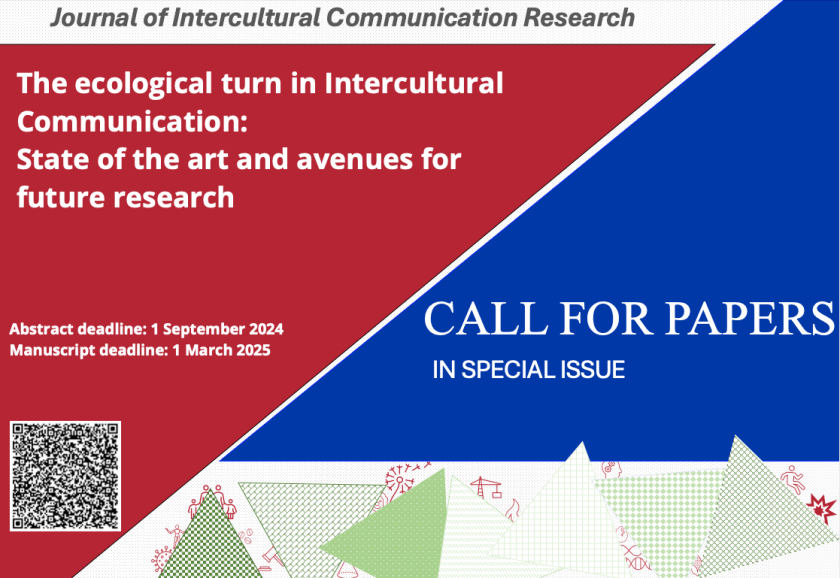
CFP JICR: The Ecological Turn in Intercultural Communication

“Publication

Call for papers for a special issue of the Journal of Intercultural Communication Research on The ecological turn in Intercultural Communication: State of the art and avenues for future research. Deadline: extended abstract, 1 September 2024.

Special issue editors:
Mélodine Sommier (University of Jyväskylä, Finland)
Diyako Rahmani (Massey University, New Zealand)
Alice Fanari (Northeastern University, USA)

Call for papers: Ecological Turn in Intercultural Communication

This special issue hopes to tease out and strengthen the connections between interculturality and ecology by showing what such a dual focus can bring to light. Specifically, the issue editors invite articles engaging with, but not limited to, the following questions and areas of inquiry:

  • How are notions and discourses about culture, identity, community, and borders constructed and mobilized to talk about the ecological collapse?
  • How can a dual focus on interculturality and ecology be used to renew the field of intercultural communication and some of its central concepts such as competence, dialogue or reflexivity?
  • How can a dual focus on interculturality and ecology be applied in research various contexts such as education (e.g. sustainability (language) education), interpersonal relationships (e.g. interspecies dialogue), mediated communication, health etc.?
  • How can the study of interculturality and ecology benefit from and contribute to other lines of work such as decolonial scholarship, environmental justice, pluriversality and post-humanism?
  • What methods and paradigms are particularly useful to explore the interplay between interculturality and ecology?
  • How can the ecological turn in intercultural communication be used to move the field away from the Euro-western-centric production of knowledge and give room to indigenous and marginalized academic voices?

CFP JIIC: Continuing Relevance of the Global South

“Publication

Call for papers for a special issue of the Journal of International and Intercultural Communication on The Continuing Relevance of the Global South (and Where to Find it). Deadline: abstract only, 1 July 2024.

Special issue editors:
Rochelle R Davidson Mhonde (George Mason University)
Zhuo Ban (University of Cincinnati)
Last Moyo (Xian-Jiaotong Liverpool University)

In this special issue, authors are invited to submit proposals that address the theoretical expansion and translatability of critical theoretical frameworks and models across the communication discipline, emphasizing international contexts and intercultural conceptualizations. Editors encourage proposals that shed light on the continuing relevance of the Global South concept influenced by a diverse array of critical perspectives and geopolitically located vantage points (e.g., being “from” the Global South while living in the North). They welcome critical approaches including (but are not limited to) critical race theory, intersectionality, culture-centered approach, decolonial, subaltern studies, queer theory, and indigeneity, among others. Topics could include, for instance, communication issues and problematics emerging from the context of (a) immigrant labor in the new global economic structure, (b) new models of geo-political alliance and colonization, (c) global solidarity of struggles across race, gender, class among other social identities, (d) global discursive field in the age of social media, AI, and digital surveillance, and (e) the challenges in addressing global health disparities and inequities through intercultural health communication and promotion.

CFP Interculture Journal: Special Issue 2025

“Publication

Call for papers: Interculture journal special issue, to be published in 2025; articles may be in English, German, French, Spanish, or Portuguese. Deadline: 30 August 2024.

“Embracing a Relational Paradigm to Navigate Cultural Complexity.” Organizers invite scholars from diverse disciplines, including but not limited to cultural studies, communication studies, organizational theory, anthropology, sociology, psychology, and philosophy, to contribute conceptual contributions, empirical studies, interviews and reviews that explore a relational view on cultural complexity and its conceptual and practical implications. Topics of interest include but are not limited to:

• Mapping the current developments and trends in intercultural communication under the lens of a relational paradigm • Overview of relational concepts in the field of intercultural communication (e.g. Bolten 2020, etc.)
• Theoretical frameworks for understanding the creation of shared meaning and action
• The role of relational processes in shaping culturally complex events and practices
• Strategies for navigating cultural complexity in organizational contexts
• Innovative approaches to cross-cultural communication, management and cooperation
• Implications of cultural complexity for inter- and transcultural competence and training
• The impact of globalization and digitalization on inter-, cross- and transcultural practices
• Methodological approaches for studying relational aspects of cultural complexity
• Teaching and learning concepts building on a relational view on cultural complexity.

Submissions should engage with contemporary debates and offer insights into the potentials of a relational paradigm for the fields of intercultural communication, multicultural teamwork or transcultural cooperation.

CFP JICR: Theorizing in Intercultural Communication: Past, Present, and Future

“Publication

Call for papers for a special issue of the Journal of Intercultural Communication Research on Theorizing in Intercultural Communication: Past, Present, and Future Deadline: abstract only, 30 June 2024.

Special issue editors:
Alice Fanari (Northeastern University, USA)
Diyako Rahmani (Massey University, New Zealand)
Mélodine Sommier (University of Jyväskylä, Finland)

JICR Special Issue posterThis special issue offers a platform to discuss theories that have shaped the field of intercultural communication and consider how they may need to be adapted to reflect major contemporary issues. Authors are invited to submit original manuscripts that focus on the development of intercultural communication theorizing that contribute to our understanding of individual-level and societal-level phenomena at the international, intercultural, or cross-cultural level. The editors encourage manuscripts from a wide range of scholarly areas and welcome all methodological approaches. Both empirical research reports and theoretical or conceptual essays are welcomed. In addition to an emphasis on methodological pluralism, they encourage submissions that reflect global, underrepresented, and/or marginalized experiences.

CFP Bordering in Translingual Space, Languaging in Bordered Space

“Publication

Call for papers for a journal special issue on Bordering in translingual space, languaging in bordered space: Re-framing ‘languages’ in
the post-Yugoslav space. Deadline: abstract only, 30 June 2024.

Special issue editors:
Kristof Savski (Prince of Songkla University, Thailand)
Ana Tankosić and Eldin Milak (Curtin University, Australia)

In this special issue, editors propose to collect examples of scholarship on the post-Yugoslav space, a geographic area in which the study of translingual practice (Canagarajah, 2012) demands an approach sensitive to events in the recent past. By ‘post-Yugoslav space’, they refer to the territories formerly part of Kingdom of Yugoslavia (1918-1941) and to the Socialist Federal
Republic of Yugoslavia (1945-1991), as well as cross-border areas in which the languages associated with this region are spoken – among others, these include Albanian, Bosnian, Croatian, German, Hungarian, Italian, Macedonian, Montenegrin, Romani, Serbian and Slovene. A key challenge to the study of translingualism in this space is that it must account for the existence of numerous linguistic continua, including the well-documented Bosnian-Croatian-Serbian-Montenegrin continuum as well as those found in minoritized regions (e.g., Slovene-Croatian-Italian in Istria). In these continua, borders imposed by historic political processes exist in continuous tension with different forms and levels of mutual intelligibility, facilitated by linguistic similarity and ongoing cultural contact, but often obstructed by antagonistic narratives of belonging.