
 An interesting example of dialogue among cultures by Maria Flora Mangano.
I have just taught a course in a rather unique context. The course was Communication of Scientific Research, offered to students (MSc and PhD) at the Mediterranean Agronomic Institute, located in Bari (in Southern Italy). The Institute is part of the International Centre for Advanced Mediterranean Agronomic Studies, located in Paris.
This course was an extraordinary experience: five days, of 8 hours of lessons per day, supplemented by moments of dialogue during the meals and after dinner. All told, a very intense week, with more than 25 students from Masters and PhD courses in various agronomic disciplines. Among the group, only two were Italian, the other students coming from almost 15 countries in the Mediterranean area, from Kosovo to Morocco.
The course produced many challenges for me: first of all, the fear to propose content in a non-native language, especially topics related to dialogue as a space of relationship among, beyond and across our cultures and disciplines; then the proposal of building this space during all the week, in class and out, with students who came from countries where there are still conflicts.
We discussed in class the attack in Beirut last week, as one student had parents who lived in that zone; the same with the Egyptian students with whom we tried to talk about the 50 deaths in Cairo during the riots in the streets.
It was extremely intense to dialogue with students about the value of the other and otherness, starting from European philosophy, which risked appearing far from all their cultures. I tried to introduce the content starting from keywords, as I usually do in my teaching activities, also in Latin and ancient Greek languages, exploring the meaning of the various terms in all of their languages.
I proposed that every student introduce her or himself in 10 minutes by using whatever tools they wanted. We spent a lot of time in class analyzing their oral presentations, which were delivered by slide, oral speeches, or music (one student played some songs from his country with a guitar).
The issues around scientific research gave me the opportunity to introduce other topics related to the relationship with the other, which are different for every country. I also shared with them the notion of creating a “safe” space of dialogue.
One exercise used the short film, Twice upon a time (about bilingualism in Canada). The results were interesting: the students who came from countries close to the European tradition (if we can use this expression), like Turkey or the Balkans (in particular, Macedonia, Kosovo, and Bosnia), appreciated the movie and found it a fitting conclusion to the lesson. But the students from the Maghreb (Morocco, Tunisia, Algeria) and from the Middle East (Egypt, Palestine, Lebanon) did not enjoy it as much. In fact, they found it boring and a bit excessive, as they did not fully appreciate the issues depicted.
Ramadan started during the course, which provided another wonderful opportunity for sharing and dialogue. The majority of the students in this course were Muslim, but only about half were observant. Those who were needed to fast (not only avoiding food, but also even water), throughout the day, even though in Southern Italy the summer is hot. I proposed to the students that I would participate in their evening prayer, after dinner, for almost one hour, since it was the only one of the five times dedicated to daily prayer that we might share. They were very happy and surprised, as they told me that it was uncommon for a non-Muslim to join in prayer with them.
At the end of the sessions we had ice cream in the garden (the campus is really beautiful), after dinner and after prayer. It was another occasion for interaction among the group members, including some students who were not enrolled in this course.
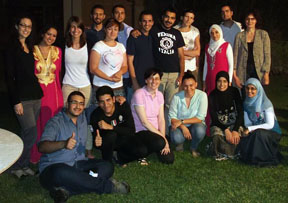
I asked students to send me their feedback and so I have been receiving beautiful notes. I have the feeling that we shared something new, beyond only disciplinary content, as many of them have now told me.
Download the entire post as a PDF.

