CFP: Institute of General Semantics Symposium on Communication, Consciousness, and Culture (USA)

“Collaborative

Call for papers and proposals for Communication, Consciousness, and Culture: A Symposium Sponsored by the Institute of General Semantics, co-sponsored by the New York Society for General Semantics, Media Ecology Association, International Bateson Institute, Tomkins Institute, and the 404 Festival of Art and Technology, September 20-22, 2024, The Players, 16 Gramercy Park South, New York, NY 10003. Deadline: 18 August 2024.

Organizers welcome papers and proposals that fit the symposium theme or that otherwise relate to the topics of general semantics, linguistics and semiotics, media ecology, communication and culture, science and the empirical method, epistemology and phenomenology, cybernetics and systems theory, technology and society, art and perception, cognition and consciousness, evolution and emergence, health and human potential, etc.


CFP: Civitates: Civil Space in Europe

GrantsCall for proposals: Civic Power: Protecting and Expanding Civic Space in Europe, Civitates, Brussels, Belgium. Deadline: 18 August 2024.

Civic Power – Anchor Grantees (Slovakia, Romania, Bulgaria, Hungary, Poland, and France). Civitates envisions democracy in Europe being strengthened by an independent civil society powered with the resources, constituencies and capabilities to protect and expand civic space and mobilise support for democratic principles, particularly at moments of emerging opportunity and threat.

Therefore, Civitates announces a call for proposals open to civil society organisations registered in Slovakia, Romania, Bulgaria, Hungary, Poland, and France. With this call Civitates aims to build the readiness and power of civil society in the selected European Union countries to protect and expand civic and democratic space, particularly at key social and political moments. Civitates seeks to support civil society to anticipate transformative moments which present opportunities and threats for civic space and enable it to develop and implement strategies to address these. Civitates sees a need to support civil society to build the capabilities needed to meet such opportunities. This can help broader civil society to understand the emerging threats to their space but also enable coalitions in countries where that threat has already clearly manifested to prepare for social and political events that help them to push back against the trend.

Civitates would be looking to support at least one anchor group in each country to lead this work. Anchor grantee will be given flexible, core support up to 120,000 EUR over two years.

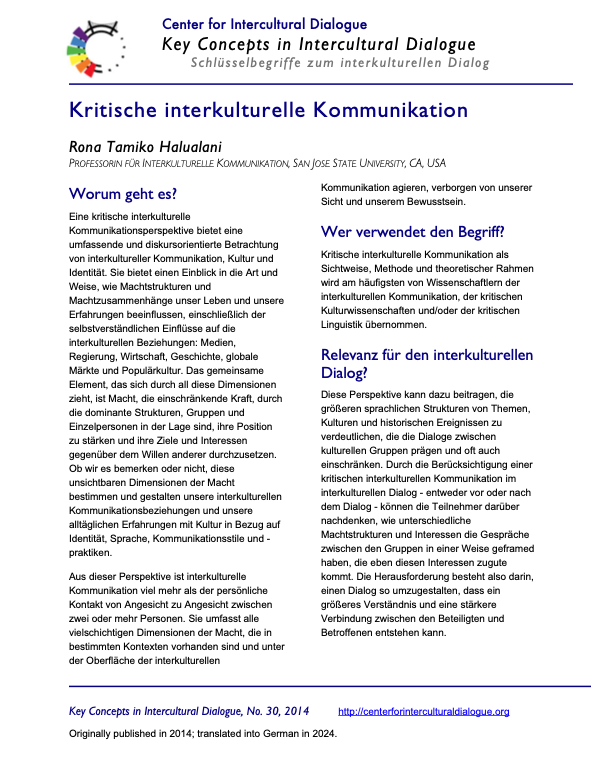
KC30 Critical Intercultural Communication Translated into German

Key Concepts in ICDContinuing translations of Key Concepts in Intercultural Dialogue, today I am posting KC#30: Critical Intercultural Communication, which Rona Tamiko Halualani wrote for publication in English in 2014, and which Marlena Pompino has now translated into German.

As always, all Key Concepts are available as free PDFs; just click on the thumbnail to download. Lists of Key Concepts organized chronologically by publication date and number, alphabetically by concept, and by languages into which they have been translated, are available, as is a page of acknowledgments with the names of all authors, translators, and reviewers.

KC30 Critical Intercultural Communication in GermanHalualani, R. T. (2024). Kritische interkulturelle Kommunikation. (M. Pompino, trans). Key Concepts in Intercultural Dialogue, 30. Retrieved from: https://centerforinterculturaldialogue.org/wp-content/uploads/2024/06/kc30-critical-intercultural-communication-_german.pdf

If you are interested in translating one of the Key Concepts, please contact me for approval first because dozens are currently in process. As always, if there is a concept you think should be written up as one of the Key Concepts, whether in English or any other language, propose it. If you are new to CID, please provide a brief resume. This opportunity is open to masters students and above, on the assumption that some familiarity with academic conventions generally, and discussion of intercultural dialogue specifically, are useful.

Wendy Leeds-Hurwitz, Director
Center for Intercultural Dialogue


Creative Commons License
This work is licensed under a Creative Commons Attribution-NonCommercial-NoDerivatives 4.0 International License.