CFP Taos Institute: Co-Creating Social Worlds (USA)

Conferences

Call for papers: Co-Creating Social Worlds Symposium, Taos Institute, held at Mercy University, New York, NY, USA, 27-28 February 2026. Deadline: 15 November 2025.

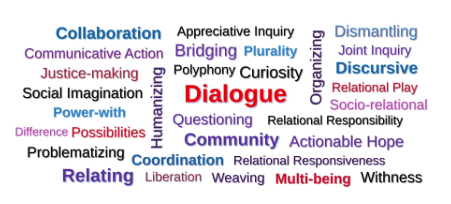
Amid dissonance and division, gather as improvisers of possibility, ensemble players in care, and weavers of bridges toward a more generous world—an ecology of connection where human and more-than-human lives entwine in fragile, co-creative rhythms, reminding us that we belong to a living, breathing assemblage greater than ourselves. Join for a vibrant gathering across disciplines to deepen our connections and spark meaningful collaboration–re-imagining our personal, public, and political lives.

word cloud for Co-Creating Social Worlds

Taos Institute: Strategies for Opening Master Conflict Narratives (Webinar)

EventsStrategies for Opening Master Conflict Narratives, Pulsating Practices: Constructionism in Action, Taos Institute (Webinar), 5 November 2025, 1-2:30 EST.

With Sara Cobb (Director of the Institute for Conflict Analysis and Resolution, George Mason University, USA)

Persistent conflicts, such as wars, the rise of fascism, political and social conflicts over colonialism, marginalization, climate change, race, etc., depend on “master narratives” that keep the parties prisoner to their own logics, their descriptions of histories, and their vision of possible futures. We see master narratives at work, constructing the world, from the local to the global level, in personal conflicts where families fracture over their ideological differences, in communities divided by race, in professional settings where “merit” seems to challenge “diversity” and vice versa, in political settings where “science” is in opposition to “belief,” and of course, in violent conflicts. Indeed, the more persistent the conflict, the more power master narratives have, to maintain the conflict by sealing themselves off from re-interpretation or evolution. From this perspective, conflict transformation or even conflict evolution depends on opening master narratives to new logics/descriptions.

This webinar offers a strategy for evolving master narratives via the development of “proximate narratives.” Drawing on case examples, we will define ”proximate narratives” and explore how they can function to open new pathways for conflict transformation. Finally, we will practice the development of proximate narratives in our own master narratives and explore our experience of this process, sharing insights, for our collective learning.

Taos Institute: Crafting Peace Through Autoethnography (Webinar)

EventsDialogue with the Author: Crafting Peace Through Autoethnography, Reflexive Pedagogies for Navigating Difficult Times, Taos Institute (Webinar), 24 October 2025, 12-1:30 EDT.

With Susan Riva (Switzerland),  Sheila McNamee (USA) and Robin Cooper (USA).

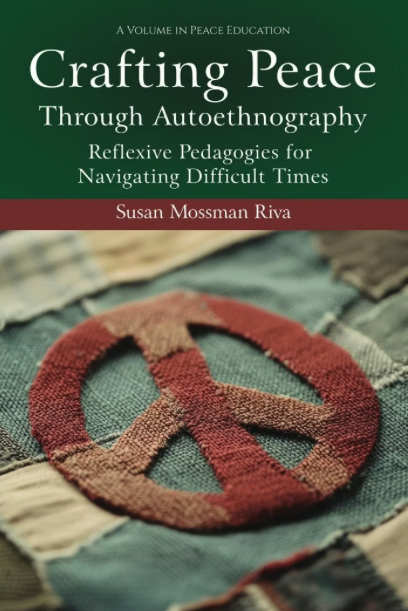
Crafting Peace by Susan Riva book cover

With a foreword by Sheila McNamee and an afterword by Robin Cooper—both scholars from the Taos Institute—the book Crafting Peace Through Autoethography: Reflexive Pedagogies for Navigating Difficult Times is grounded in a social constructionist perspective and offers a reflective framework for navigating complexity in higher education.

In this work, Riva introduces the Transformational Learning Model and feature students’ Transformagram Portfolios—creative, personal expressions of their transformative learning journeys. She also shares how her online courses provide a safe and supportive virtual space for accompanying students through deeply experiential and reflective processes.

At Creighton University, her conflict resolution course uses personal conflict narratives to connect lived experience with theoretical frameworks. Students craft story mandalas and engage with autoethnography as a social science method, deepening their understanding of conflict, identity, and personal transformation.

Taos Institute: Facilitating Participant Dialogues in Research (Webinar)

EventsFacilitating Participant Dialogues in Research, Pulsating Practices: Constructionism in Action, Taos Institute, NM, USA, (Webinar), 8 October 2025, 10-11:30 EDT.

With Norma Romm (University of South Africa) and Francis Akena Adyanga (Kabale University, Uganda).

The Taos Institute invites you to join this webinar where Norma and Francis showcase how, as professional researchers, they have worked alongside research participants with the intent that fruitful constructions can be dialogically generated via the research process. The examples will indicate how research participants can participate in reconstructing ways of living together in relation to their expressed concerns.

The research setting that will constitute the prime example in this webinar was Francis and Norma’s effort to intervene in peace-building between farmers and pastoralists in the context of land disputes in Northern Uganda. Through focus group facilitation, participants came to discuss new options for their co-existence and were appreciative of how the research process contributed to this.

The webinar will also refer to another example in Northern Uganda where participants in a community were distressed by the practices of certain foreign-owned companies and mobilized resistance. As part of their dialoguing around their (relatively successful) efforts, they offered re-constructions of the notion of “development”. Finally, Francis and Norma will point to research in South Africa exploring Indigenous practices for advocating food sovereignty (as a counterpoint to globally dominant narratives around “food security”).

The webinar will invite audiences to reflect upon (and discuss) their roles as professional or lay researchers in shaping social and ecological life.

Taos Institute: Co-Creating Futures – An Introduction to Social Construction (USA but Online)

Professional OpportunitiesSelf-paced online course: Co-Creating Futures – An Introduction to Social Construction, Taos Institute, Dallas, TX, USA. (no deadline, but available as of April 2025)

Provocative, unsettling, liberating, inspiring … all have been applied to the dialogues on the social construction of knowledge. The ideas have swept across the academic world and into personal and professional life. For many, they contain the ingredients for a promising life together on this planet.

In this new self-paced online course, Ken Gergen introduces the transformative ideas of social construction, challenging traditional notions of objectivity, truth, and knowledge. Emphasizing that our views of reality emerge through our relationships, the course explores the powers and limitations of language, the design of dialogues, and the transformation of conflict.

Through 6 modules, each featuring 3 short videos by Ken Gergen, you will explore and critique approaches that prioritize claims to truth, prediction and control. You will develop a curiosity and appreciation for multiple perspectives, stories, and values. Applications range from therapy, consulting, coaching, education, healthcare, research, governance, community development, to your personal life. In addition, you will learn how adopting a constructionist stance offers significant resources for transforming political, religious and organizational divides.

This self-paced course will challenge your current worldview, inspire innovation in your profession, and point to means of moving more harmoniously in every-day relationships.

The course is composed of 6 modules in 18 parts. Each part features a short video and lecture as well as questions for reflection. Topics include:

Module 1: Multiple Realities
Module 2: Facts & Values
Module 3: Language
Module 4: Making Knowledge
Module 5: Social Construction in Action
Module 6: Peace and Conflict

Sign up now to take part in a next live group meeting with Ken Gergen and Loek Schoenmakers on July 8, 2025, 10-11am EST! (Open to all registered participants.)


Cultural Dialogue at Home – Austrian Hosts and Syrian Refugees

Resources in ICD“ width=

Cultural dialogue at home – Austrian hosts and Syrian refugees: An autoethnographic narrative by by Corina Ahlers (printed version, 2019; Taos Institute Publications WorldShare Books version, 2024). The ebook version is free to download.

This book is filled with tender, funny and frustrating scenes, as Viennese and Syrian cultures meet and mingle, and sometimes clash. Much can be learned about multicultural relations by reading this book.

In 2015 a great influx of Syrian refugees flooded Europe. Vienna was one of the cities that had a large group of people with no place to be. Many citizens who were sympathetic to these people became involved in charitable projects, including providing food, money, and other forms of care. Few went so far as to open up their homes so that refugees could live with them. This book describes the experience of Corina Ahlers, a family therapist and teacher, who opened up the apartment on the ground floor of her home, in a lovely suburb of Vienna to several refugees. Inter-cultural experiences of a great variety are described, as Corina, her husband, Reinhard, and their dog, invite their new residents to share in the Austrian lifestyle, as they open themselves to share in theirs. In the first month they hosted two men (Tarek, age 45 and Can, age 33). One month later, the second wife of Tarek, a widow with a little girl (Samira, age 25 and Leyla, age 6), arrived. Tarek’s first wife arrived in Vienna with 5 children (aged 18, 17, 14, 10, and 9) six months later. Previously his first family had lived in a big Jordanian refugee camp. From the moment his first family arrived, he switched between Corina’s house, where his second wife and her daughter lived, and the new home of his first family in another district of Vienna. Can had no relatives in Austria, and he stayed until May 2016. Tarek, Samira and Leyla moved out at the end of 2017. They found a one-room apartment on the other side of the city, very near to Tarek’s first family’s flat.

Related publication: Key Concept #1: Intercultural dialogue by Wendy Leeds-Hurwitz.

Taos Institute: Pathways to Relational Resilience Dec 2024

EventsPathways to Relational Resilience: Creating relational resilience in the midst of conflict through the use of the arts and reflective dialogue, Taos Institute, 6 December 2024, 10:00am-12:30pm and 2:00-4:00pm EST (online).

Hosted by Taos Institute Vice-President, Sheila McNamee and Taos Institute Associate and Artsbridge Founder, Deb Nathan. Whether it’s conflict between nations, within families, between partners, or with colleagues, it is challenging to find ways to move beyond conflict towards greater understanding and an appreciation of difference. However, it is not impossible, and hope can be found even amid the deepest of divides. How do we hold on to our beliefs while making room for other perspectives? As the political and social aspects of the world in which we live become more polarized, how do we learn to tolerate difference and listen to viewpoints that differ dramatically from our own? How do we work together and learn to value difference?

This online workshop features relational alternatives to more traditional approaches to conflict resolution. Participants will explore a unique approach to engaging with conflict that encourages the development of relational resilience by helping them learn to think critically and creatively, and to appreciate the value of difference.

Participants will engage in interactive experiences that incorporate the utilization of art and reflecting dialogue to illustrate how the two can work together to shift from conflict to curiosity and generate constructive understandings of difference.

Positive Approaches to Peacebuilding: A Resource for Innovators

Resources in ICD“ width=

Positive Approaches to Peacebuilding: A Resource for Innovators by by Cynthia Sampson, Mohammed Abu-Nimer, Claudia Liebler, and Diana Whitney (printed version, 2010; Taos Institute Publications WorldShare Books version, 2024). The ebook version is free to download.

Positive Approaches to Peacebuilding presents an innovative perspective on peacebuilding that breaks new ground. The theoretical frameworks are rich enough to satisfy scholars, the case studies are practical enough to engage practitioners and the tips and guides to practice are sure to inspire new and innovative work among peacebuilders. This book beautifully describes the social construction of imagined futures, inviting us, as scholar-practitioners, to move beyond ‘problem solving’ and its ethic of ‘neutrality,’ towards Appreciative Inquiry, and its ethics of narrative, voice, and meaning-making, relying on the heart-wisdom that flourishes in the context of affirmation This book powerfully delivers what it promises — a provocation to think more deeply about how we conduct our peacemaking and peacebuilding relationships. A must read for those who dare to make a difference.

Related publication: Key Concept #64: Peacebuilding by Elenie Opffer; Seeds of Dialogue.

Celebrating The Other: A Dialogic Account of Human Nature

Resources in ICD“ width=

Celebrating The Other: A Dialogic Account of Human Nature by Edward Sampson (printed version, 2008; Taos Institute Publications WorldShare Books version, 2024). The ebook version is free to download.

In this important book, Sampson launches a new attack – this time on Western culture’s centuries-long preoccupation with a contained, individualistic, monologic Self and its fearful suppression of all that is Other – all that is experienced as different from the implicit, self-affirming white male standard.

This view, he demonstrates, focuses more on the leading protagonist and supporting cast that he has assembled to service his own interests, desires and fears, than on others as viable people in their own right. Denying the Other so as to create a world secured on behalf of the dominant groups’ interests has become an obsession driving not only the larger culture but also the human sciences, in particular psychology’s theories of human nature. Women, African-Americans and others not of the dominant classes have been constructed as serviceable Others, and appear in textbooks, journals and popular accounts as figures whose images and everyday realities have been created to serve the dominant groups’ desires.

Sampson uses the writings of Mikhail Bakhtin, George Herbert Mead, and postmodern and feminist theorists to reject this dangerous obsession and to create a dialogic foundation to replace the Other-suppressing views of psychology, and indeed, of all Western culture. Sampson’s arguments are convincing, liberating, and have major implications for the human sciences and the people they claim to serve. ‘Celebrating the Other’ changes the way human nature is viewed and studied. As the author reminds us, in silencing the Other we distort our own situation and stunt our opportunities for growth – ‘no one voice can be quoted without losing the greatest opportunity of all: to converse with otherness and to learn about our own otherness in and through those conversations.’

Related publications: Key Concept #39: Otherness and the Other by Peter Praxmarer; Seeds of Dialogue, Guest post by Maria Flora Mangano.

Taos Institute: Pathways to Relational Resilience 2024

EventsPathways to Relational Resilience, Taos Institute, 31 May-1 June, 2024, 12:00pm-2:30pm EDT each day (online).

A 2-part workshop featuring the use of the arts and reflective dialogue to create relational resilience in the midst of conflict. Hosted by Taos Institute Vice-President Sheila McNamee and Taos Institute Associate Deb Nathan.

Whether it’s conflict between nations, within families, between partners, or with colleagues, it is challenging to find ways to move beyond conflict towards greater understanding and an appreciation of difference. However, it is not impossible, and hope can be found even amid the deepest of divides. How do we hold on to our beliefs while making room for other perspectives? As the political and social aspects of the world in which we live become more polarized, how do we learn to tolerate difference and listen to viewpoints that differ dramatically from our own? How do we work together and learn to value difference?

This online workshop features relational alternatives to more traditional approaches to conflict resolution. Participants will explore a unique approach to engaging with conflict that encourages the development of relational resilience in participants by helping them learn to think critically and creatively, and to appreciate the value of difference.

Participants will engage in interactive experiences that incorporate the utilization of art and reflecting dialogue to illustrate how the two can work together to shift from conflict to curiosity and generate constructive understandings of difference.