
ICD Exercise #7: Anti-Bias Advocacy

ICD Exercises

The next ICD Exercise is now available. Ifeoma Onyebuchi, Stellina Ibrahim, and Favour Ilolo have designed an exercise for anti-bias advocacy.

This exercise engages participants in recognising how biases shape interactions and contribute to exclusion or discrimination. Using Bias Jenga, an interactive activity, participants will visually experience how biases accumulate and destabilise social and professional structures. The exercise introduces practical advocacy techniques such as active listening, challenging stereotypes, and promoting inclusive language. Through reflection and discussion, participants will learn how to effectively address biases and advocate for more equitable and welcoming environments.
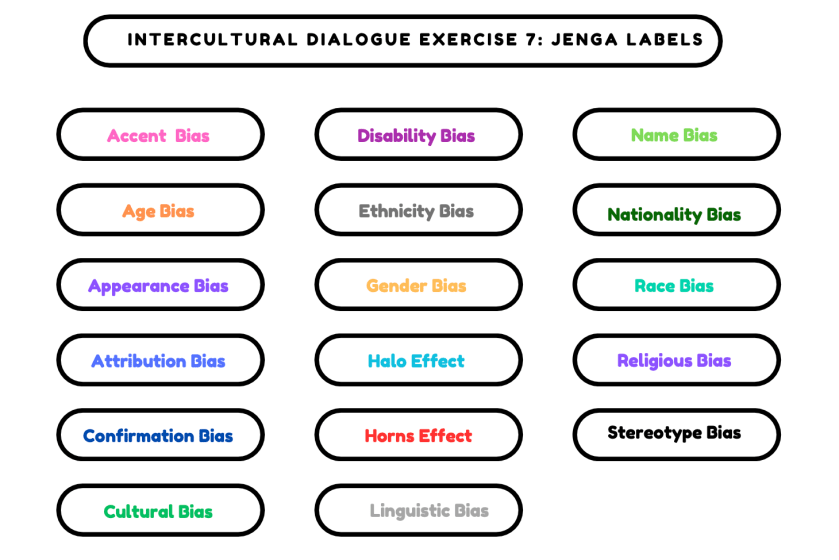
Jenga labels for ICD Exercise 7

The heart of the exercise uses Jenga blocks, labeled with the names of multiple types of potential bias, as a prompt for group discussion. Once the Jenga tower has been constructed, participants take turns pulling out a Jenga block. If they pull a labelled block, they read the bias aloud and discuss:

• How does this bias affect individuals in real life?
• How does it impact workplace culture or social interactions?
• How can this bias be addressed or challenged?

As with prior publications, ICD Exercises are available as free PDFs; just click on the thumbnail to download the Jenga labels, and on the link in the citation to download the exercise itself.

Onyebuchi, I., Ibrahim, S., & Ilolo, F. (2025). Anti-bias advocacy. Intercultural Dialogue Exercises, 7. Available from: https://centerforinterculturaldialogue.org/wp-content/uploads/2025/03/icd-ex-7-anti-bias-advocacy.pdf

If you have an exercise you’ve used that works, and you would like to share it, please submit it. All authors will be asked to answer the same set of questions, and to make the exercises available for others to use, thus these are being published with a Creative Commons license (as is the case for all CID publications). If you are new to CID, please provide a brief resume. This opportunity is open to masters students and above, on the assumption that some familiarity with academic conventions generally, and discussion of intercultural dialogue specifically, are useful.


This work is licensed under a Creative Commons Attribution-NonCommercial-NoDerivatives 4.0 International License.       Wendy Leeds-Hurwitz Director Center for Intercultural Dialogue
ICD Exercise #6: Exploring Cultural Symbols in Intercultural Dialogue

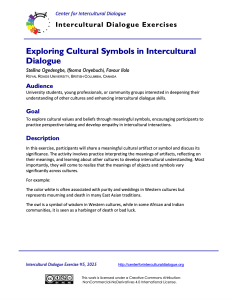
ICD ExercisesThe next ICD Exercise is now available. Stellina OgedengbeIfeoma Onyebuchi, and Favour Ilolo have written about exploring cultural symbols in intercultural dialogue.

The objective of this exercise is to help participants share a meaningful cultural artifact or symbol and discuss its significance. The activity involves practice interpreting the meanings of artifacts, reflecting on their meanings, and learning about other cultures to develop intercultural understanding. Most importantly, they will come to realize that the meanings of objects and symbols vary significantly across cultures. 

As with prior publications, ICD Exercises are available as free PDFs; just click on the thumbnail to download the exercise.

ICD Ex 6 Ogendengbe

Ogedengbe, S., Onyebuchi, I., & Ilolo, F. (2025). Exploring cultural symbols in intercultural dialogue. Intercultural Dialogue Exercises, 6. Available from:
https://centerforinterculturaldialogue.org/wp-content/uploads/2025/02/icd-ex-6-ogedengbe.pdf

If you have an exercise you’ve used that works, and you would like to share it, please submit it. All authors will be asked to answer the same set of questions, and to make the exercises available for others to use, thus these are being published with a Creative Commons license (as is the case for all CID publications). If you are new to CID, please provide a brief resume. This opportunity is open to masters students and above, on the assumption that some familiarity with academic conventions generally, and discussion of intercultural dialogue specifically, are useful.

Wendy Leeds-Hurwitz
Director Center for Intercultural Dialogue

This work is licensed under a Creative Commons Attribution-NonCommercial-NoDerivatives 4.0 International License.

ICD Exercise #5: Challenging Cultural Stereotypes through Intercultural Dialogue

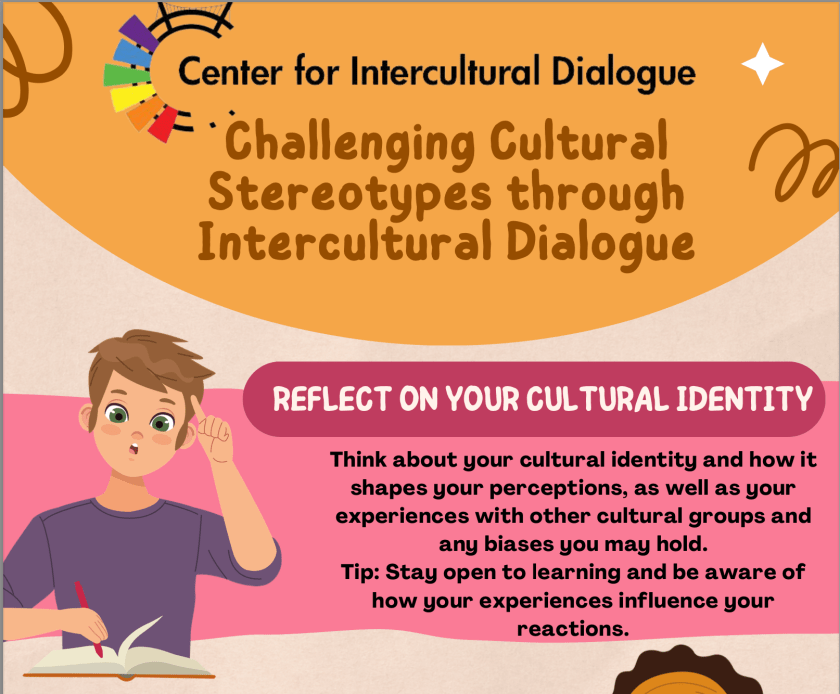
ICD ExercisesThe next ICD Exercise is now available. Favour Ilolo, Stellina Ogedengbe, and Ifeoma Onyebuchi have written about challenging cultural stereotypes through intercultural dialogue. In addition to written instructions, this exercise comes with an infographic as well.

The objective of this exercise is to equip participants with strategies for engaging in dialogue to challenge stereotypes. Using a detailed infographic as the instructional guide, participants will learn to initiate constructive conversations, incorporating personal storytelling, active listening, counter-stories, reflection on cultural identity, creating a safe space, and following up. This exercise empowers participants to foster inclusivity and mutual understanding.

As with prior publications, ICD Exercises are available as free PDFs; just click on the thumbnail to download the infographic, and on the link in the citation to download the exercise itself.

Intercultural Dialogue Exercises #5 infographic

Ilolo, F., Onyebuchi, I., & Ogedengbe, S. (2025). Challenging cultural stereotypes through intercultural dialogue. Intercultural Dialogue Exercises, 5. Available from: https://centerforinterculturaldialogue.org/wp-content/uploads/2025/02/icd-ex-5-ilolo.pdf

If you have an exercise you’ve used that works, and you would like to share it, please submit it. All authors will be asked to answer the same set of questions, and to make the exercises available for others to use, thus these are being published with a Creative Commons license (as is the case for all CID publications). If you are new to CID, please provide a brief resume. This opportunity is open to masters students and above, on the assumption that some familiarity with academic conventions generally, and discussion of intercultural dialogue specifically, are useful.

Wendy Leeds-Hurwitz
Director Center for Intercultural Dialogue

This work is licensed under a Creative Commons Attribution-NonCommercial-NoDerivatives 4.0 International License.

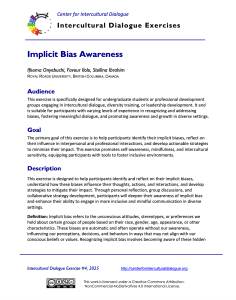
ICD Exercise #4: Implicit Bias Awareness

ICD Exercises

The next ICD Exercise is now available. Ifeoma Onyebuchi, Stellina Ibrahim, and Favour Ilolo have written about implicit bias awareness. 

This exercise is designed to help participants identify and reflect on their implicit biases, understand how these biases influence their thoughts, actions, and interactions, and develop strategies to mitigate their impact. Through personal reflection, group discussions, and collaborative strategy development, participants will deepen their awareness of implicit bias and enhance their ability to engage in more inclusive and mindful communication in diverse settings.

Implicit bias refers to the unconscious attitudes, stereotypes, or preferences we hold about certain groups of people based on their race, gender, age, appearance, or other characteristics. These biases are automatic and often operate without our awareness, influencing our perceptions, decisions, and behaviors in ways that may not align with our conscious beliefs or values. Recognizing implicit bias involves becoming aware of these hidden prejudices and understanding how they can affect interactions in professional and personal contexts.

As with prior publications, ICD Exercises are available as free PDFs; just click on the thumbnail to download.

Onyebuchi, I., Ibrahim, S., & Ilolo, F. (2025). Implicit bias awareness. Intercultural Dialogue Exercises, 4. Available from: https://centerforinterculturaldialogue.org/wp-content/uploads/2025/02/icd-ex-4-onyebuchi-et-al-1.pdf

If you have an exercise you’ve used that works, and you would like to share it, please submit it. All authors will be asked to answer the same set of questions, and to make the exercises available for others to use, thus these are being published with a Creative Commons license (as is the case for all CID publications). If you are new to CID, please provide a brief resume. This opportunity is open to masters students and above, on the assumption that some familiarity with academic conventions generally, and discussion of intercultural dialogue specifically, are useful.

Wendy Leeds-Hurwitz
Director Center for Intercultural Dialogue

This work is licensed under a Creative Commons Attribution-NonCommercial-NoDerivatives 4.0 International License.