Peace by Prompt

Applied ICD

Peace by Prompt, by Lena Slachmuijlder, and published in the Tech and Social Cohesion substack, provides a fascinating description of two efforts to build AI tools to facilitate mediation and encourage peacebuilding.

Slachmuijlder focuses on two initiatives:

Akord AI and the peace accord library

“Developed by Conflict Dynamics International, Akord AI is a chatbot designed to support Sudanese peacebuilders, civil society actors, diplomats, and policy influencers. Instead of scraping the internet, it draws exclusively from a curated library of more than 3,000 resources—peace agreements, constitutional texts, case studies on women’s inclusion, and strategies from both global and local sources, in English and Modern Standard Arabic. Because Akord only draws on its curated library, it has so far avoided the hallucinations common in mainstream chatbots.”

Kinshasa’s AI Analyst

“In Kinshasa, a different experiment is unfolding. “Cocorico,” an AI chatbot developed by Kinshasa Television, isn’t just helping in the newsroom—it’s become an on-air analyst. It has weighed in on issues from the DRC–Rwanda peace talks to UN expert reports, government reshuffles, and legal cases.”

CFP: Academic Ethics, AI, and the Future of Humanities

“Publication

Call for papers: Academic ethics, AI, and the future of humanities, Orbis Linguarum (Ezikov svyat) . Deadline: 31 December 2025.

Ezikov Svyat – Orbis Linguarum plans to publish a section on academic ethics, artificial intelligence and the future of the humanities. In the last few years, we have witnessed a rapid development of artificial intelligence programmes, which have become an unavoidable factor not only in the field of technology and digital communication, but also in education, translation, literature, and art, as well as in the field of academic communication. Although they facilitate access to information and increase the opportunities for translation into different languages and for learning in a variety of fields, their use also raises many ethical issues related to copyright violations, false authorship, the generation of inaccurate and incomplete information by free and sometimes paid versions of the various AI programmes, etc.

Articles related to the proposed topic are welcome until 31st December 2025. They can be written in any of the Slavic languages, English, German, or French. All manuscripts will undergo a rigorous double-blind peer review process. Those of them that are approved will be published in 2026.

Ezikov Svyat – Orbis Linguarum is an open-access journal published by the Faculty of Philology at South-West University “Neofit Rilski” (Bulgaria). It has no publication fee and is included in databases such as ERIH+, SCOPUS, MLA, EBSCO, DOAJ, Index Copernicus, CEEOL, etc.

Dall-E (AI) Interpretations of Intercultural Concepts

Applied ICD

I was curious, given all the current attention being paid to Dall-E and Dall-E Mini, and Craiyon, to see what any of these would come up with if I input concepts related to intercultural dialogue.

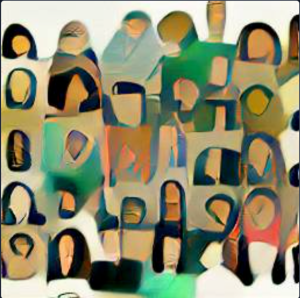
Dall-E mini intercultural dialogue
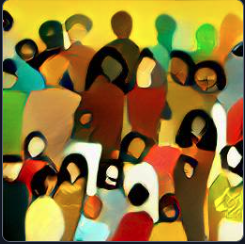
Craiyon Intercultural Dialogue
Craiyon intercultural competence
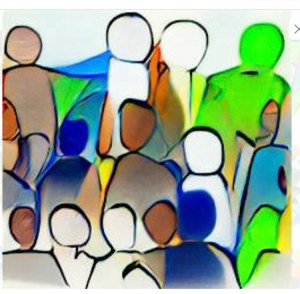
Craiyon multiculturalism
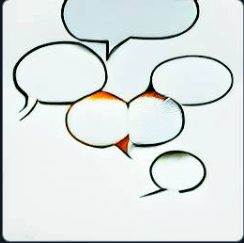
Craiyon dialogue
Craiyon dialogue

Obviously, the very first term I input was intercultural dialogue. You receive 9 images for any text, and most of them were blurred and distorted beyond much use. But I’m attaching the images both Dall-E Mini and Craiyon created. Interestingly, related terms, such as multiculturalism or intercultural competence, look much the same: a group of evidently diverse people – but never two individuals.

Whereas dialogue looks quite different – just speech bubbles. And many of the images created at my request, such as that for peacebuilding, were quite useless (nearly all of the designs for that simply showed a badly distorted vision of the UN logo, for example).

I thought others might find it interesting to see what the results looked like. Clearly, given that these AI programs simply search the internet for relevant text and images, we all need to be posting more content for it to discover that includes both descriptions and visual depictions that come closer to what we think it should find.

For those who are not yet familiar with these programs, Dall-E is a tool to turn words into images using AI, but it is in beta and not yet publicly available. Dall-E mini is the less competent but publicly available version. And that has already morphed into Craiyon. All of them work by looking to see what images are attached to words across the internet, and then editing those images into something new. Apparently, so long as you credit the source, the images are yours to use and post.

If others try any of these systems and obtain interesting results, send them along in an email, and I’ll create a later post to showcase them.

Wendy Leeds-Hurwitz, Director
Center for Intercultural Dialogue